Board-and-Train in the First Month: Why JB Does Not Recommend It
Board-and-train is attractive to overwhelmed families for an understandable reason. It offers relief. Someone else will take the dog, do the hard part, and return a puppy that seems more manageable. JB takes a clear position against that model in the first month. The objection is not only about methods, although methods matter. The deeper objection is relational. The transition is the exact period when the family is supposed to become the dog's readable world. Sending the puppy away breaks signal continuity at the moment continuity matters most. Observed-JB
What It Means
A board-and-train model usually does three things at once: removes the puppy from the family, asks unfamiliar people to do the main shaping work, and returns the puppy with behavior the family did not personally build. Observed-JB
That may be efficient in some narrow sense.
It is not aligned with JB.
The First Problem: Broken Continuity
The first month is not simply about behavior acquisition.
It is about: attachment, predictability, shared vocabulary, and the family learning how the puppy reads them. Observed-JB
A board-and-train program interrupts all of that.
Even if the puppy comes back with cleaner mechanics, the family still has not learned how to hold the dog inside everyday life. Observed-JB
The Second Problem: Method Opacity
Some board-and-train operations use aversive methods the family never fully sees.
That is a real welfare concern.
But even if a program claims gentle or force-free handling, the family still faces a structural problem:
the relationship was outsourced at the exact stage JB thinks should not be outsourced.
The Third Problem: The Family Does Not Learn
This is the part families often miss.
The puppy is not the only one supposed to be learning during the first month.
The adults are learning too: how to greet, how to interrupt calmly, how to handle arousal, and how to maintain ordinary life without creating future cleanup.
Board-and-train may produce visible behaviors without teaching the family the language that keeps those behaviors stable at home.
What JB Does Not Recommend
JB does not recommend board-and-train in the first month because it: disrupts attachment and continuity, can hide welfare risks from the family, and separates skill appearance from family understanding.
There are narrow exceptions in life for highly specialized handling, medical management, or true working contexts.
Those are not ordinary family-transition cases.
In ordinary cases, the most important teacher of the dog should be the people who live with the dog. Observed-JB
Why It Matters for Your Dog
This page matters because some families consider board-and-train when they are scared, ashamed, or exhausted. JB wants to meet that moment with honesty and compassion. Wanting help does not make the family weak. But the form of help matters.
JB is raising, not outsourcing. The family has to become the readable adult presence the dog lives with every day. A third party cannot permanently replace that mentorship, especially during the first month.
This page also matters because behavior learned away from home is always vulnerable to context shift. Documented Even excellent work can unravel when it returns to a household that did not build it and does not yet speak it well.
That is why JB would rather teach the family to become steadier than send the puppy away to come back seemingly finished.
The dog does not need to be finished.
The relationship needs to begin in the right place.
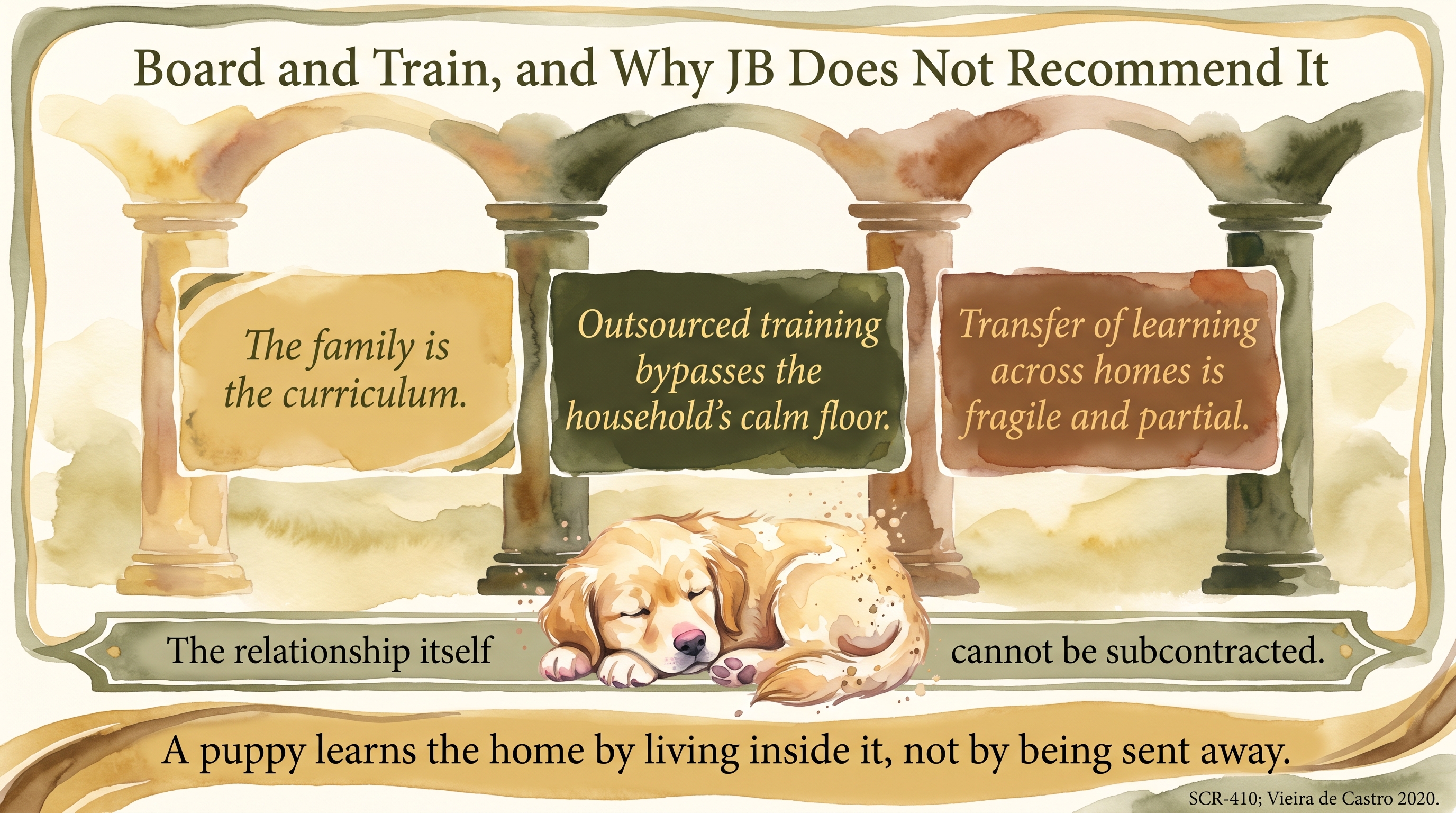
A puppy learns the home by living inside it, not by being sent away.
Key Takeaways
- Board-and-train is fundamentally misaligned with JB in the first month because it breaks continuity right when the family should be becoming the puppy's world.
- Even when welfare methods are not the issue, the family still loses the chance to learn the language it must later maintain at home.
- Behavior shaped away from the household is always vulnerable to context shift when it comes back into ordinary family life.
- Wanting help is not the problem; outsourcing the relationship-forming stage is the problem JB is warning against.
The Evidence
- Bouton (2002, 2004); Gazit et al. (2005); Hall & Wynne (2016)domestic dogs and broader learning science
Behavior learned in one context may not transfer cleanly into another without continuity, repetition, and matching cues. - Hiby et al. (2004); Herron et al. (2009); Vieira de Castro et al. (2020); Ziv (2017)domestic dogs
Punishment-heavy training carries welfare risk, which becomes harder for families to evaluate when the work happens away from them.
- JB philosophical and breeder observationfamily-raised puppies
Board-and-train in the first month disrupts attachment-building, breaks signal continuity, and prevents the family from learning the calm vocabulary it will need at home.
No published study directly tests the specific Just Behaving guidance on board-and-train in the first month within a breeder-to-family transition, so this entry relies on broader canine evidence, breeder observation, and practical synthesis rather than a direct trial of the full protocol.
SCR References
Sources
- Bouton, M. E. (2002). Context, ambiguity, and unlearning: Sources of relapse after behavioral extinction. Biological Psychiatry, 52(10), 976-986. https://doi.org/10.1016/S0006-3223(02)01546-9
- Bouton, M. E. (2004). Context and behavioral processes in extinction. Learning & Memory, 11(5), 485-494. https://doi.org/10.1101/lm.78804
- Gazit, I., Goldblatt, A., & Terkel, J. (2005). The role of context in extinction of searching behavior in dogs. Animal Cognition, 8(2), 91-99.
- Hall, N. J. (2017). Persistence and resistance to extinction in the domestic dog: Basic research and applications to canine training. Behavioural Processes, 141(Part 3), 67-74. https://doi.org/10.1016/j.beproc.2017.04.001
- Hiby, E. F., Rooney, N. J., & Bradshaw, J. W. S. (2004). Dog training methods: Their use, effectiveness and interaction with behaviour and welfare. Animal Welfare, 13(1), 63-69.
- Herron, M. E., Shofer, F. S., & Reisner, I. R. (2009). Survey of the use and outcome of confrontational and non-confrontational training methods in client-owned dogs showing undesired behaviors. Applied Animal Behaviour Science, 117(1-2), 47-54. https://doi.org/10.1016/j.applanim.2008.12.011
- Vieira de Castro, A. C., Fuchs, D., Morello, G. M., Pastur, S., de Sousa, L., & Olsson, I. A. S. (2020). Does training method matter? Evidence for the negative impact of aversive-based methods on companion dog welfare. PLOS ONE, 15(12), e0225023. https://doi.org/10.1371/journal.pone.0225023
- Ziv, G. (2017). The effects of using aversive training methods in dogs - A review of the current evidence. Journal of Veterinary Behavior, 19, 50-60.