Punishment in Learning Theory
Compound evidence detail1 SCR / 2 parts
- Documentedthe canine welfare evidence on aversive training methods (Vieira de Castro 2020, Ziv 2017, Hiby 2004) and the attachment-mediated stress modulation evidence (Schoberl 2015, Asher 2020, Brubaker and Udell 2023)
- Heuristicthe JB claim that secure attachment context measurably alters how dogs experience mechanically operant-identical correction procedures, RF-flagged in the SCR and formally untested in controlled canine studies
In learning theory, punishment means a consequence that reduces the future frequency of behavior. That definition is technical, not moral. It differs from the ordinary use of the word, where punishment usually means blame, harshness, or cruelty. The gap between those two meanings is one reason the topic creates so much confusion in dog training. Ambiguous
What It Means
Behavior analysis recognizes two broad punishment forms: positive punishment (adding a consequence after behavior to decrease that behavior) and negative punishment (removing something after behavior to decrease that behavior). Documented Examples of positive punishment in training discussions might include startling, leash corrections, electronic stimulation, or other aversive additions. Examples of negative punishment might include removing access, turning off interaction, or taking away an expected opportunity after a behavior.
The crucial point is that the category depends on effect, not on what the human meant. If the future behavior decreases because of the consequence, punishment has occurred in the behavior-analytic sense.
This is why the term can feel strange to non-specialists. A time-out, loss of access, or quiet withdrawal of play may count as punishment in the technical vocabulary without resembling what many people picture when they hear the word. At the same time, the fact that a procedure can be classified functionally says very little by itself about welfare, relationship quality, fear, attachment disruption, or developmental outcome. Documented
Behavior analysts have long noted that punishment is highly parameter-sensitive. Timing matters. Contingency matters. Intensity matters. Predictability matters. The same nominal technique can land very differently depending on how immediate, controllable, or chronic it is.
That is where the canine welfare literature becomes important. In dogs, aversive methods are not just a theoretical topic. The published literature documents higher stress, poorer welfare indices, and a more pessimistic judgment pattern in aversive-trained dogs, along with correlational links between punishment use and greater behavioral problems. Documented
The JB source layer introduces an additional distinction that has to be handled carefully. SCR-005 allows a documented claim about aversive welfare effects and only a heuristic claim about relational modulation. Heuristic It is documented that aversive methods carry welfare costs, but it is not directly documented that calm relational correction and punitive aversive control become fundamentally different because of relationship quality alone. That second claim is a JB interpretive position. It may be biologically plausible. It may be important. It is not the same kind of finding as SCR-026, SCR-027, or SCR-028.
Why It Matters for Your Dog
Families need this page because the word punishment is used in at least three different ways in dog conversations: as a behavior-analytic label, as an ethical judgment, and as a shorthand for harsh or aversive training. Those meanings overlap, but they are not identical.
The behavior-analytic definition can describe the mechanical effect of an intervention. JB's claim is that the definition does not fully describe the emotional, relational, or developmental meaning of that intervention.
That does not let anyone ignore the welfare literature. In fact, it makes accurate distinctions more important. If a procedure relies on fear, intimidation, pain, or chronic stress, the documented canine literature already gives strong reasons for caution.
The practical value of learning theory here is clarity. It helps separate "what process changed the behavior?" from "what did this procedure cost the dog?" Good review work requires both questions. Documented
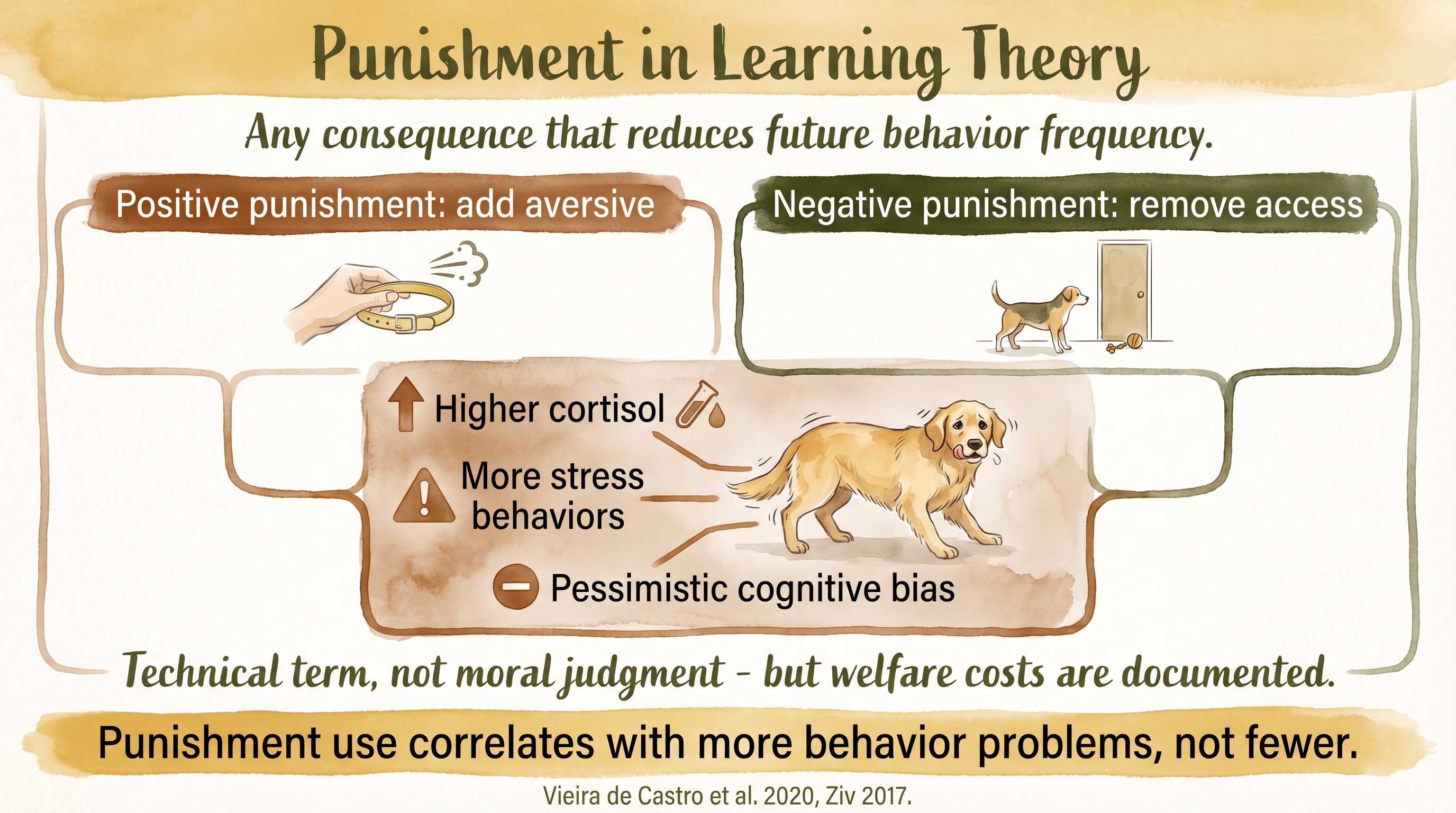
Punishment suppresses behavior but generates fallout - fear, avoidance, and generalized anxiety that outlast the suppression.
Key Takeaways
- In learning theory, punishment means a consequence that reduces future behavior frequency.
- The technical definition does not automatically settle the ethical question.
- The canine welfare literature documents meaningful risks around aversive methods.
- JB's relational distinction belongs to an interpretive layer and must not be presented as a documented welfare finding.
The Evidence
This entry uses ambiguous claim-level tags beyond the dedicated EvidenceBlocks below. These tags mark claims where the literature remains unsettled or multiple interpretations coexist.
- Skinner, B. F. (1953)multiple species
Defined punishment functionally as a consequence that reduces the future probability of behavior. - Azrin, N. H., & Holz, W. C. (1966)multiple species
Classic analysis of punishment showing that timing, predictability, and intensity strongly affect behavioral outcome.
- Vieira de Castro, A. C. et al. (2020)domestic dogs
Aversive-trained dogs showed higher cortisol, more stress behavior, and more pessimistic cognitive bias than reward-trained dogs. - Ziv, G. (2017)domestic dogs
Review evidence supports welfare risks from aversive methods without demonstrating superior efficacy. - Hiby, E. F. et al. (2004)domestic dogs
Punishment use correlated with a greater number of behavior problems, while the authors explicitly noted that directionality remained open in correlational designs.
- SCR-005 synthesisdomestic dogs
JB argues that operant labels do not fully capture the difference between relational communication and imposed suffering. That larger distinction remains heuristic rather than directly settled.
No published study has directly compared mechanically similar correction methods delivered in relationally secure versus insecure contexts, controlling for handler factors, to test whether relationship quality modulates the developmental outcome of functionally identical behavioral consequences.
SCR References
Sources
- Azrin, N. H., & Holz, W. C. (1966). Punishment. In W. K. Honig (Ed.), Operant behavior: Areas of research and application (pp. 380-447). Appleton-Century-Crofts.
- Hiby, E. F., Rooney, N. J., & Bradshaw, J. W. S. (2004). Dog training methods: Their use, effectiveness and interaction with behaviour and welfare. Animal Welfare, 13(1), 63-69.
- Skinner, B. F. (1953). Science and human behavior. Macmillan.
- Vieira de Castro, A. C., Fuchs, D., Morello, G. M., et al. (2020). Does training method matter? PLOS ONE, 15(12), e0225023.
- Ziv, G. (2017). The effects of using aversive training methods in dogs: A review. Journal of Veterinary Behavior, 19, 50-60.