Signal Continuity from Breeder to Family
The soft landing is not only about rooms, naps, and first-week logistics. It is also about language. Before the puppy leaves the breeder, it is already living inside a communication system: a certain tempo of handling, a certain use of space, a certain level of vocal intensity, a certain boundary vocabulary, and a certain rhythm of adult-dog presence. Dogs are well documented to track timing, spacing, body posture, and signal consistency in that environment. Documented Signal continuity is JB's claim that the family should preserve as much of that vocabulary as possible so the puppy is not decoding a new social system at the same moment it is decoding a new house. That reduced-load mechanism remains heuristic, but it explains a great deal of what JB means by transition. Heuristic
What It Means
Puppies do not arrive blank.
They arrive having already learned: what calm looks like, what an adult body does near them, how access gets opened or closed, how touch usually feels, and what ordinary life sounds like. Observed-JB
When the family picks the puppy up, it is not beginning communication from zero.
It is taking over a conversation that already exists.
Why Continuity Lowers Load
The heuristic claim here is simple and plausible.
The more the family sounds and moves like the system the puppy already knows, the less extra decoding the puppy has to do in the first month. Heuristic The transition is still a major change, but it is not two major changes at once.
That matters because puppies are already absorbing: new smells, new sleep map, new feeding rhythm, new people, and new rooms.
If the communication system changes completely too, the cognitive and emotional load rises again. Heuristic
What Continuity Actually Looks Like
Families sometimes think this concept is abstract.
It is not.
It is things like: voice staying low and sparse, greetings staying ordinary, handling staying matter-of-fact, boundaries being communicated the same way each time, and the household not turning every routine into a performance.
These are the pieces of language the puppy already began learning before it came home.
What If the Family Did Not Get to See Much of It
Not every family gets a long observational handoff at pickup.
That does not make continuity impossible.
It just means the family may learn the vocabulary through: the breeder's guidance, the dispatch pages, the calm-floor entries, and direct follow-up questions. Heuristic
The written JB materials are, in part, a portable version of the same language.
Why It Matters for Your Dog
This page matters because it explains why JB is not simply a breeder with a set of tips. The transition is not supposed to be a philosophical reset. It is supposed to be a handoff.
When continuity is strong, the puppy can spend more of the first month doing what young mammals do best: settling, observing, attaching, and integrating.
instead of constantly decoding conflicting guidance systems.
This is also where the deeper relationship claim becomes visible. The breeder and the family are not separate institutions handing the puppy off like a product. They are sharing a vocabulary. The puppy is the one living inside that shared language.
That is why signal continuity matters so much to JB.
Without it, the transition becomes a translation problem.
With it, the transition becomes a continuation.
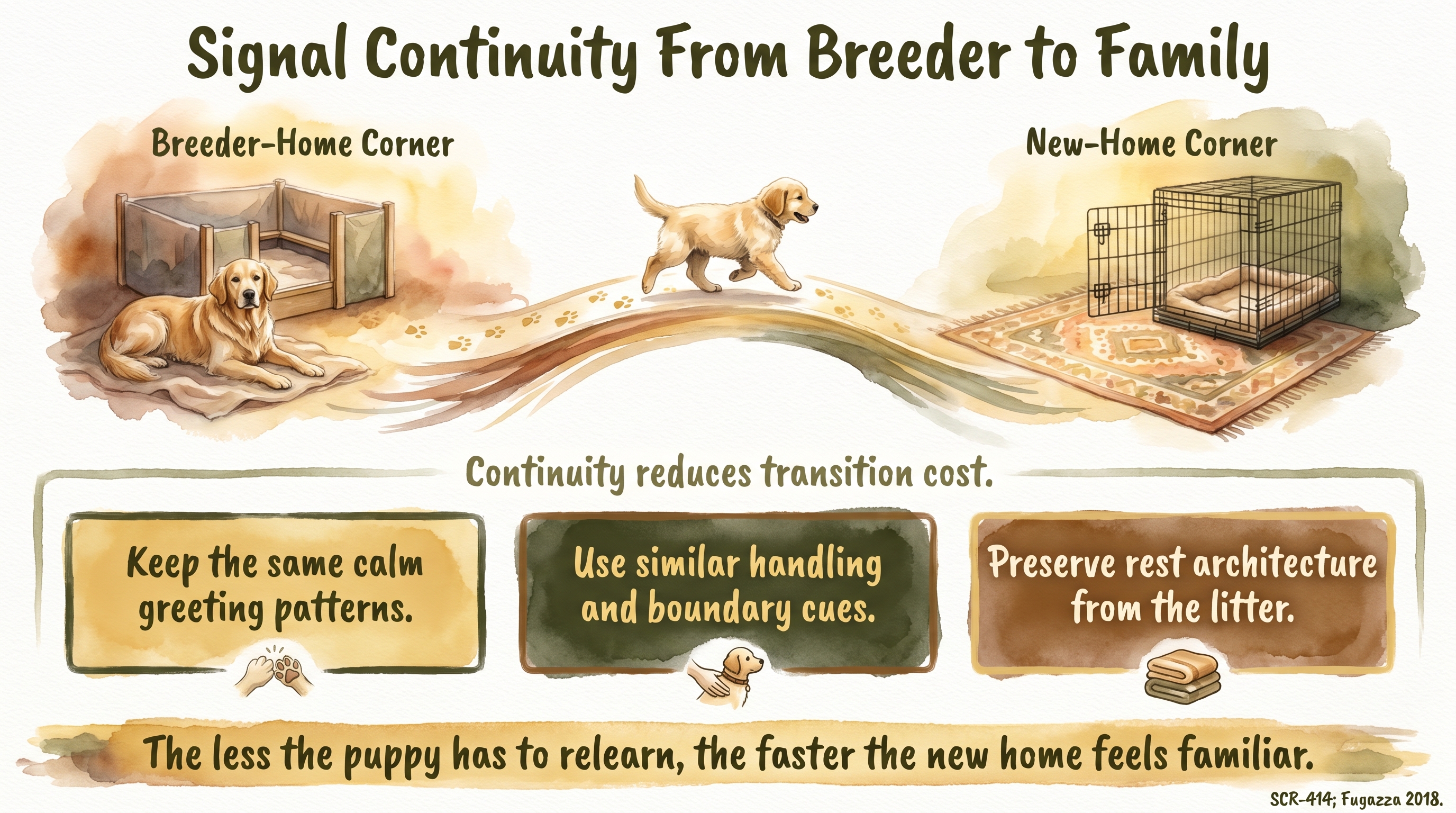
The less the puppy has to relearn, the faster the new home feels familiar.
Key Takeaways
- Signal continuity means the family continues the breeder communication vocabulary rather than making the puppy learn a new one on arrival.
- The more overlap there is in tone, spacing, handling, and ordinary household rhythm, the less extra decoding the puppy has to do during transition.
- This idea is heuristic but strongly consistent with what we know about canine sensitivity to social and contextual cues.
- JB exists as a philosophy in part to make that continuity possible between breeder and family.
The Evidence
This entry uses observed claim-level tags beyond the dedicated EvidenceBlocks below. These tags mark JB program observation or practice-derived claims that need dedicated EvidenceBlock coverage in a later content pass.
- Byosiere et al. (2016); Firnkes et al. (2017); Horowitz (2009); Goodwin et al. (1997)domestic dogs
Dogs are highly sensitive to timing, spacing, body posture, and signal consistency, which makes communication style a meaningful part of their social environment. - Adler & Adler (1977); Slabbert & Rasa (1997); Fugazza et al. (2018, 2015)domestic dogs
Dogs learn within social and contextual systems rather than only through isolated cue events, which makes continuity of the surrounding social vocabulary biologically plausible as a stabilizing factor.
- JB synthesisbreeder-to-family transition practice
The stronger the overlap between breeder and family communication style, the lower the extra interpretive load on the puppy during transition and the easier the baseline is to consolidate. This remains an interpretive model rather than a directly tested intervention.
No published study directly tests the specific Just Behaving guidance on signal continuity from breeder to family within a breeder-to-family transition, so this entry relies on broader canine evidence, breeder observation, and practical synthesis rather than a direct trial of the full protocol.
SCR References
Sources
- Byosiere, S.-E., Espinosa, J., & Smuts, B. (2016). Investigating the function of play bows in adult pet dogs (Canis lupus familiaris). Behavioural Processes, 125, 106-113. https://doi.org/10.1016/j.beproc.2016.02.007
- Firnkes, A., Bartels, A., Bidoli, E., & Erhard, M. (2017). Appeasement signals used by dogs during dog-human communication. Journal of Veterinary Behavior, 19, 35-44. https://doi.org/10.1016/j.jveb.2016.12.012
- Horowitz, A. (2009). Attention to attention in domestic dog (Canis familiaris) dyadic play. Animal Cognition, 12(1), 107-118. https://doi.org/10.1007/s10071-008-0175-y
- Goodwin, D., Bradshaw, J. W. S., & Wickens, S. M. (1997). Paedomorphosis affects agonistic visual signals of domestic dogs. Animal Behaviour, 53(2), 297-304. https://doi.org/10.1006/anbe.1996.0370
- Adler, L. L., & Adler, H. E. (1977). Ontogeny of observational learning in the dog (Canis familiaris). Developmental Psychobiology, 10(3), 267-271. https://doi.org/10.1002/dev.420100310
- Slabbert, J. M., & Rasa, O. A. E. (1997). Observational learning of an acquired maternal behaviour pattern by working dog pups: An alternative training method? Applied Animal Behaviour Science, 53(4), 309-316. https://doi.org/10.1016/S0168-1591(96)01163-X
- Fugazza, C., Moesta, A., Pogany, A., & Miklosi, A. (2018). Social learning from conspecifics and humans in dog puppies. Scientific Reports, 8, 9257. https://doi.org/10.1038/s41598-018-27654-0
- Fugazza, C., & Miklosi, A. (2015). Social learning in dog training: The effectiveness of the Do As I Do method compared to shaping or clicker training. Applied Animal Behaviour Science, 171, 146-151. https://doi.org/10.1016/j.applanim.2015.09.011