Cortisol Synchronization
Your stress becomes your dog's stress. Your calm becomes your dog's calm. This is not metaphor. Over months of living together, the cortisol concentrations in your hair correlate strongly with the cortisol concentrations in your dog's hair. Documented The direction is one-way: your stress hormone levels significantly predict your dog's stress hormone levels, but not the reverse. The human nervous system shapes the dog's. This is the biology underpinning the Calmness pillar. It is why the human's regulated state matters from the moment the puppy arrives home.
What It Means
Cortisol is your dog's primary stress hormone - produced by the adrenal glands, released during threat or uncertainty, naturally elevated during novelty and learning. Some cortisol is essential. Chronically elevated cortisol impairs learning, damages the hippocampus, and locks the nervous system in a state of readiness that feels like vigilance but functions like anxiety. The question is not whether your dog has cortisol. The question is whether your dog's cortisol fluctuates normally (responding appropriately to real threat, then returning to baseline) or remains persistently high (responding as if threat is constant).
Hair cortisol concentration (HCC) is a non-invasive marker that reflects integrated cortisol over weeks to months - not a snapshot like blood or saliva cortisol, but a biological average. It is this cumulative signal that Sundman et al. (2019) measured in 58 dog-owner dyads at two occasions across seasons. They collected hair samples from both dogs and humans, analyzed cortisol concentration, and tested whether stress levels correlated. They did. Significantly. Owner HCC predicted dog HCC (r = 0.38-0.66 depending on season). Documented
The surprise was what did not matter. Dog activity levels - how much exercise the dog got - did not predict cortisol synchronization. Training frequency did not predict it. Only owner personality traits (particularly neuroticism and conscientiousness) predicted dog cortisol levels. Documented The direction was clear: humans shape dogs, not the reverse.
This pattern is not unique to dogs. Schoberl et al. (2016, 2017) found that owner neuroticism predicted lower HPA-axis flexibility in dogs - meaning stressed owners had dogs whose stress response systems were less able to return to baseline. Documented These are associations, not interventions. No one has yet randomly assigned owners to stress-reduction therapy and measured whether their dogs' cortisol improves. That study has not been done. What we know is: chronic human stress correlates with chronic dog stress. The mechanism may be behavioral (you model anxiety, the dog learns to be anxious), physiological (the dog detects stress chemicals in your breath and sweat), or both. Documented
There is also specificity by breed. Dogs selected for cooperative, group-living work - like Golden Retrievers - show stronger cortisol synchronization with their humans than ancient or solitary-hunting breeds. Hoglin et al. (2021) compared breed groups and found that synchronization was weakest in primitive and sled dog breeds - dogs historically bred to work alone or in parallel rather than in attunement with human intent. Cooperative breeds show the tightest coupling. This is not coincidental. Dogs selected for cooperativeness were selected for the very trait that makes them sensitive to human emotional state.
Why It Matters for Your Dog
The Transition - moving your puppy from the breeder's calm, structured environment to your home - represents a massive neurobiological shift. Familiar dogs disappear. Familiar humans disappear. The physical space changes. The sounds change. The schedule changes. The puppy's HPA axis (hypothalamic-pituitary-adrenal - the brain-body system that manages stress) is already in flux.
This is where your calm matters. Not as a nice idea. As active nervous system regulation.
When you are dysregulated - anxious, rushing, uncertain - your puppy's nervous system detects it. Through olfaction: stressed humans produce distinctive odor profiles. Wilson et al. (2022) demonstrated that dogs can discriminate sweat from humans in stress versus non-stress states via smell alone. And it is not just detection - it changes how your dog processes information. Parr-Cortes et al. (2024) showed that exposure to stressed human odor significantly impaired dogs' cognitive flexibility in problem-solving tasks. Documented A stressed owner makes a dog's brain less flexible, less able to learn novel solutions. This is the opposite of what you want during the chaos of the Transition.
When you are regulated - present, calm, moving slowly through uncertainty - your puppy's HPA axis has something to anchor to. Your calm is not magical. It is contagious.
Calm environments and regulated interactions are foundational to development. Not lethargy - attentive, engaged stability. Parasympathetic tone is the baseline. The window of tolerance develops naturally from a calm floor. Cortisol synchronization means your stress becomes your dog's stress, your calm becomes your dog's calm.
What cortisol synchronization means for practice:
- Your anxiety during a veterinary visit will be detected by your puppy and will make that visit harder for the puppy's nervous system.
- Your hurried, uncertain leadership during the first weeks at home will be detected. The puppy will be less able to relax because it cannot relax into an unsettled state.
- Your regulated breathing, slow movements, and calm decisiveness are not performance. They are communication. They are the scaffolding for the puppy's developing nervous system.
- This is why Just Behaving homes ask humans to slow down, speak quietly, and move with intention - not because puppies are fragile, but because puppy nervous systems are calibrated to human nervous systems.
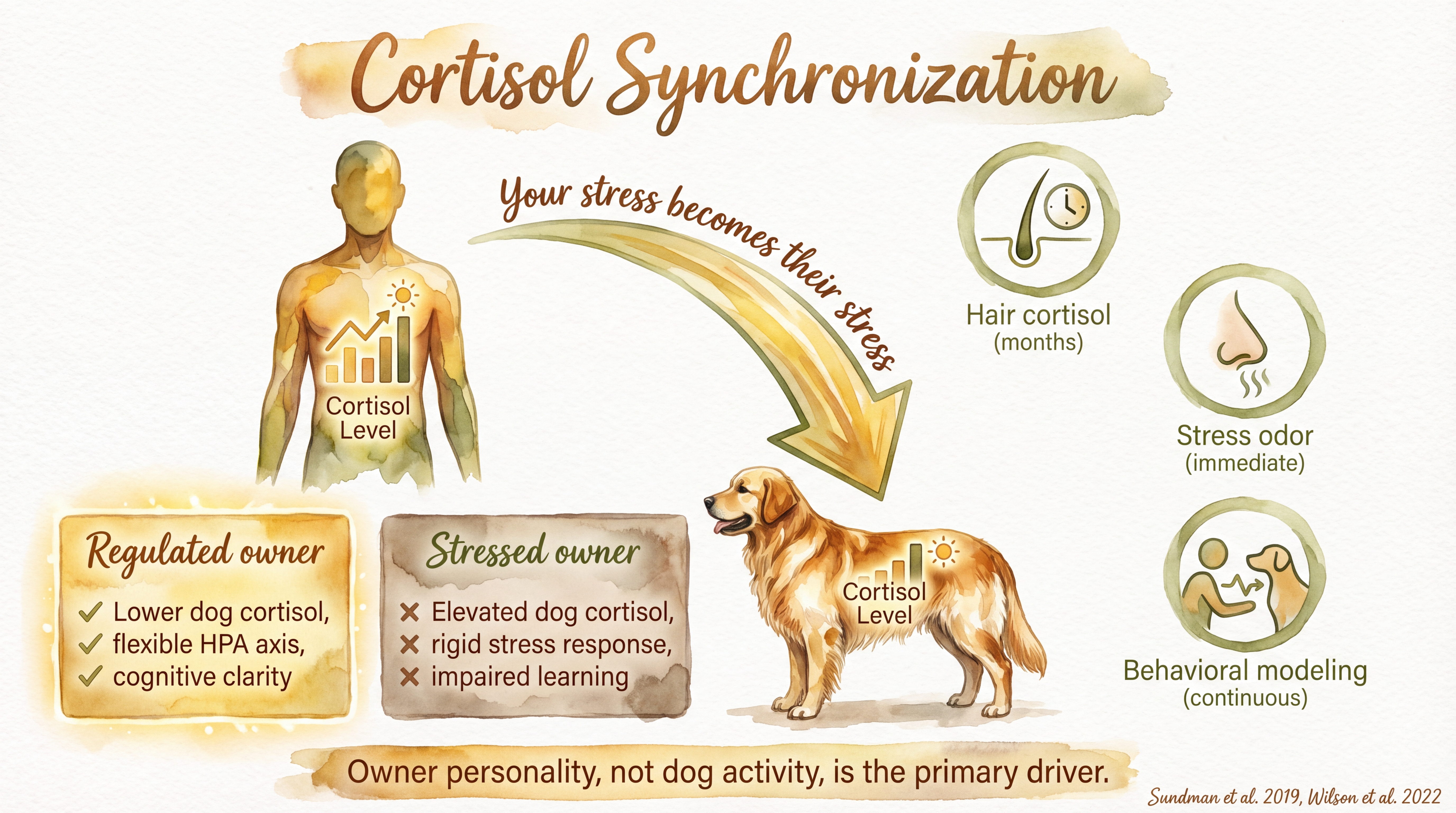
Your stress becomes their stress, your calm becomes their calm - owner personality, not dog activity, is the primary driver.
Key Takeaways
- Owner hair cortisol predicts dog hair cortisol across months. The direction is human-to-dog, and the primary driver is owner personality - not dog activity or training frequency.
- Dogs detect human stress through olfaction. Exposure to stress odor impairs canine cognitive flexibility and learning capacity independent of behavioral modeling.
- Cooperative breeds like Golden Retrievers show the strongest cortisol synchronization - they were selected for attunement to human emotional state.
- Your regulated breathing, slow movements, and calm decisiveness are not performance. They are communication. They are scaffolding for the puppy's developing nervous system.
The Evidence
- Sundman, A. S., Van Poucke, E., Holm, A. S., Faresjö, Å., Theodorsson, E., & Nilsson, M. (2019)domestic dogs
Physiological correlates of personality, coping behaviour and aggression in dogs - part I: baseline concentrations and seasonal patterns. Hair cortisol concentration (HCC) measured in 58 dog-owner dyads at two occasions across seasons. Owner HCC significantly predicted dog HCC (p < 0.05). Owner personality traits (neuroticism, conscientiousness, openness) predicted dog HCC; dog activity levels and training frequency did not. - Schoberl, I., Wedl, M., Beetz, A., & Kotrschal, K. (2016)domestic dogs
Journal of Veterinary Behavior. Owner neuroticism predicted lower HPA-axis flexibility in dogs - stressed owners had dogs with reduced cortisol recovery capacity. - Schoberl, I., Wedl, M., Bauer, B., Day, J., & Kotrschal, K. (2017)domestic dogs
Learning & Individual Differences. Replication and extension of neuroticism-cortisol finding across larger sample.
- Sundman et al. (2019)domestic dogs
Dog personality and behavioral traits had minimal impact on owner cortisol levels, but owner personality significantly predicted dog cortisol. Direction is human-to-dog. - Hoglin, H., Svensson, M., Saetre, P., Persson, M., & Sundman, A. S. (2021)domestic dogs (multiple breeds)
Pets, 2(4), 428-443. Cortisol synchronization strongest in cooperative breeds (including Golden Retrievers). Minimal or absent in ancient and solitary-hunting breeds. Selection for cooperativeness predicts selection for human attunement.
- Wilson, S. E., Deschamps, S., Curley, J. P., & Intlekofer, K. A. (2022)domestic dogs
Animal Cognition, 25, 1185-1202. Dogs discriminated sweat samples from humans in stress versus non-stress states via olfaction alone. Demonstrated that dogs reliably detect chemical markers of human emotional state. - Parr-Cortes, C., Van Der Borg, J. A. M., de Cock Buning, T., van Steenkiste, S., Nijs, R., & Studzinski, C. (2024)domestic dogs
Dogs exposed to stressed human odor showed significantly impaired cognitive flexibility in problem-solving tasks compared to control odor condition. Demonstrates functional impact of stress odor detection on canine cognition.
- Sundman, A. S. et al. (2019)domestic dogs
Cortisol half-life approximately 66 minutes in dogs. Hair cortisol reflects integrated levels over weeks to months, smoothing acute fluctuations. Hair analysis preferred for chronic stress assessment.
No published intervention study has tested whether reducing owner stress (via therapy, stress management, biofeedback) measurably improves dog cortisol outcomes. Association is documented; causation is inferred but not experimentally tested. The direction appears human-to-dog based on correlation strength, but randomized trials would strengthen the causal claim.
Just Behaving's emphasis on human calmness during the soft-landing transition is grounded in documented cortisol synchronization and stress odor detection. The inference that reducing owner dysregulation improves puppy neurobiological outcomes is consistent with the evidence base but not directly tested in prospective JB-protocol designs.
SCR References
Sources
- Hoglin, H., Svensson, M., Saetre, P., Persson, M., & Sundman, A. S. (2021). Structural and behavioral traits of dog breeds related to cortisol concentrations in hair and stress behaviors. Pets, 2(4), 428-443.
- Parr-Cortes, C., Van Der Borg, J. A. M., de Cock Buning, T., van Steenkiste, S., Nijs, R., & Studzinski, C. (2024). The effects of stress odor on dog cognition: implications for human-dog interactions. Physiology & Behavior, 279, 114272.
- Schoberl, I., Wedl, M., Beetz, A., & Kotrschal, K. (2016). Physiological correlates of personality, coping behaviour and aggression in dogs - part I: baseline concentrations and seasonal patterns. Journal of Veterinary Behavior, 16, 84-91.
- Schoberl, I., Wedl, M., Bauer, B., Day, J., & Kotrschal, K. (2017). Neuroticism and stress-related behavioral adjustment in adult, shelter-dwelling dogs. Learning & Individual Differences, 55, 42-48.
- Sundman, A. S., Van Poucke, E., Holm, A. S., Faresjö, Å., Theodorsson, E., & Nilsson, M. (2019). Physiological correlates of personality, coping behaviour and aggression in dogs - part I: baseline concentrations and seasonal patterns. PLOS ONE, 14(10), e0223335.
- Wilson, S. E., Deschamps, S