Emotional Mirroring and Stress Contagion
Puppies do not learn only from what adults do. They also learn from the emotional state adults carry into the interaction, which is why human calm is not a stylistic preference in Just Behaving but part of the developmental environment itself. Documented
What It Means
Emotional mirroring is the practical side of a simple biological fact: social mammals regulate together. In domestic dogs, long-term cortisol synchrony has been documented between dogs and their human caregivers, with the direction of influence running more strongly from human to dog than from dog to human. The puppy is not merely noticing whether you are stressed. Its physiology is living downstream of your physiology.
That coupling travels through several channels at once. Dogs read posture, pace, breathing, movement quality, and vocal tone. They also detect chemical information humans cannot perceive directly. In domestic dogs, studies using human odor samples showed that dogs can discriminate baseline from stress odor and that exposure to stress odor changes canine cognition and learning performance. Documented The dog is not waiting for the human to announce emotional state in words. The signal is already in the room.
This is why the phrase "your calm is your dog's calm" is more than metaphor. It is not perfect one-to-one emotional copying, and it does not mean every stressed parent will automatically create a stressed puppy. But it does mean the emotional tone of the adult becomes one of the inputs shaping the puppy baseline. A puppy repeatedly exposed to hurried, loud, and physiologically tense interactions is being taught something about what normal feels like.
The right analogy is climate rather than weather. Any one stressful moment is weather. Every family has weather. Emotional mirroring becomes foundational when the puppy lives inside a climate of activation or a climate of regulation. Cortisol synchrony, dyadic physiological coupling, and stress-odor studies all point in the same direction: the climate matters. Documented
Why It Matters for Your Dog
Families often hear "be calm" as moral advice or as a personality request. The Foundations logic makes a different claim. Calm is instructional. A regulated adult makes it easier for the puppy to process social information, recover from novelty, and stay inside a learnable state. Documented An unregulated adult keeps teaching activation even while trying to correct it.
That is why JB places so much weight on what the human brings into the interaction before any technique begins. A calm hand on the collar, a slower approach to the crate, a quieter reunion after separation, a softer tone at the door - these are not small style choices. They are the emotional material the puppy is copying.
Calmness starts in the adult before it can stabilize in the puppy. If the household keeps sending activation through body, voice, pace, and stress chemistry, the puppy keeps receiving activation as information.
This also helps explain why some families feel as though the puppy "suddenly changed" after coming home. Documented Often the puppy did not suddenly invent a new nervous system. It entered a new emotional climate. If the go-home environment is louder, more excited, or more anxious than the breeder environment, the puppy begins adapting to that climate immediately.
The hopeful side of this Foundation is that the same mechanism works in the safer direction too. Regulation is contagious as well. The adult who repeatedly brings steady movement, measured touch, and lower-intensity presence is not only preventing stress. Documented That adult is actively teaching the puppy what safety feels like.
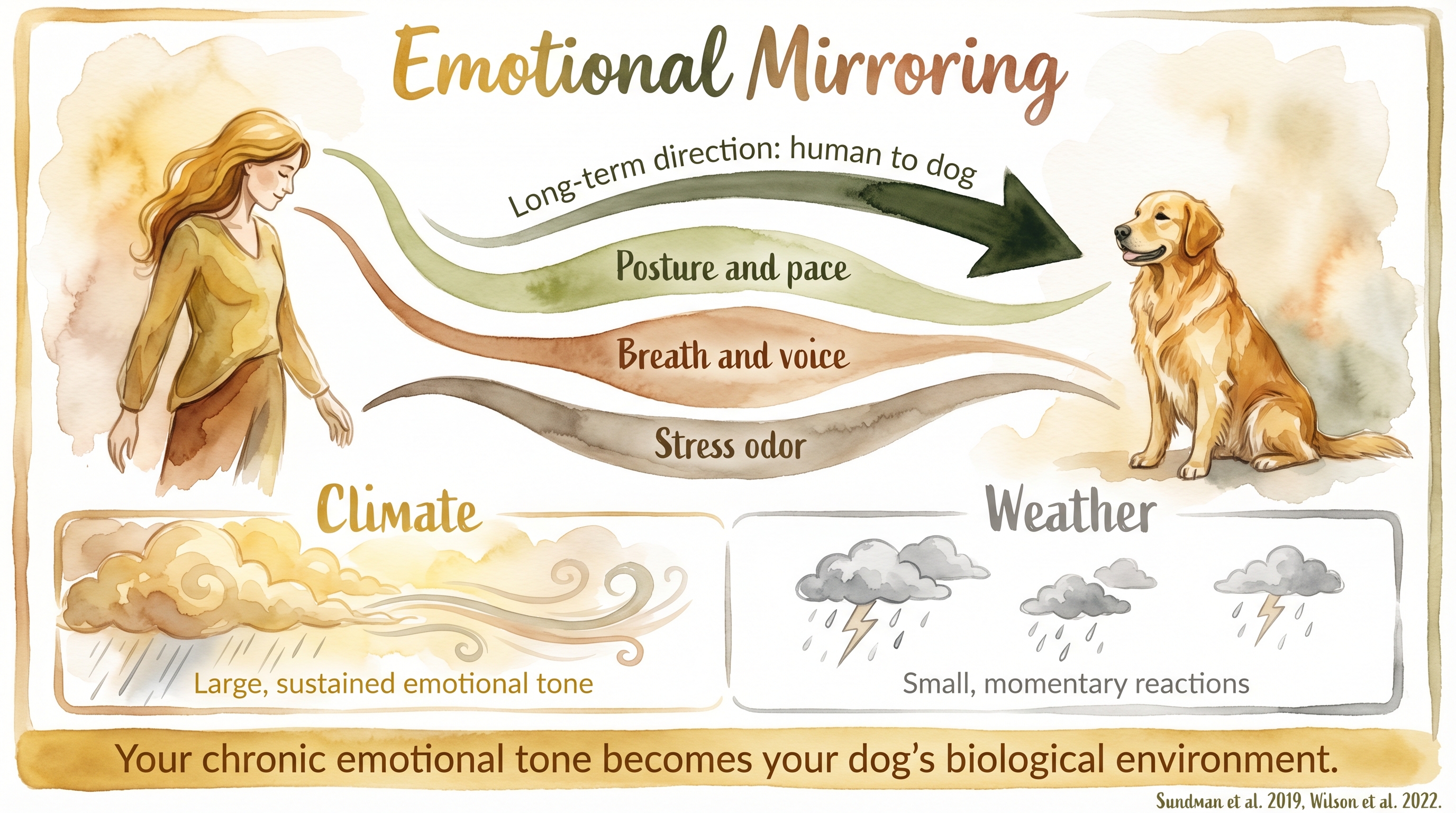
Long-term cortisol synchrony runs human-to-dog - your chronic emotional tone becomes your dog's biological environment through multiple physiological channels.
Key Takeaways
- Puppies absorb emotional state from the adults around them, not only explicit commands or visible actions.
- In domestic dogs, long-term cortisol synchrony and related dyadic measures show that human stress can become part of the dog daily physiology.
- Dogs also detect stress through odor and other nonverbal channels, which means the signal reaches them before words do.
- Human calm is therefore a developmental input. It shapes the emotional climate the puppy is learning to treat as normal.
The Evidence
- Sundman, A. S. et al. (2019)dog-human dyads
Documented long-term cortisol synchrony between dogs and their owners, with owner personality and stress variables predicting dog cortisol more strongly than the reverse. - Hoglin, A. et al. (2021)dog-human dyads
Extended the long-term stress picture by linking relationship and breed-related factors to chronic cortisol patterning in dogs. - Koskela, A. et al. (2024)dog-human dyads
Found dyad-specific behavioral and emotional co-modulation measured through heart rate variability and activity during interaction.
- Wilson, C. et al. (2022)domestic dogs
Showed that dogs can discriminate between baseline and stress odor samples from humans. - Parr-Cortes, Z. et al. (2024)domestic dogs
Found that exposure to odor from stressed humans impaired canine cognitive flexibility and learning performance. - Katayama, M. et al. (2019)domestic dogs
Reported emotional contagion from humans to dogs, supporting the idea that dog physiology and behavior shift in response to human affective state.
- Schoberl, I. et al. (2017)dog-human dyads
Showed that caregiver psychological profile predicts canine HPA-axis flexibility, reinforcing that the human emotional state is part of the dog regulatory environment.
No published study has tracked how quickly a puppy entering a new household begins to physiologically synchronize with that specific family emotional climate.
No study has isolated which human channels - posture, voice, routine pace, touch, or odor - contribute the most to stress contagion during the breeder-to-family transition.
SCR References
Sources
Hoglin, A., et al. (2021). Long-term stress in dogs is related to the human-dog relationship and personality traits. Scientific Reports, 11, 10940.
Katayama, M., et al. (2019). Emotional contagion from humans to dogs is facilitated by duration of ownership. Frontiers in Psychology, 10, 167.
Koskela, A., et al. (2024). Behavioral and emotional co-modulation during dog-owner interaction measured by heart rate variability and activity. Scientific Reports.
Parr-Cortes, Z., et al. (2024). The odour of an unfamiliar stressed or relaxed person affects dogs cognition and learning. Scientific Reports.
Schoberl, I., et al. (2017). Psychobiological factors affecting cortisol variability in human-dog dyads. PLOS ONE, 12(2), e0170707.
Sundman, A. S., et al. (2019). Long-term stress levels are synchronized in dogs and their owners. Scientific Reports, 9, 7391.
Wilson, C., et al. (2022). Dogs can discriminate between human baseline and stress odours. PLOS ONE, 17(9), e0274143.