The Authoritative Parenting Model
Compound evidence detail1 SCR / 3 parts
- Documentedthe Baumrind authoritative-parenting literature in human child development
- Documentedthe canine correlational evidence linking dog-directed caregiving styles to attachment, attention, sociability, and problem-solving outcomes (van Herwijnen 2018/2020, Brubaker and Udell 2023)
- Heuristicthe JB inference that one specific caregiving style experimentally produces the best long-term developmental outcomes in dogs
The authoritative parenting model gives JB a clean way to describe what kind of adult a puppy needs. Mixed Evidence High warmth and high structure belong together. Warmth without structure becomes permissiveness. Structure without warmth becomes authoritarian control. JB argues that the strongest developmental position is the one that stays affectionate, responsive, and calm while also holding firm boundaries.
What It Means
Developmental psychologist Diana Baumrind described four broad parenting styles organized around two axes: warmth and control. The style associated with the strongest outcomes in children is authoritative: high warmth plus high structure. Documented The caregiver is responsive, engaged, and emotionally available, but also clear, boundaried, and willing to lead.
That framework is attractive to JB because it captures something families feel intuitively once it is named. Good raising is not softness alone, and it is not strictness alone. It is not emotional distance. It is not emotional leakage. It is not endless negotiation. It is not brittle rule enforcement. It is the combination of steady affection and dependable order.
This also clarifies what Structured Leadership is not.
It is not authoritarian. In dog language, authoritarian handling often shows up as pressure-first relationships: the human emphasizes obedience, compliance, and correction, but warmth, sensitivity, and genuine relational safety are weak. The dog may still comply in the moment, but the developmental cost can be high.
It is not permissive. In dog language, permissiveness looks like affection without standards. The owner loves the puppy, talks constantly to the puppy, and gives the puppy social access to everything, but hesitates to hold lines. The home becomes emotionally engaged but structurally unstable.
It is not neglectful. This one is easier to spot. The puppy receives little structure and little attuned care. Needs are met at the level of feeding and housing, but the social and developmental work is thin.
Authoritative parenting avoids all three failure modes. It says yes to relationship and yes to boundaries.
That is exactly why JB's "parent, not playmate" framing is so important. The playmate model often slides into permissiveness because the relationship is organized around shared fun, not developmental asymmetry. A playmate does not naturally hold standards, pace excitement, or think in terms of maturation. A parent does.
In humans, the evidence for authoritative parenting is long-standing and strong. In dogs, the adaptation is newer and more limited, but it is no longer fair to say there are no dog studies. Owner-directed parenting-style instruments have been adapted for dogs, and recent work links owner style with attention, sociability, attachment-related behavior, and problem-solving. Heuristic The field is not yet at the stage of randomized intervention studies showing that authoritative dog raising causes better outcomes. But the correlational pattern is important enough that JB can responsibly use the model as a bounded framework.
Why would the model transfer at all? Because the underlying ingredients are not species-exclusive. Warmth, predictability, responsiveness, and regulation are fundamental features of social caregiving. Panksepp's work on the CARE system helps explain why sensitive caregiving matters in mammalian development. Documented And dog-human affiliative physiology, including the oxytocin-gaze literature, suggests that calm, relational warmth is not an invented metaphor. It is measurable.
At the same time, warmth in JB is not high-energy enthusiasm. That is a crucial distinction. Many owners think they are being loving when they are actually being stimulating. The authoritative model does not require the adult to become animated, noisy, or peer-like. In JB language, warmth means steadiness, responsiveness, availability, and calm contact. It is not the same thing as amping the dog up.
Structure also needs a precise definition. It does not mean coercion. It means the environment has shape. Rest has shape. Greetings have shape. Doorways, food routines, boundaries, furniture access, transitions, and social expectations all have shape. The adult is not improvising the social order every hour. The puppy lives inside a coherent system.
This matters because owner effects are real. Powell and colleagues found that owner personality and attachment variables were associated with treatment outcome after behavioral consultation. Documented That finding does not erase method, but it does warn against overly technical models that treat behavior as though the owner's relational style is irrelevant. The adult's style is part of the intervention whether anyone names it or not.
So the authoritative model helps JB do three things at once:
- reject dominance-based authoritarianism
- reject affection-only permissiveness
- describe a concrete middle path that is warm, structured, and developmentally adult
That middle path is not a compromise. It is the point.
Why It Matters for Your Dog
The authoritative model matters because dogs do not just react to what owners want. Mixed Evidence They react to how owners are. A warm, organized adult gives the dog better information about safety, boundaries, and recovery than either a harsh adult or an indulgent one.
JB maps most closely to authoritative caregiving: high warmth, high structure, calm guidance, and clear boundaries that do not depend on mood.
The four-style map in dog-raising terms:
- Authoritative: calm affection, reliable routines, clear rules, responsive support
- Authoritarian: pressure, control, low warmth, weak emotional safety
- Permissive: affection and indulgence, but moving rules and weak limits
- Neglectful: low involvement, low structure, little developmental guidance
Why authoritative wins:
- the dog gets closeness without instability
- the dog gets boundaries without fear
- the owner stays relationally important without becoming a peer
- the household becomes easier to predict
The family-level benefit is clarity. Once people understand that love and structure are not competing values, a lot of confusion disappears. The owner can be deeply affectionate without becoming permissive, and firmly boundaried without becoming harsh.
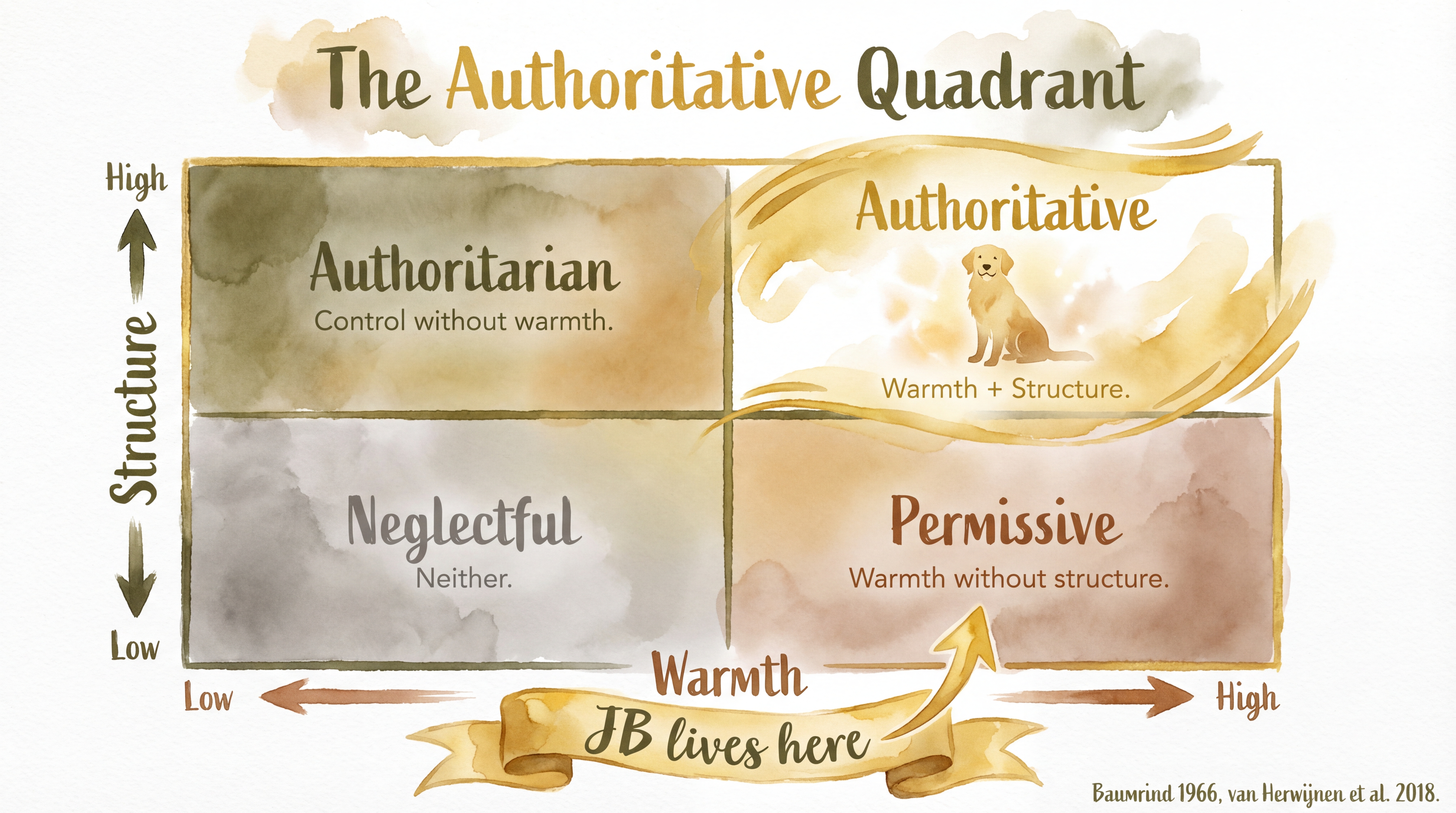
Four caregiving styles mapped by warmth and structure - Just Behaving operates in the authoritative quadrant.
Key Takeaways
- Love and structure are not competing values - they go together best when both are strong.
- The goal is not to be the boss or the entertainer; it is to be the calm adult who is both responsive and boundaried.
- Harsh control without warmth creates fear; permissiveness with weak limits creates chaos; warmth plus structure creates safety.
- Your puppy needs to feel loved and to know where the edges are, and the best raising happens when those two things happen at the same time.
The Evidence
This entry uses mixed-evidence claim-level tags beyond the dedicated EvidenceBlocks below. These tags mark claims that combine documented findings with observed practice, heuristic application, or unresolved gaps.
- Baumrind (1966, 1991)humans
Authoritative parenting consistently predicts stronger developmental outcomes than authoritarian, permissive, or neglectful styles. - Panksepp (1998)multiple mammals
The CARE system provides a mammalian affective basis for why sensitive caregiving and relational safety matter developmentally.
- van Herwijnen et al. (2018, 2020)domestic dogs
Adapted dog-directed parenting-style measures and linked owner styles to observable behavior and dog attention patterns. - Brubaker and Udell (2023)domestic dogs
Found associations between owner caregiving style, dog attachment-related behavior, and problem-solving tendencies. - Bouma et al. (2024)domestic dogs
Extended the dog-directed parenting-style literature with associations involving sociability and relational functioning. - Powell et al. (2021)domestic dogs
Owner personality and owner-dog attachment were associated with treatment outcomes after behavioral consultation. - Nagasawa et al. (2015)domestic dogs and humans
Supports the claim that calm affiliative interaction between dogs and owners has measurable physiological correlates.
- JB synthesisdomestic dogs and humans
JB maps the authoritative quadrant onto dog raising because it best preserves both warmth and boundaries. The dog evidence is meaningful but still correlational and sampling-limited. - JB synthesisdomestic dogs
The strongest bounded claim is association: authoritative-style caregiving aligns with better relational outcomes. The stronger causal claim remains untested.
No published study directly tests the specific claims or protocols described in this entry within a controlled canine trial.
SCR References
Sources
- Baumrind, D. (1966). Effects of authoritative parental control on child behavior. Child Development, 37(4), 887-907.
- Baumrind, D. (1991). The influence of parenting style on adolescent competence and substance use. Journal of Early Adolescence, 11(1), 56-95.
- Bouma, E. M. C., Vink, L. M., Dijkstra, A., & den Uijl, I. (2024). Dog-directed parenting styles and associations with canine social behavior. Animals, 14.
- Brubaker, L., & Udell, M. A. R. (2023). Owner caregiving style, attachment, and problem solving in companion dogs. Animals, 13.
- Nagasawa, M., Mitsui, S., En, S., Ohtani, N., Ohta, M., Sakuma, Y., Onaka, T., Mogi, K., & Kikusui, T. (2015). Oxytocin-gaze positive loop and the coevolution of human-dog bonds. Science, 348(6232), 333-336.
- Panksepp, J. (1998). Affective neuroscience: The foundations of human and animal emotions. Oxford University Press.
- Powell, L., Stefanovski, D., Siracusa, C., & Serpell, J. A. (2021). Owner personality, owner-dog attachment, and canine demographics influence treatment outcomes in canine behavioral medicine cases. Frontiers in Veterinary Science, 7, 630931. https://doi.org/10.3389/fvets.2020.630931
- van Herwijnen, I. R., van der Borg, J. A.