The Oxytocin-Gaze Loop
The oxytocin-gaze loop is one of the clearest modern demonstrations that dog-human bonding has a measurable chemical signature. In at least some dyads, mutual gaze is associated with increased owner oxytocin, and experimentally increasing oxytocin in dogs can increase gazing and affiliative behavior back toward the human. That is a documented modern physiological phenomenon. It is not a license to say every quiet interaction works the same way or that the loop itself was conclusively selected during domestication. Documented
What It Means
Oxytocin is not simply a "love hormone." Across mammals, it is part of a broader system involving affiliation, parenting, touch, and social salience. In dogs, the most famous finding comes from Nagasawa et al. (2015), who showed a bidirectional loop: when some dogs gazed at their people, those people showed increased urinary oxytocin, and giving oxytocin intranasally to dogs increased their affiliative gazing and behavior. Documented The finding matters because it makes the dog-human bond chemically legible rather than leaving it only in the language of sentiment.
Touch matters just as much as gaze. Handlin and colleagues showed that human touch is not uniformly calming in dogs. Documented Slow stroking is associated with calmer effects, while activating touch such as scratching and vigorous patting is associated with cortisol increase. That means the oxytocin story is not just about being close. It is about interaction quality. Calm affiliative contact and high-energy stimulation are not the same physiological event.
This is what makes the loop so important to the Foundations layer. It gives JB a neurochemical reason to care about tone. Quiet presence, soft voice, measured touch, and unhurried eye contact are not just nice manners. They are the kind of interaction pattern that best fits the documented affiliative pathway. Documented By contrast, overly activating touch and command-heavy interaction styles can pull the dyad into a different chemical state.
The boundary matters too. The loop is documented in modern dog-human physiology. Documented The stronger evolutionary claim, that domestication selected this exact loop as a coevolutionary mechanism, remains more contested. There is also a developmental gap. The adult-dog literature is much stronger than the newly rehomed puppy literature, so families should not talk as if the full adult oxytocin loop has already been mapped across the eight-to-ten-week rehoming window.
Why It Matters for Your Dog
For families, the practical lesson is simple: the bond is built most reliably through calm, readable affiliation rather than through constant activation. When the home is always noisy, excitable, and physically stimulating, it may be generating interaction but not the kind of interaction that best supports the affiliative loop. When the home makes room for calm eye contact, gentle touch, and quiet companionship, it is working with the strongest documented chemistry of the bond.
Mentorship works best inside a bond that is chemically settled enough for the puppy to stay socially open and readable. The oxytocin-gaze loop is one reason calm adult presence has so much leverage.
This also helps explain why JB keeps emphasizing the difference between calm affection and stimulating affection. Documented Families often think all touch and attention are automatically helpful. The evidence says they have to discriminate. A puppy can be loved in a way that settles the nervous system or in a way that spins it up. The oxytocin literature makes that distinction more than a stylistic preference.
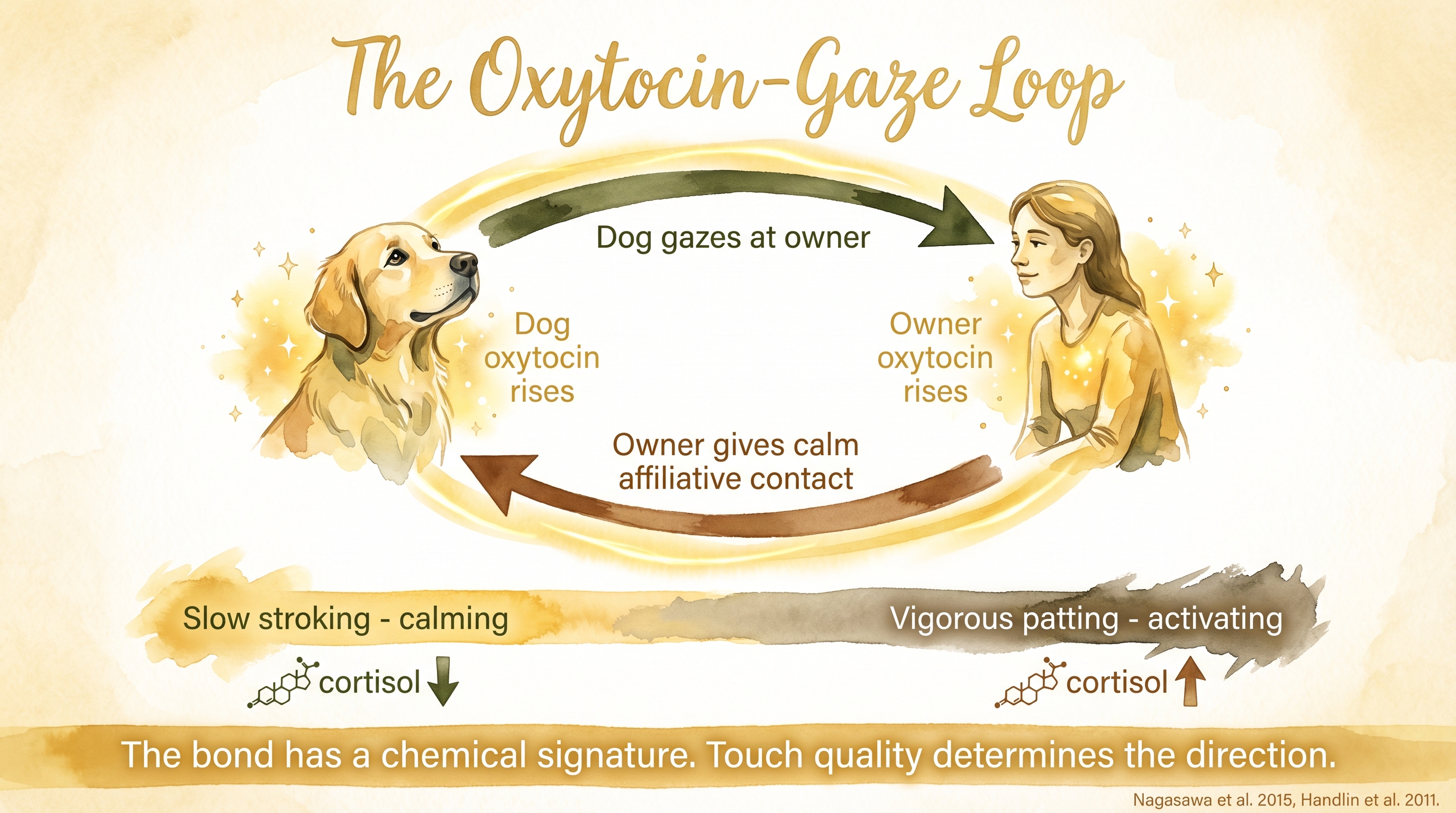
Mutual gaze creates a measurable oxytocin pathway between dogs and humans - touch quality determines the direction, with slow stroking calming and vigorous patting activating.
Key Takeaways
- Mutual gaze and affiliative contact between dogs and humans have a documented oxytocin component.
- The loop matters because it gives the bond a measurable chemical signature rather than leaving it as a vague feeling.
- Touch quality matters. Slow stroking and activating touch are not physiologically interchangeable.
- The adult-dog evidence is strong, but the exact onset and strength of the loop in newly rehomed puppies are still not fully mapped.
The Evidence
- Nagasawa, M. et al. (2015)dogs and humans
Demonstrated a bidirectional oxytocin-gaze loop in which dog gaze and owner oxytocin rise together, with experimental oxytocin increasing dog affiliative gazing. - Nagasawa, M. et al. (2009)dogs and humans
Earlier work showed that dog gaze increased owner urinary oxytocin, laying the groundwork for the later loop finding. - Romero, T. et al. (2014)domestic dogs
Showed that intranasal oxytocin increases affiliative social behavior in dogs.
- Handlin, L. et al. (2011)domestic dogs
Found that short-term dog-owner interaction changed oxytocin and cortisol measures, with touch type influencing the endocrine pattern. - Handlin, L. et al. (2012)domestic dogs
Linked relationship qualities and touch patterns to different oxytocin and cortisol responses, reinforcing that activating touch is not equivalent to calm stroking.
No published study has directly demonstrated the full oxytocin-gaze loop in newly rehomed eight-to-ten-week-old puppy-owner dyads, so the developmental timing of the loop during the soft-landing window remains a real evidence gap.
SCR References
Sources
Nagasawa, M., Mitsui, S., En, S., Ohtani, N., Ohta, M., Sakuma, Y., Onaka, T., Mogi, K., & Kikusui, T. (2015). Oxytocin-gaze positive loop and the coevolution of human-dog bonds. Science, 348(6232), 333-336. https://doi.org/10.1126/science.1261022
Nagasawa, M., Kikusui, T., Onaka, T., & Ohta, M. (2009). Dog's gaze at its owner increases owner's urinary oxytocin during social interaction. Hormones and Behavior, 55(3), 434-441. https://doi.org/10.1016/j.yhbeh.2008.12.002
Handlin, L., Hydbring-Sandberg, E., Nilsson, A., Ejdeback, M., Jansson, A., & Uvnas-Moberg, K. (2011). Short-term interaction between dogs and their owners: Effects on oxytocin, cortisol, insulin and heart rate. Anthrozoos, 24(3), 301-315. https://doi.org/10.2752/175303711X13045914865385
Handlin, L., Nilsson, A., Ejdeback, M., Hydbring-Sandberg, E., & Uvnas-Moberg, K. (2012). Associations between the psychological characteristics of the human-dog relationship and oxytocin and cortisol levels. Anthrozoos, 25(2), 215-228. https://doi.org/10.2752/175303712X13316289505468
Romero, T., Nagasawa, M., Mogi, K., Hasegawa, T., & Kikusui, T. (2014). Oxytocin promotes social bonding in dogs. Proceedings of the National Academy of Sciences, 111(25), 9085-9090. https://doi.org/10.1073/pnas.1322868111