Calibrated Challenge and the Bray Paradox
Compound evidence detail2 SCRs / 4 parts
- Documentedthe cross-species behavioral principle that parasympathetic-dominant autonomic states support social engagement, with direct canine HRV evidence (Berg 2026, Wormald 2017, Koskela 2024)
- Ambiguousthe polyvagal-theory-specific neuroanatomical mechanism, with the Grossman 2026 critique and Porges 2026 rebuttal active in current literature
- Documentedthe canine methylation pattern reported by Awalt 2024 for NR3C1 and OXTR in dogs with measured early-life history
- Heuristicthe JB extrapolation that ordinary calm raising produces durable epigenetic advantages in dogs beyond preventing adverse environments
One of the most useful correctives inside the calm-first philosophy is that calmness does not mean wrapping the puppy in permanent comfort. Bray and colleagues documented a finding that sounds paradoxical on first read - higher maternal investment was associated with lower later resilience - and that finding matters because it prevents families from confusing regulation with overprotection. Documented
What It Means
The Bray finding matters because it protects calmness from being caricatured. If calmness meant eliminating all frustration, all novelty, and all effort, then the puppy would never have to build recovery capacity. That is not what the developmental literature supports. The point of a calm floor is not to remove challenge. It is to make challenge digestible.
In guide-dog populations, Bray and colleagues found that more indulgent, less effort-requiring maternal patterns predicted poorer later resilience outcomes. Documented That does not invalidate the broader value of stable care. It means the best developmental environments do two things at once: they buffer overwhelming stress and they allow manageable challenge. The puppy needs enough support to stay inside a learnable state and enough demand to practice coming back from mild activation.
This is why JB frames the calm floor as a launchpad rather than a cushion. The launchpad image matters. Mixed Evidence A good launchpad is stable. It does not toss the puppy into the air unpredictably. But it is also not a permanent parking space. The puppy uses that stable base to explore, hesitate, wobble, and recover.
Calibrated challenge is the name for that middle zone. Novel surface. Short wait at a threshold. Mild social frustration. A slightly awkward new environment entered with adult support. Mixed Evidence These are not flooding events. They are stretch events. The distinction matters because resilience is not built by chaos. It is built by recovery after tolerable demand.
Why It Matters for Your Dog
Families can misread calmness in two opposite directions. One family keeps the puppy revved up all day because it mistakes activation for joy. Another family becomes so afraid of activation that it removes every obstacle, every wait, every surprise, and every opportunity for the puppy to practice recovery. Both paths miss the developmental target.
JB wants neither a crash landing nor a padded bubble. It wants a stable baseline with honest experience layered onto it. The puppy should encounter life, but encounter it with enough adult regulation around it that the nervous system can integrate rather than fragment. Mixed Evidence
The Window of Tolerance does not widen because the puppy never feels anything difficult. It widens because the puppy feels manageable challenge and then returns to calm without losing relationship or safety.
This is practically useful on ordinary days. The puppy can wait briefly before being picked up. Mixed Evidence It can notice a new sound without an adult rushing to rescue it. It can meet novelty without the human amplifying the moment into drama. These are tiny exercises in recovery capacity. Calmness provides the floor. Calibrated challenge gives the floor something to support.
The Bray paradox is therefore not a problem for the JB system. It is a refinement of it. Calm raising does not mean maximum comfort. It means stable regulation plus tolerable challenge plus successful return.
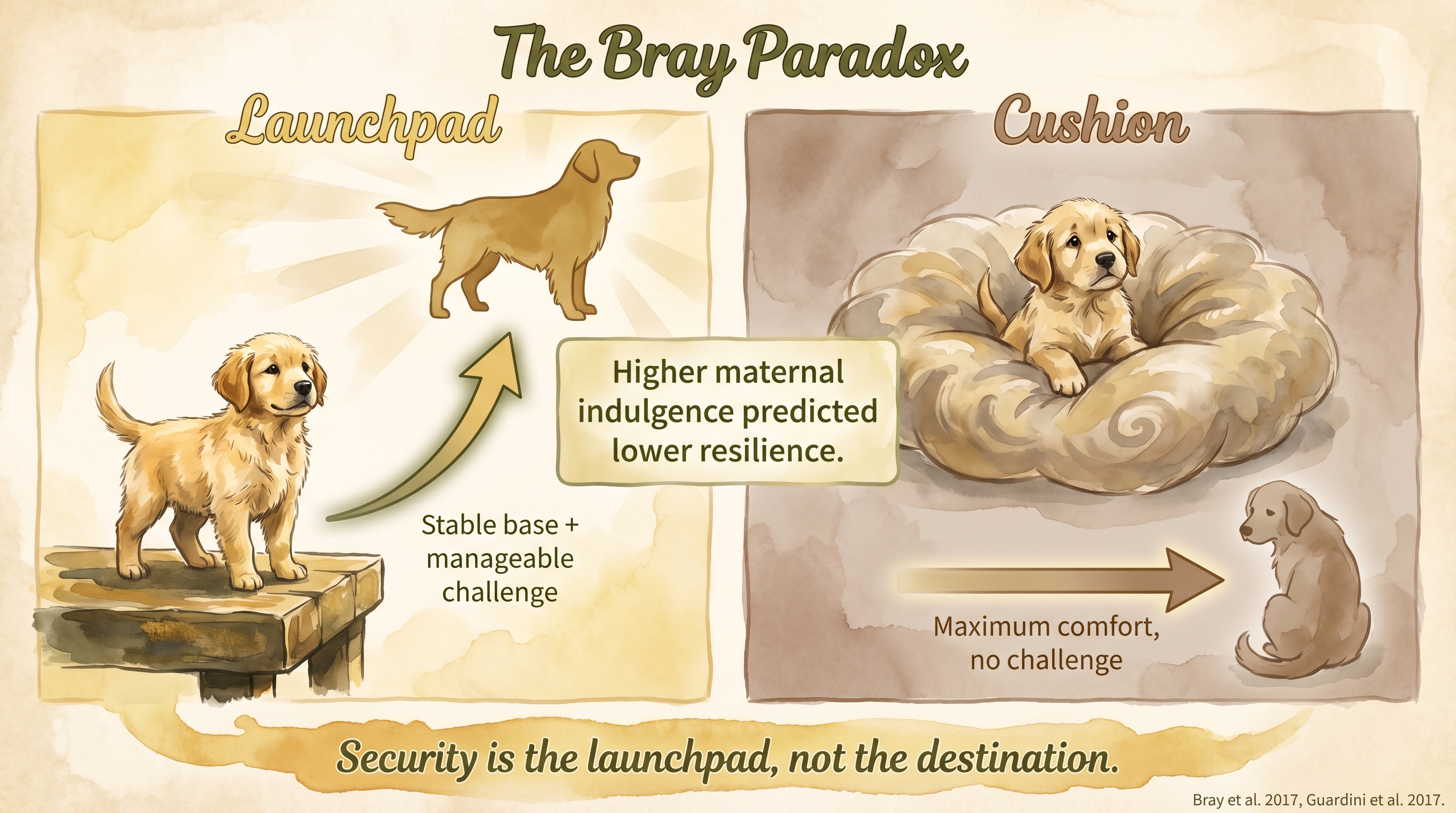
The Bray Paradox - higher maternal indulgence predicted lower later resilience. Security is the launchpad, not the destination.
Key Takeaways
- The Bray finding shows that maximum comfort is not the same thing as strong resilience.
- Calmness works best when it provides a stable base from which puppies can meet manageable challenge and recover.
- Resilience is built by recovery after tolerable demand, not by chaos and not by overprotection.
- Families help most by giving puppies support without removing every stretch moment from the day.
The Evidence
This entry uses mixed-evidence claim-level tags beyond the dedicated EvidenceBlocks below. These tags mark claims that combine documented findings with observed practice, heuristic application, or unresolved gaps.
- Bray, E. E. et al. (2017)domestic dogs
Found that higher maternal investment, especially more unchallenging ventral nursing, predicted lower later resilience and poorer guide-dog outcomes. - Guardini, G. et al. (2017)domestic dogs
Linked maternal care style to how puppies respond to environmental and social novelty, reinforcing that early challenge quality matters.
- Hennessy, M. B. et al. (2009)multiple mammals
Reviewed social buffering as a mechanism that reduces stress while still allowing organisms to engage with challenge. - Kikusui, T. et al. (2006)multiple mammals
Described social buffering as relief from stress and anxiety, clarifying why supportive presence can moderate challenge without erasing it.
- JB calm-floor synthesisfamily-raised dogs
JB interprets the Bray finding to mean that the most developmentally productive environment is calm plus calibrated challenge, not calm plus permanent indulgence.
No published trial has tested what dose, frequency, or type of challenge best expands recovery capacity in family-raised puppies without crossing into overload.
The literature documents the maternal-care paradox, but it has not yet translated that finding into a standardized family-home protocol for calibrated challenge.
SCR References
Sources
Bray, E. E., Levy, K. A., Kennedy, B. S., Villegas-Quintero, P., Duarte, P., Udell, M. A., & MacLean, E. L. (2017). Personality after the service dog selection and training process changes as a result of previous family environment. Proceedings of the National Academy of Sciences, 114(36), 9665-9670.
Guardini, G., Mariti, C., Bowen, J., Fatjo, J., Ruzzante, S., Kaminski, J., & Gazzano, A. (2017). Influence of morning maternal care on the behavioural responses of 8-week-old Beagle puppies to new environmental and social stimuli. Applied Animal Behaviour Science, 181, 137-144. https://doi.org/10.1016/j.applanim.2016.05.006
Hennessy, M. B., Kaiser, S., & Sachser, N. (2009). Social buffering of the stress response: Diversity, mechanisms and functions. Frontiers in Neuroendocrinology, 30(4), 470-482.
Kikusui, T., Winslow, J. T., & Mori, Y. (2006). Social buffering: Relief from stress and anxiety. Philosophical Transactions of the Royal Society B, 361(1476), 2215-2228.