Arousal, Learning, and the Yerkes-Dodson Curve
Compound evidence detail1 SCR / 2 parts
- Documentedthe cross-species behavioral principle that parasympathetic-dominant autonomic states support social engagement, with direct canine HRV evidence (Berg 2026, Wormald 2017, Koskela 2024)
- Ambiguousthe polyvagal-theory-specific neuroanatomical mechanism, with the Grossman 2026 critique and Porges 2026 rebuttal active in current literature
The calm floor matters because learning quality depends on arousal state. In domestic dogs, Yerkes-Dodson-style findings are not a slogan about calm being always better. They show something more precise: added arousal can help dogs that start calm and impair dogs that already start hot. Golden Retriever baseline physiology, canine inhibitory-control imaging, and post-learning consolidation studies all point the same way. Calmness is not passive. It is the state that leaves room on the curve. Documented
What It Means
The original Yerkes-Dodson idea came from mice, where task performance changed with stimulus intensity rather than improving indefinitely as activation rose. Documented In domestic dogs, Bray, MacLean, and Hare (2015) tested the same basic principle directly and found the crucial variable was starting point. Calm assistance dogs improved under added stimulation. More excitable pet dogs deteriorated under the same manipulation. The curve is real, but the dog has to be located on it before the stimulation can be interpreted.
That finding matters because it blocks two common mistakes at once. The first mistake is saying that all arousal is bad. The second is saying that high energy is good for learning. Both flatten the actual canine data. In dogs, added activation helps only when the animal begins low enough to absorb it without losing inhibitory control.
Timing matters too. In domestic dogs, Affenzeller and colleagues showed that arousal after learning can support consolidation, while arousal during acquisition can interfere with performance and clarity. Documented The point is not to eliminate activation from life. The point is to stop placing the dog at the top of the curve before the learning task has even started.
The physiology beneath that curve is also becoming visible. The AI-COLLAR study found that Golden Retrievers have a lower resting heart-rate baseline than the broader dog population, which supports the JB claim that the breed begins with unusually strong parasympathetic tone. Heuristic In domestic dogs, Cook, Spivak, and Berns (2016) then showed that stronger frontal cortical activation during an inhibition task predicted fewer impulsive errors. Calmness, in other words, is not merely behavioral politeness. It is the condition that preserves executive control.
There is a careful mechanistic bridge here as well. In humans, rodents, and nonhuman primates, acute stress can shift control away from flexible prefrontal processing and toward more automatic habit systems. Documented-Cross-Species Applied to dogs, that suggests why chronic excitement narrows learning flexibility, but the real-time canine shift has not been imaged during household interaction. JB can use the bridge as a model. JB should not present it as directly filmed canine fact.
Why It Matters for Your Dog
For families, this Foundation changes what "engaged" should mean. A dog does not need to be revved up to be available. In many household dogs, the very activation people call engagement is the thing that pushes the animal past its learning optimum.
Calmness is the learning floor because it gives the dog room to absorb stimulation without losing inhibitory control, working memory, and social readability.
This is why JB keeps insisting on building the calm floor first. A dog raised inside chronic excitement starts close to the top of the curve. Ordinary life then becomes cognitively expensive. A door opening, a guest arrival, a leash coming off the hook, or a high-pitched greeting can be enough to tip the dog out of the state where it can still think clearly. Documented
The practical implication is not to produce a flat dog. It is to produce a dog with range. A settled dog can rise when life requires it and still remain available. A chronically activated dog has nowhere to go except over.
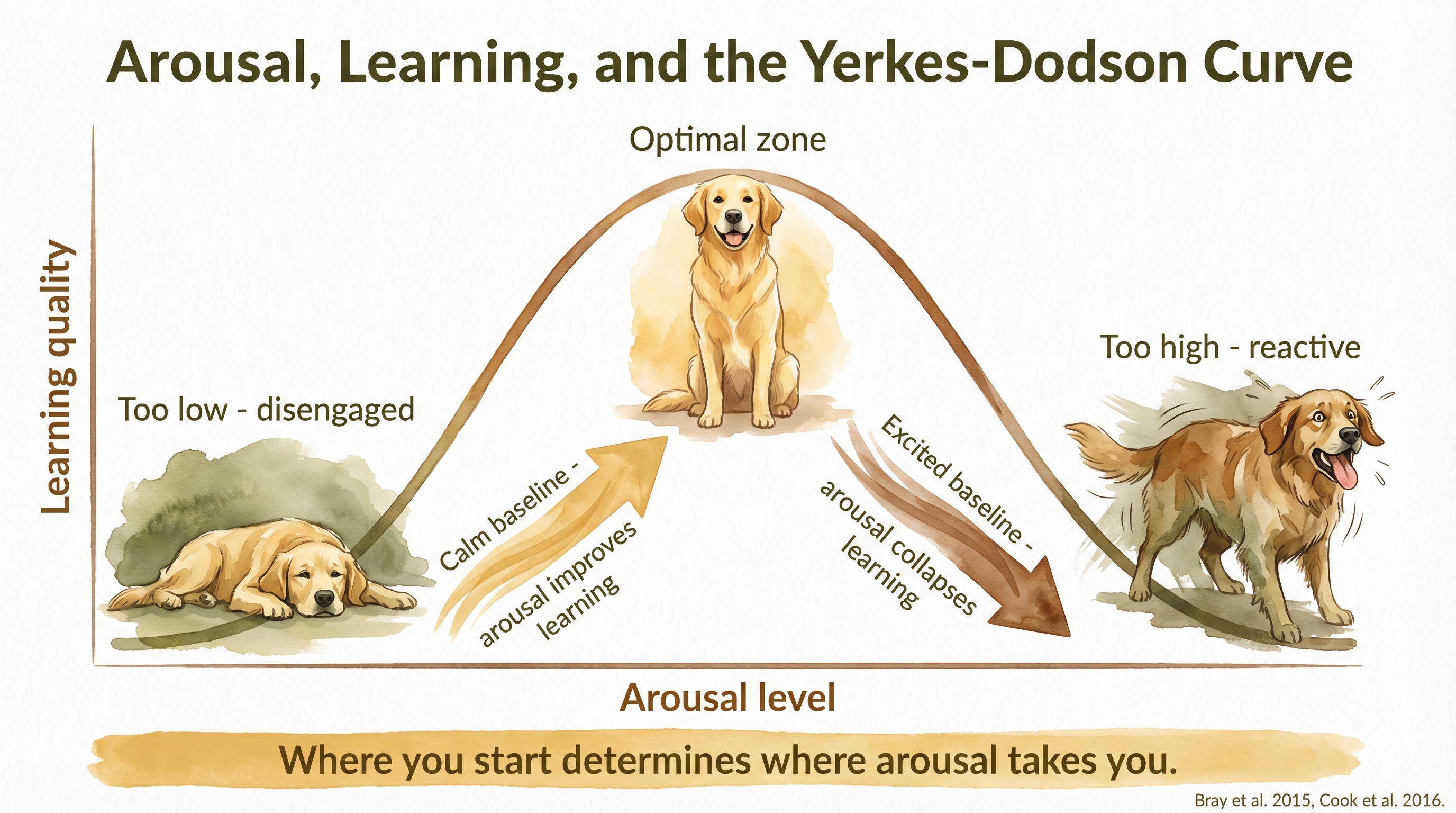
The Yerkes-Dodson curve applied to dogs - where you start on the arousal spectrum determines whether added stimulation helps or collapses learning.
Key Takeaways
- In dogs, the effect of arousal on learning depends on where the dog starts, not on a simple rule that more excitement is always better or always worse.
- Bray and colleagues showed that added stimulation helped calmer dogs and impaired more excitable dogs on inhibitory-control tasks.
- Golden Retrievers appear to begin with a relatively parasympathetic physiological baseline, which means calmness is a breed-aligned starting point rather than an artificial suppression strategy.
- The practical goal is not zero arousal. It is enough calm baseline that the dog can absorb stimulation without losing executive control.
The Evidence
This entry uses documented cross-species claim-level tags beyond the dedicated EvidenceBlocks below. Species and application scope should be checked during the next evidence-chain authoring pass.
This entry uses heuristic claim-level tags beyond the dedicated EvidenceBlocks below. These tags mark JB interpretive application rather than direct study findings.
- Bray, E. E., MacLean, E. L., & Hare, B. (2015)domestic dogs
Showed that increased arousal improved inhibitory control in calmer dogs but impaired it in more excitable dogs. - Affenzeller, N. et al. (2017)Labrador Retriever dogs
Showed that playful activity after learning improved later training performance, which supports the timing-specific nature of arousal effects. - Affenzeller, N. (2020)Labrador Retriever dogs
Showed that post-learning dog-human play improved re-training performance over long intervals, reinforcing that arousal after acquisition is different from arousal during acquisition.
- AI-COLLAR Study (2025)domestic dogs including Golden Retrievers
Found that Golden Retrievers had a lower resting heart-rate baseline than the general canine population, consistent with stronger parasympathetic tone. - Cook, P. F., Spivak, M., & Berns, G. S. (2016)domestic dogs
Showed that stronger frontal cortical activation during successful inhibition predicted fewer impulsive errors in an awake-fMRI go-no-go task. - Collins-Pisano, C. et al. (2025)detection dogs
Showed that post-training arousal effects on retention differed by the dog baseline reward-arousal profile, which reinforces the baseline-dependent interpretation.
No longitudinal canine study has mapped the full arousal-performance curve from breeder period through adulthood while tracking how household style shifts a dog baseline over time.
No canine neuroimaging study has directly captured the real-time shift from flexible frontal control toward more automatic responding during ordinary high-arousal household events.
SCR References
Sources
Affenzeller, N., Palme, R., & Zulch, H. (2017). Playful activity post-learning improves training performance in Labrador Retriever dogs. Physiology & Behavior, 168, 62-73. https://doi.org/10.1016/j.physbeh.2016.10.014
Affenzeller, N. (2020). Dog-human play, but not resting post-learning, improves re-training performance up to one year after initial task acquisition in Labrador Retriever dogs. Animals, 10(3), 447. https://doi.org/10.3390/ani10030447
Bray, E. E., MacLean, E. L., & Hare, B. A. (2015). Increasing arousal enhances inhibitory control in calm but not excitable dogs. Animal Cognition, 18(6), 1317-1329. https://doi.org/10.1007/s10071-015-0901-1
Collins-Pisano, C., et al. (2025). The effect of arousal during and post-training on memory consolidation in detection dogs. Journal of Applied Behavior Analysis.
Cook, P. F., Spivak, M., & Berns, G. S. (2016). Neurobehavioral evidence for individual differences in canine cognitive control: An awake fMRI study. Animal Cognition, 19(5), 867-878. https://doi.org/10.1007/s10071-016-0997-y
Doxey, S., Boswood, A., & Rodriguez, C. (2004). Differences between breeds of dog in a measure of heart rate variability. Veterinary Record, 154(23), 713-717.
AI-COLLAR Study. (2025). Resting heart and respiratory rates in dogs in their natural environment. Frontiers in Veterinary Science.