Calmness as Neurological Prerequisite
Compound evidence detail2 SCRs / 4 parts
- Documentedthe cross-species behavioral principle that parasympathetic-dominant autonomic states support social engagement, with direct canine HRV evidence (Berg 2026, Wormald 2017, Koskela 2024)
- Ambiguousthe polyvagal-theory-specific neuroanatomical mechanism, with the Grossman 2026 critique and Porges 2026 rebuttal active in current literature
- Documentedthe canine methylation pattern reported by Awalt 2024 for NR3C1 and OXTR in dogs with measured early-life history
- Heuristicthe JB extrapolation that ordinary calm raising produces durable epigenetic advantages in dogs beyond preventing adverse environments
In the Just Behaving system, calmness is not a personality style and it is not a luxury add-on. It is the nervous-system condition that lets puppies process social information, recover from challenge, and stay in relationship while learning, which is why JB treats calmness as a prerequisite rather than as an outcome to chase later. Heuristic
What It Means
The shortest scientific version is that regulated states learn better than flooded states. When the autonomic nervous system is tilted toward parasympathetic regulation, social engagement, attention, and recovery are easier to sustain. When the puppy is stuck in sympathetic overactivation, the body is organizing around action and survival rather than absorption. The puppy may still be moving, reacting, and appearing energetic, but those are not the same as learning well.
This is why JB pushes back so hard against the cultural habit of treating excitement as proof of happiness. A puppy bouncing off the walls can be delighted for a moment, but chronic activation is not joy. It is a body that has not learned how to come back down. The difference matters because families often build the wrong floor first. Observed-JB They create excitement and then search for ways to train calmness onto the top of it.
The biological bridge is broader than dogs alone. In rats, Weaver and related maternal-care work established that caregiving environment can alter later stress physiology through epigenetic pathways. Documented In domestic dogs, newer early-life epigenetic work shows that early adversity is associated with methylation differences in stress- and bonding-related genes. Those findings do not prove the full JB claim that calm puppy raising creates permanent adult stress advantages in the exact form JB proposes. They do make the direction of the claim biologically coherent.
A second bridge comes from attachment and secure-base research. Heuristic In dogs, the adult human secure-base role materially affects stress regulation and exploratory confidence. That matters because calmness is not only internal chemistry. It is relationally supported regulation. Puppies settle more easily when the adult around them is predictable, steady, and non-chaotic.
Why It Matters for Your Dog
A calm puppy can watch, copy, recover, and stay socially open. Mixed Evidence A chronically activated puppy can do none of those things reliably for long. That is why calmness sits underneath the other Foundations rather than beside them. Social learning needs it. Structured leadership depends on it. Correction is only tolerable inside it.
This is also why JB avoids importing excitement as a bonding strategy. The goal is not to make the puppy flat or dull. The goal is to build the calm floor first, so that play, novelty, and challenge happen on top of regulation rather than instead of it. Families do not have to suppress all energy. They have to stop making activation the organizing principle of the relationship.
Calmness is the floor of the system. JB does not start in excitement and try to train down to regulation later. It starts in regulation so everything else has somewhere safe to stand.
The practical implication is almost always less dramatic than people expect. Slower greetings. Less calling. Fewer frantic reunions. More rest. More predictability. More carrying and settling. More quiet participation in household rhythm. These are not separate hacks. They are ways of keeping the puppy inside a state where learning stays available.
The strongest caution belongs at the edge of the claim. The documented science supports the importance of regulation, caregiving environment, and relationship-supported stress buffering. Documented The stronger claim that a specific JB calm-raising protocol produces permanent canine stress-architecture outcomes remains interpretive. Families should still act on the practice, because the practice is safe and biologically aligned. They just should not confuse that practical confidence with a completed intervention science.
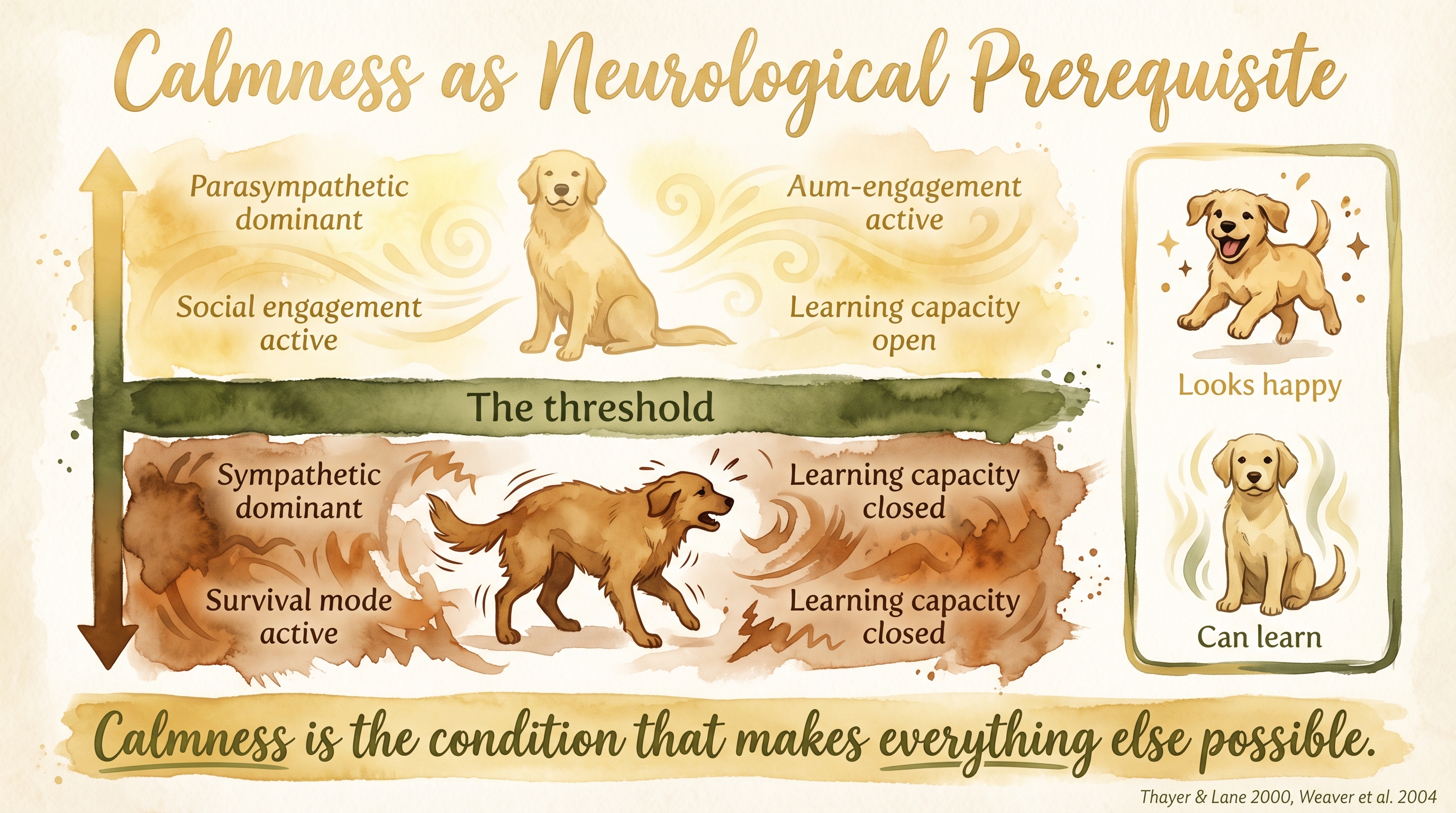
Calmness is the nervous-system condition that enables learning and relationship - not personality, not lethargy, but the prerequisite for everything else.
Key Takeaways
- Calmness is not a style preference in JB. It is the nervous-system condition that keeps learning, recovery, and relationship available.
- Parasympathetic-dominant states support social engagement and regulation, while chronic overactivation narrows what the puppy can process well.
- Cross-species caregiving research and newer canine epigenetic evidence make the calm-first thesis biologically coherent, even though the full JB permanence claim remains more interpretive.
- Families build calmness through the atmosphere they create: slower pace, predictable routine, measured touch, and less imported excitement.
The Evidence
This entry uses observed claim-level tags beyond the dedicated EvidenceBlocks below. These tags mark JB program observation or practice-derived claims that need dedicated EvidenceBlock coverage in a later content pass.
This entry uses heuristic claim-level tags beyond the dedicated EvidenceBlocks below. These tags mark JB interpretive application rather than direct study findings.
This entry uses mixed-evidence claim-level tags beyond the dedicated EvidenceBlocks below. These tags mark claims that combine documented findings with observed practice, heuristic application, or unresolved gaps.
- Thayer, J. F. & Lane, R. D. (2000)humans and broader mammalian framework
Described neurovisceral integration linking autonomic regulation to emotional and cognitive function, providing a strong mechanistic frame for why calmer states support better processing. - Bray, E. E. et al. (2015)domestic dogs
Showed that added arousal can help calm dogs but impair excitable dogs, reinforcing the importance of baseline state rather than treating arousal as universally beneficial. - Berg, N. L. et al. (2026)domestic dogs
Extended the canine autonomic picture through heart-rate-variability measurement, supporting meaningful individual differences in regulation state.
- Weaver, I. C. G. et al. (2004)rats
Demonstrated that maternal care alters glucocorticoid-related methylation and later stress physiology in offspring. - Awalt, K. M. et al. (2024)domestic dogs
Documented early-life epigenetic associations in stress- and bonding-related genes, extending the broader caregiving-regulation framework into canine evidence.
- Topal, J. and later attachment literature summarized in SCR-289domestic dogs
Document secure-base effects showing that the adult human relationship materially affects canine exploratory confidence and stress regulation. - Hennessy, M. B. et al. (2009)multiple mammals
Reviewed social buffering as a real biological mechanism by which stable social presence reduces stress load.
No controlled canine intervention trial has tested whether a specifically JB-style calm-first puppy-raising protocol produces durable adult stress-regulation advantages over more excitement-heavy household styles.
The science supports regulated states and caregiving effects, but it has not yet quantified how much household excitement is enough to shift long-term developmental baseline in ordinary family homes.
SCR References
Sources
Awalt, K. M., et al. (2024). Early adversity and epigenetic variation in the oxytocin and glucocorticoid receptor genes in dogs. Frontiers in Behavioral Neuroscience.
Berg, N. L., Christensen, J. W., Ladewig, J., & Nielsen, B. L. (2026). Behavior-related heart rate variability changes during measurement in domestic dogs. Applied Animal Behaviour Science, 296, 106899.
Bray, E. E., MacLean, E. L., & Hare, B. (2015). Increasing arousal enhances inhibitory control in calm but not excitable dogs. Animal Cognition, 18(6), 1317-1329.
Hennessy, M. B., Kaiser, S., & Sachser, N. (2009). Social buffering of the stress response: Diversity, mechanisms and functions. Frontiers in Neuroendocrinology, 30(4), 470-482.
Thayer, J. F., & Lane, R. D. (2000). A model of neurovisceral integration in emotion regulation and dysregulation. Journal of Affective Disorders, 61(3), 201-216.
Weaver, I. C. G., Cervoni, N., Champagne, F. A., D'Alessio, A. C., Sharma, S., Seckl, J. R., Dymov, S., Szyf, M., & Meaney, M. J. (2004). Epigenetic programming by maternal behavior. Nature Neuroscience, 7(8), 847-854.