Non-Verbal Communication as Primary Language
Compound evidence detail1 SCR / 2 parts
- Observed-JBthe ethological evidence that adult dogs deploy specific social signals with situational selectivity and brief contextual deployment (Abrantes, Bekoff, Mech) together with the Bray, MacLean et al. 2021 retriever puppy demonstration that canine attention to human gestural cues is biologically pre-loaded
- Heuristicthe JB application generalizing the dog signal-precision pattern into a universal social-signaling principle and the corollary claim that high-frequency human verbal praise categorically degrades communicative information in household contexts
Before a puppy understands a word, it is already reading bodies. Scent, touch, posture, movement, distance, and orientation arrive earlier and with more consistency than speech, which is why non-verbal communication operates as the primary language of the relationship even when words later become useful. Mixed Evidence
What It Means
Dogs are born into a world where touch and scent come first. Vision and hearing open later, and the social meaning of what is seen and heard develops through repeated interaction. By the time a puppy goes home, it is already a sophisticated reader of where bodies are placed, how fast they move, which direction they angle, whether the adult is leaning in or easing off, and whether contact feels calm or activating. Mixed Evidence
The documented communication literature supports that these are real signals, not projections by sentimental humans. Documented-Cross-Species Domestic dogs use approach angle, body orientation, and other subtle visual cues in socially meaningful ways. De-escalatory signals also matter. A relationship does not have to become loud or forceful for information to move through it. Often the clearest message is carried by where the adult places the body and what the adult does not do next.
This matters because verbal language rides on top of that older channel rather than replacing it. A human can say "good girl" while moving abruptly and tightening the leash, and the puppy will believe the leash and the body before it believes the sentence. Mixed Evidence Words can later become helpful labels, markers, and ritual cues, but the body stays upstream.
The strongest JB application is not that words are useless. It is that relationship lives primarily in the non-verbal channel. That is the channel the puppy was born ready to read, the channel other dogs use, and the channel most likely to stay coherent across context when the household is calm enough to use it well.
Why It Matters for Your Dog
Families often assume communication problems are word problems. They search for the right cue, the right tone, the right command sequence. The Foundation view says the larger issue is often the body. If the human body is crowded, inconsistent, hurried, or noisy, the puppy is receiving mixed information before the first word arrives. Ambiguous
This is why so many JB instructions sound less like training advice and more like choreography. Do not call constantly. Do not wake the puppy unnecessarily. Move in a way the puppy can follow. Use placement, pause, and space. The point is not theatrical body language. It is to stop sabotaging the channel the puppy is already using.
Structured Leadership communicates through presence before it communicates through vocabulary. The adult body defines boundary, safety, and direction long before a cue can do that job reliably.
This also explains why non-verbal communication sits so close to Indirect Correction. Body blocking, spatial pressure, and quiet disengagement are effective only because the puppy already treats body and space as meaningful language. Mixed Evidence If words were primary and the body secondary, those methods would be far weaker than they are.
The practical translation is simple: pay at least as much attention to what your body is saying as to what your mouth is saying. In dog raising, that is usually the more honest transcript anyway.
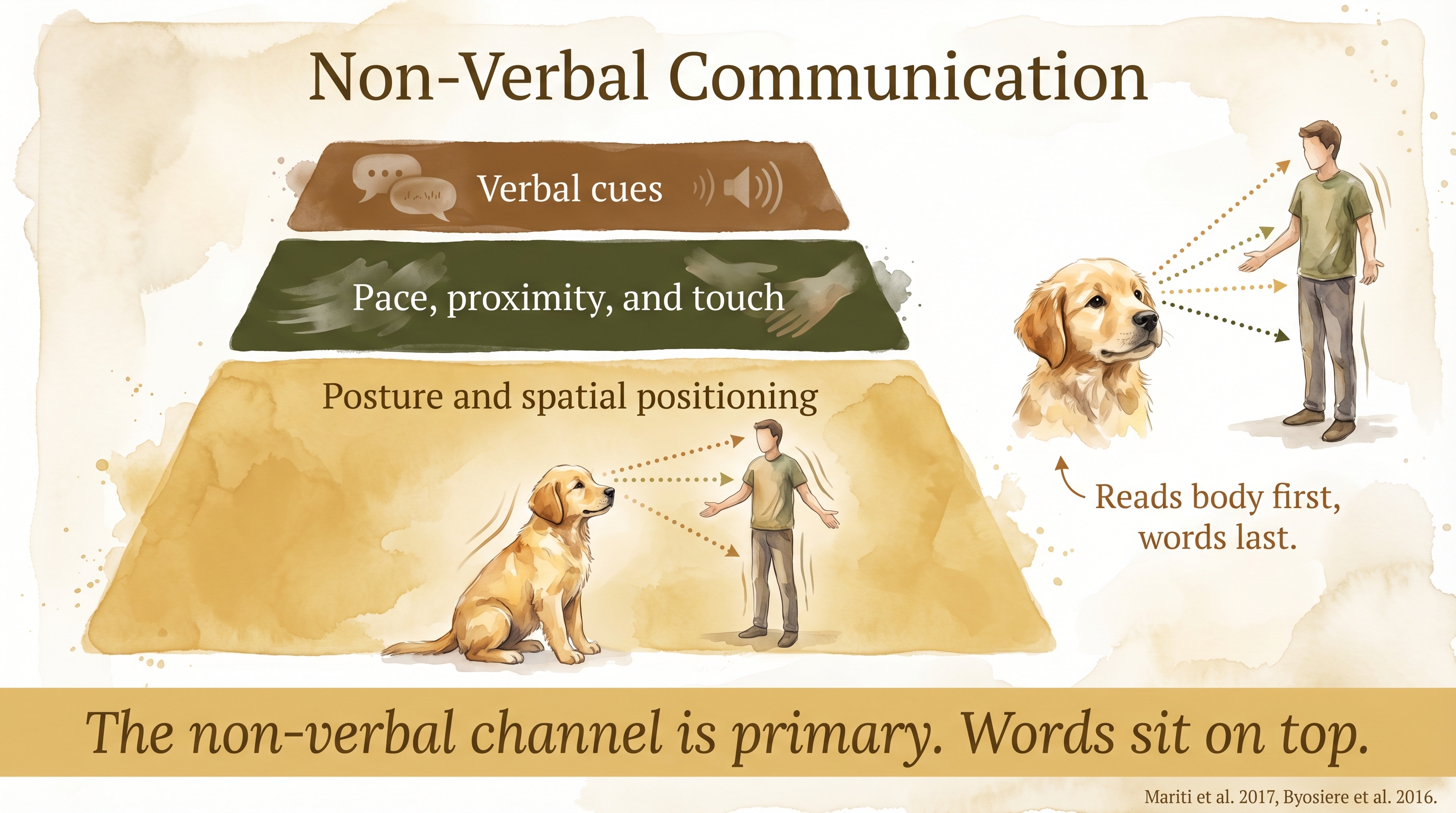
Puppies read posture, space, pace, and touch before words - the non-verbal channel is primary, and words sit on top of what the body already said.
Key Takeaways
- Puppies read bodies before they process words, which makes non-verbal communication the primary relationship channel.
- Domestic-dog communication research supports the importance of orientation, spatial placement, and subtle de-escalatory signaling.
- Words can be useful, but they sit on top of an older and more powerful body-based channel.
- Families usually improve communication most by making their movement, spacing, and pace clearer rather than by talking more.
The Evidence
This entry uses documented cross-species claim-level tags beyond the dedicated EvidenceBlocks below. Species and application scope should be checked during the next evidence-chain authoring pass.
This entry uses ambiguous claim-level tags beyond the dedicated EvidenceBlocks below. These tags mark claims where the literature remains unsettled or multiple interpretations coexist.
This entry uses mixed-evidence claim-level tags beyond the dedicated EvidenceBlocks below. These tags mark claims that combine documented findings with observed practice, heuristic application, or unresolved gaps.
- Mariti, C. et al. (2017)domestic dogs
Documented meaningful visual and social signaling in dogs, including the importance of interaction context and body-based behavior. - Byosiere, S. E. et al. (2016)domestic dogs
Showed that fine-grained body orientation within the play bow carries social information rather than functioning as random posture. - Canine communication literature summarized in SCR-110domestic dogs
Body orientation, approach angle, and spatial positioning are established communicative media in dogs.
- Fugazza, C. et al. (2018)domestic dogs
Showed that puppies can learn novel behavior through observation, reinforcing the importance of what demonstrator bodies are doing rather than only what humans say. - Calming-signals literature summarized in SCR-050domestic dogs
Supports the behavioral significance of subtle de-escalatory signaling in dog interaction.
- JB communication synthesisfamily-raised dogs
JB interprets the documented importance of body and space to mean that non-verbal communication is the primary language of the relationship, with verbal cues functioning as a later overlay.
No published puppy-development study has directly measured the relative weight of body-based and word-based cues in ordinary family-home communication over time.
The literature documents non-verbal cue importance, but it has not yet quantified which body variables families can most easily change to improve relationship clarity fastest.
SCR References
Sources
Byosiere, S. E., et al. (2016). Body orientation as a component of the play bow in domestic dogs (Canis lupus familiaris). Behavioural Processes, 125, 35-42.
Fugazza, C., Moesta, A., Pogany, A., & Miklosi, A. (2018). Social learning from conspecifics and humans in dog puppies. Scientific Reports, 8, 9257.
Mariti, C., et al. (2017). Analysis of social, non-social and human-directed behaviors in dogs. Ethology, 123(12), 1059-1067.
Rugaas, T. (2005). On Talking Terms with Dogs: Calming Signals. Dogwise.