Communication Through Presence
Compound evidence detail1 SCR / 2 parts
- Observed-JBthe ethological evidence that adult dogs deploy specific social signals with situational selectivity and brief contextual deployment (Abrantes, Bekoff, Mech) together with the Bray, MacLean et al. 2021 retriever puppy demonstration that canine attention to human gestural cues is biologically pre-loaded
- Heuristicthe JB application generalizing the dog signal-precision pattern into a universal social-signaling principle and the corollary claim that high-frequency human verbal praise categorically degrades communicative information in household contexts
Communication through presence means the adult teaches most powerfully by how it occupies space, regulates contact, and allows the puppy to orient toward it. That is an observed JB foundation built on documented canine communication and social-learning capacities, and it explains why some of the strongest instructions in the system are instructions not to do things. Observed-JB
What It Means
Most people think of communication as output. More words. More cues. More reassurance. More correction. Presence flips that. Presence treats communication as legibility. The question becomes whether the adult is clear enough, calm enough, and consistent enough that the puppy can organize itself around what is already there.
That is why so many classic JB lines sound almost negative: do not call constantly, do not wake the puppy up, do not keep leaning into the interaction, do not turn every quiet moment into a performance. Observed-JB These are not rules against affection. They are rules against channel noise. The puppy needs room to notice where the adult is, what the adult body is doing, and how the environment feels when the adult is calm inside it.
Presence also creates initiative. When the human stops over-managing every moment, the puppy gets to practice following, settling nearby, checking in, and reading the rhythm of the household. Observed-JB Those behaviors are not forced into existence one by one. They emerge because the social world becomes readable enough for the puppy to join.
The documented science beneath this is straightforward. Dogs read spatial and body cues. Puppies learn from observation. The stronger JB claim is the integration logic: restraint is often the most powerful communication because it preserves the signal value of the moments when the adult does act. That larger claim remains observed rather than trial-proven, which is why this entry carries the practitioner register.
Why It Matters for Your Dog
Families often communicate themselves into trouble. They over-call, over-praise, over-soothe, and over-explain. Observed-JB The puppy becomes surrounded by input yet oddly deprived of clarity. Communication through presence solves that by reducing the number of moving parts.
When a puppy enters a room and the adult simply continues moving calmly, that is information. Observed-JB When the adult pauses at a threshold and lets the puppy notice the pause, that is information. When the adult remains available without chasing the puppy through the room, that is information. These moments build a dog that tracks the household naturally instead of waiting to be activated by a command.
Mentorship depends on the adult being worth watching. Presence is what makes the adult watchable. The quieter and clearer the adult is, the easier it is for the puppy to take in the lesson without being crowded by performance.
Communication through presence is also emotionally protective. A constantly intrusive human can feel noisy and unpredictable to the puppy even when the human means well. Observed-JB A calm, available, restrained human is easier to trust, easier to follow, and easier to learn from.
The practical instruction is simple but demanding: say less, interrupt less, let the puppy notice more, and trust that clarity is often built by what you withhold as much as by what you deliver.
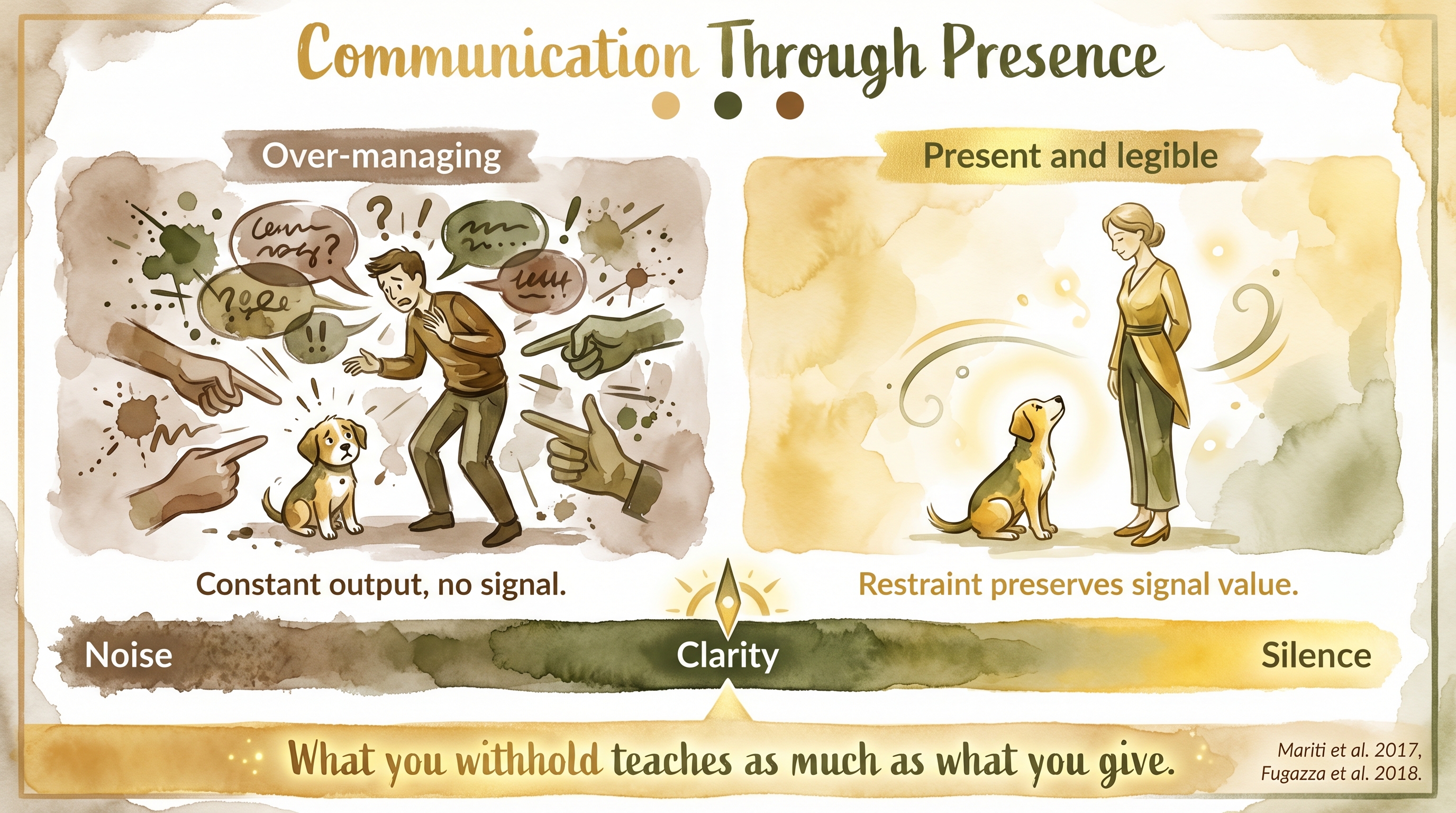
Restraint preserves signal value - what you withhold teaches as much as what you give, and puppies learn by reading the calm adult.
Key Takeaways
- Communication through presence teaches through clarity, calm availability, and spatial legibility rather than through constant output.
- JB observed that restraint often improves learning because it preserves the signal value of the moments when the adult does intervene.
- Puppies can follow, settle, and orient more naturally when the adult stops over-managing every second of the interaction.
- Families often improve communication by doing less with more consistency, not by adding more words and more prompts.
The Evidence
- Mariti, C. et al. (2017)domestic dogs
Documented that dogs use context-sensitive visual social behavior, including orientation and interaction pattern, as meaningful information. - Byosiere, S. E. et al. (2016)domestic dogs
Showed that subtle body orientation features can carry social meaning in canine interaction. - Canine communication literature summarized in SCR-110domestic dogs
Supports the role of body orientation, spatial positioning, and approach angle as communicative signals.
- Fugazza, C. et al. (2018)domestic dogs
Showed that puppies learn from observation, which helps explain why adult presence can teach even in the absence of explicit instruction.
- JB program observationfamily-raised Golden Retrievers
JB consistently observes that puppies given more room to watch, orient, and follow within a structured household become less prompt-dependent and more naturally legible in their behavior. - JB restraint synthesisfamily-raised dogs
The program treats human restraint as a communication tool because reduced chatter and reduced intrusion appear to increase signal clarity for puppies.
No published trial has directly compared a high-intervention communication style against a restrained presence-based style in otherwise similar puppy-rearing environments.
The literature documents canine sensitivity to body and space, but it has not yet quantified how much human verbal reduction improves developmental outcomes in family puppies.
SCR References
Sources
Byosiere, S. E., et al. (2016). Body orientation as a component of the play bow in domestic dogs (Canis lupus familiaris). Behavioural Processes, 125, 35-42.
Fugazza, C., Moesta, A., Pogany, A., & Miklosi, A. (2018). Social learning from conspecifics and humans in dog puppies. Scientific Reports, 8, 9257.
Mariti, C., et al. (2017). Analysis of social, non-social and human-directed behaviors in dogs. Ethology, 123(12), 1059-1067.
Rugaas, T. (2005). On Talking Terms with Dogs: Calming Signals. Dogwise.