Signal Precision as a Foundation
Compound evidence detail1 SCR / 2 parts
- Observed-JBthe ethological evidence that adult dogs deploy specific social signals with situational selectivity and brief contextual deployment (Abrantes, Bekoff, Mech) together with the Bray, MacLean et al. 2021 retriever puppy demonstration that canine attention to human gestural cues is biologically pre-loaded
- Heuristicthe JB application generalizing the dog signal-precision pattern into a universal social-signaling principle and the corollary claim that high-frequency human verbal praise categorically degrades communicative information in household contexts
Natural social systems do not communicate by flooding the channel. They communicate by contrast - brief, contextual, well-timed signals that stand out because they are not happening constantly, which is why signal precision functions as a learning foundation rather than only as a philosophical preference. Documented
What It Means
Dogs live inside a communication world built from timing, orientation, proximity, touch, pause, and release. The documented literature shows that domestic dogs use body orientation, approach angle, and other subtle visual cues as meaningful signals, and that de-escalatory social behavior can alter the direction of an interaction without force or drama. Documented The common thread is selectivity. Signals carry information because they arrive at the right moment with the right intensity.
The simplest analogy is punctuation. A period matters because it is not after every single word. An exclamation point matters because it is rare. If every line ends with shouting, nothing stands out. Signal precision works the same way. A brief body block communicates because the body is not always blocking. Quiet disengagement communicates because engagement was available a moment earlier. Calm praise communicates because it is not sprayed indiscriminately over every breath the puppy takes.
This matters especially in a species that is already built for social learning. Documented Puppies pay attention to what adults highlight. When the adult uses sparse, legible feedback, the puppy can distinguish ordinary background from meaningful social information. When the adult produces constant verbal correction, constant praise, constant touching, and constant excitement, the signal-to-noise ratio collapses. The puppy still receives input, but the channel becomes muddy.
The claim that dogs use social signals contextually is well grounded. The stronger JB contrast - that humans routinely flood the channel and therefore weaken meaning - belongs partly to program observation and partly to ethological interpretation. Mixed Evidence That is why this entry stays mixed. The documented foundation is real. The JB application is an observed pattern explained through that foundation.
Why It Matters for Your Dog
Families often assume better communication means more communication. In puppy raising, the opposite is often true. Better communication usually means fewer, clearer moments that the puppy can actually sort and store.
This is one reason JB looks quiet from the outside. The human does not narrate every choice. The human does not praise continuously. The human does not issue a stream of backup commands when the first one does not land. Instead, the adult waits, positions, interrupts selectively, and lets the moment carry its own weight. The puppy learns which moments matter because not every moment is treated as a headline. Mixed Evidence
Indirect Correction depends on signal precision. A spatial block or calm withdrawal only works if it arrives as information rather than as constant ambient pressure.
Signal precision also explains why Mentorship works better in a calm household than in a loud one. Mixed Evidence Observation requires legibility. The more cluttered the channel becomes, the harder it is for the puppy to extract the pattern from the performance.
The practical takeaway is not silence for its own sake. It is informational discipline. Use fewer signals, make them cleaner, and give the puppy enough space to notice what you just said without immediately drowning it in something else.
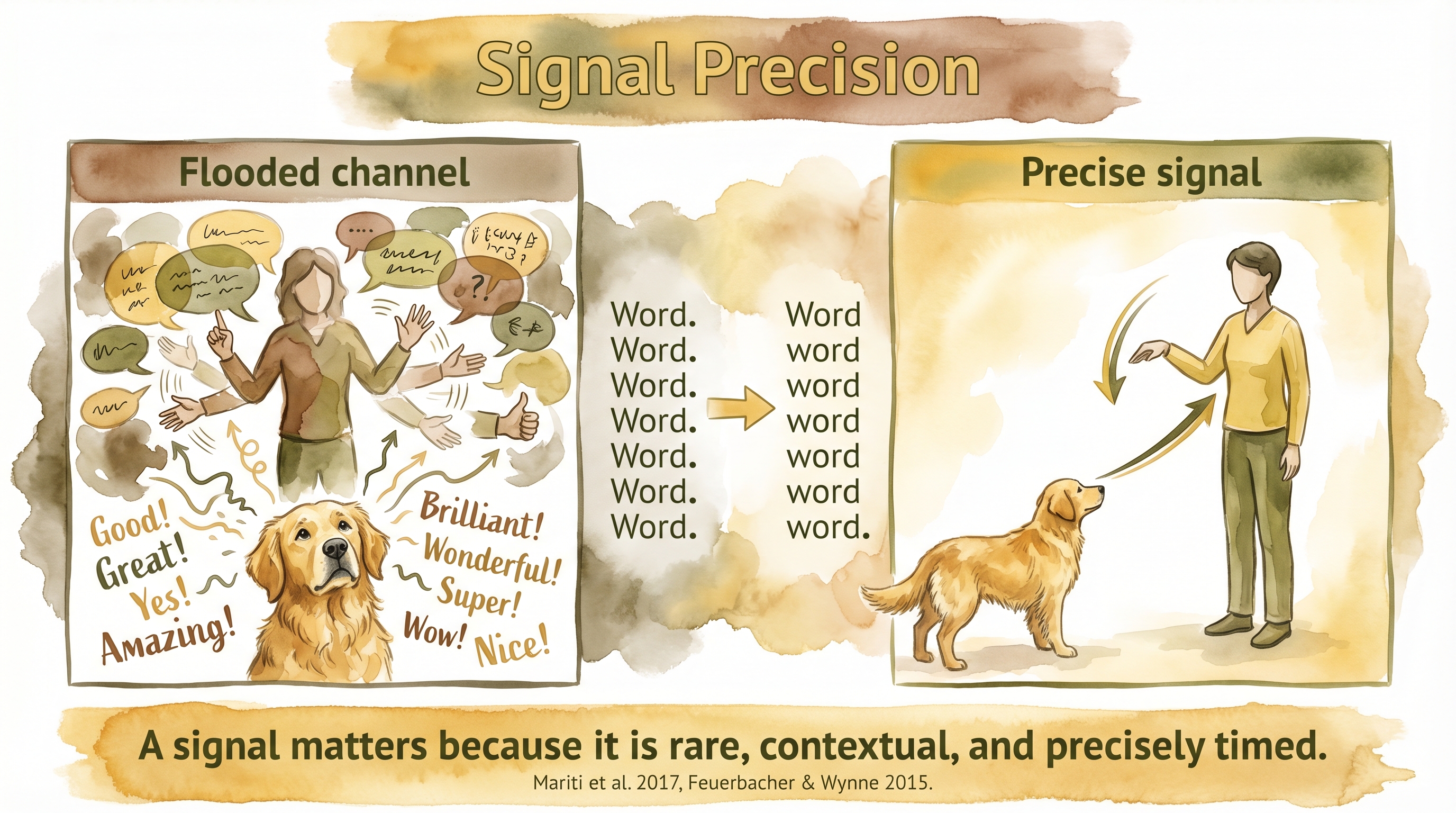
Natural systems communicate through contrast - a signal matters because it is rare, contextual, and precisely timed, not because it is constant.
Key Takeaways
- Dogs are built to read subtle, contextual signals, which is why timing and selectivity matter so much in social communication.
- Signal precision works like punctuation: information carries more weight when it is not repeated constantly.
- The documented literature supports the importance of body orientation, de-escalation, and social legibility. The stronger JB critique of human channel-flooding is an observed application of that foundation.
- Families usually improve communication by becoming clearer and quieter, not by becoming more talkative.
The Evidence
This entry uses mixed-evidence claim-level tags beyond the dedicated EvidenceBlocks below. These tags mark claims that combine documented findings with observed practice, heuristic application, or unresolved gaps.
- Mariti, C. et al. (2017)domestic dogs
Documented that dogs use visual social behavior, orientation, and interaction context in structured communicative ways rather than as random output. - Byosiere, S. E. et al. (2016)domestic dogs
Analyzed body orientation inside the play bow, supporting the claim that fine-grained posture carries social information. - Fugazza, C. et al. (2018)domestic dogs
Showed that puppies attend closely enough to demonstrator behavior for observation to drive novel behavior acquisition, reinforcing the importance of clear social signaling.
- Calming-signals literature summarized in SCR-050domestic dogs
Pilot canine data support subtle de-escalatory signals as meaningful social behavior in real dog-dog interaction. - Canine communication literature summarized in SCR-110domestic dogs
Body orientation, approach angle, and spatial positioning function as communicative signals rather than as neutral movement.
- JB signal-precision synthesisfamily-raised dogs
The JB argument is that humans often weaken signal meaning by flooding the interaction with continuous verbal and emotional output, making selective social feedback harder for puppies to parse.
No published study directly compares low-frequency, high-precision social feedback against constant verbal prompting in a family-dog developmental environment.
The literature documents communicative subtlety in dogs, but it has not quantified the exact threshold at which human feedback frequency begins to reduce signal discrimination for puppies.
SCR References
Sources
Byosiere, S. E., et al. (2016). Body orientation as a component of the play bow in domestic dogs (Canis lupus familiaris). Behavioural Processes, 125, 35-42.
Fugazza, C., Moesta, A., Pogany, A., & Miklosi, A. (2018). Social learning from conspecifics and humans in dog puppies. Scientific Reports, 8, 9257.
Mariti, C., et al. (2017). Analysis of social, non-social and human-directed behaviors in dogs. Ethology, 123(12), 1059-1067.
Rugaas, T. (2005). On Talking Terms with Dogs: Calming Signals. Dogwise.