The Progressive Deepening
Compound evidence detail1 SCR / 2 parts
- Documentedthe cross-species behavioral principle that parasympathetic-dominant autonomic states support social engagement, with direct canine HRV evidence (Berg 2026, Wormald 2017, Koskela 2024)
- Ambiguousthe polyvagal-theory-specific neuroanatomical mechanism, with the Grossman 2026 critique and Porges 2026 rebuttal active in current literature
The seven Foundations are arranged in a sequence for a reason. They move from what the puppy is, to how the puppy learns, to the state in which that learning can happen, to the language that carries information in that state, to what happens when interruption becomes necessary, to how much interruption can be avoided through setup, and finally to the body that houses all of it. JB calls that order a progressive deepening. Heuristic
What It Means
Foundation 1 begins with development because everything else is downstream of what kind of young animal the puppy actually is. If you do not know what capacities are open, fragile, or still forming, every later conversation gets distorted. Foundation 2 then explains how that developing animal takes in information: through observation and social learning more than through formal instruction alone. Heuristic
Foundation 3 deepens the picture by adding the emotional and autonomic substrate. Now the question is not only how the puppy learns, but in what state learning is most available. Heuristic Foundation 4 answers the next logical question: if the puppy learns socially and best in regulated states, what channel is doing most of the communicating? The answer is body, space, pace, and presence more than words.
Foundation 5 arrives only after that groundwork because correction without prior development, prior learning mechanism, prior calmness, and prior communication channel is impossible to understand properly. Foundation 6 then asks the economical question: how often can correction be avoided entirely through environmental design? Foundation 7 closes the sequence by reminding us that the whole structure is being carried by a body whose health and physiologic load can support or undermine everything that came before. Heuristic
The sequence is therefore not ornamental. It is argumentative. Each Foundation depends on the one before it to make full sense. That dependence is the progressive deepening.
Why It Matters for Your Dog
Families often enter dog raising through whichever problem feels loudest. Observed-JB Mouthing. Jumping. Reactivity. Sleep disruption. But the progressive-deepening model helps them back up to the right layer. If the dog is dysregulated, the answer may not begin at correction. If the dog is not reading the household, the answer may not begin at commands. If the body is strained, the answer may not begin at behavior tactics alone.
This sequence also protects against shallow imitation of JB language. A family can repeat words like calmness, leadership, and prevention without really inhabiting the order that makes those ideas coherent. The progressive-deepening model slows that down and asks whether the earlier layers are actually in place.
Structured Leadership in this architecture is not the first move. It becomes clean and comprehensible only after development, social learning, calmness, and communication have already been understood.
There is a practical kindness in that order too. It tells families where to start when overwhelmed. Start lower. Start earlier. Start more foundationally. The deeper the layer you repair, the more of the upper layers often begin to organize themselves. Observed-JB
The takeaway is simple: the sequence is part of the philosophy, not just the table of contents.
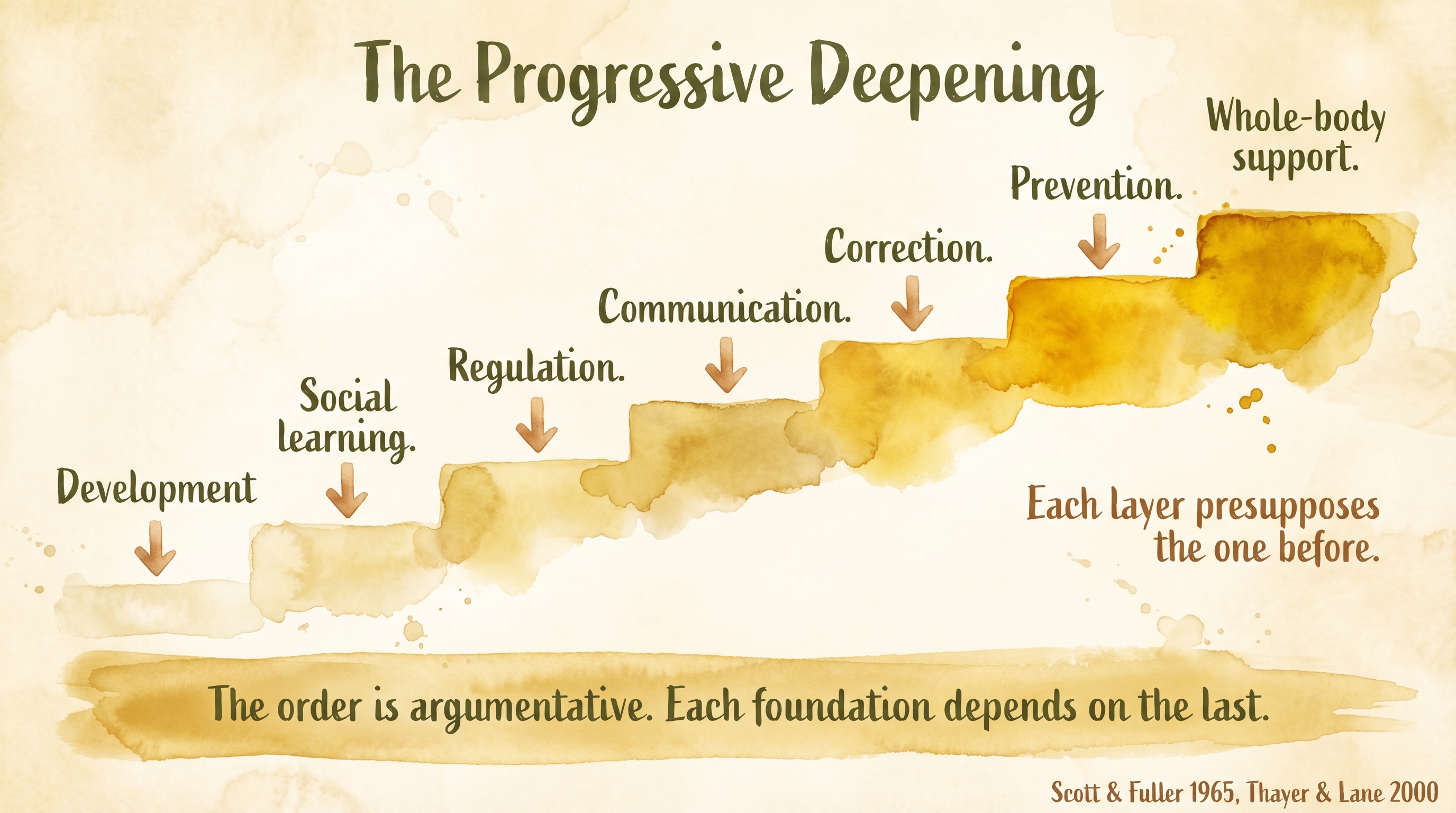
The seven Foundations are arranged sequentially, each dependent on earlier ones - development, social learning, regulation, communication, correction, prevention, whole-body support.
Key Takeaways
- The seven Foundations are arranged in an intentional order, and each later foundation depends on the earlier ones to make full sense.
- The sequence moves from development, to learning, to regulation, to communication, to correction, to prevention, to whole-body support.
- This ordering helps families diagnose problems at the right level instead of jumping straight to surface tactics.
- The progressive-deepening model is itself an interpretive JB synthesis built from documented component science.
The Evidence
This entry uses observed claim-level tags beyond the dedicated EvidenceBlocks below. These tags mark JB program observation or practice-derived claims that need dedicated EvidenceBlock coverage in a later content pass.
- Scott, J. P. & Fuller, J. L. (1965)domestic dogs
Anchor the developmental starting point. - Fugazza, C. et al. (2018)domestic dogs
Anchor the social-learning layer. - Thayer, J. F. & Lane, R. D. (2000) and canine autonomic workmultiple species and domestic dogs
Anchor the regulation layer. - Mariti, C. et al. (2017)domestic dogs
Anchor the communication layer by documenting meaningful body-based signaling. - Beerda, B. et al. (1999)domestic dogs
Anchor the whole-body cost layer by showing that chronic stress reaches beyond behavior.
- JB architectural synthesisfamily-raised dogs
JB interprets the documented component findings as a progression in which each later layer presupposes the earlier ones, creating a deepening rather than a list.
No published study has tested whether teaching families the Foundations in this specific sequence improves implementation or outcomes compared with teaching the same components in a different order.
The system-level ordering is philosophically coherent, but the field has not experimentally mapped which entry point into the sequence produces the strongest real-world improvement for struggling households.
SCR References
Sources
Beerda, B., et al. (1999). Chronic stress in dogs subjected to social and spatial restriction. II. Hormonal and immunological responses. Physiology & Behavior.
Fugazza, C., Moesta, A., Pogany, A., & Miklosi, A. (2018). Social learning from conspecifics and humans in dog puppies. Scientific Reports, 8, 9257.
Mariti, C., et al. (2017). Analysis of social, non-social and human-directed behaviors in dogs. Ethology, 123(12), 1059-1067.
Scott, J. P. & Fuller, J. L. (1965). Genetics and the Social Behavior of the Dog. University of Chicago Press.
Thayer, J. F., & Lane, R. D. (2000). A model of neurovisceral integration in emotion regulation and dysregulation. Journal of Affective Disorders, 61(3), 201-216.