The Developmental Baseline
A puppy is not a small adult dog. Its nervous system, sensory capabilities, and social cognition develop on a timeline shaped by millions of years of mammalian evolution, and what happens during that timeline is not neutral - it is building the neural architecture the dog will carry for life. This is the first Foundation of Just Behaving: honoring the developmental baseline is the prerequisite for every Pillar that follows. Documented
What It Means
Every mammalian species develops on a schedule. The schedule is not arbitrary and it is not flexible. It reflects the deep evolutionary history of the species - the pressures that shaped which capacities come online first, which windows open and close, and which experiences carry disproportionate weight at which moments. In domestic dogs, that schedule has been studied since the 1960s, when Scott and Fuller published their foundational work on critical periods in canine behavioral development. Documented Their research established that puppies pass through distinct developmental stages - neonatal, transitional, socialization, juvenile - and that the experiences a puppy has during these stages shape behavioral trajectories in ways that later intervention cannot fully reverse.
The word "critical" in developmental biology is not casual emphasis. A critical period (more precisely termed a sensitive period in contemporary literature) is a window during which the nervous system is unusually receptive to specific types of input. Documented The concept is documented across vertebrate species - in birds, primates, and mammals broadly (Knudsen, 2004) - and the neurobiological mechanisms are conserved, though the specific windows and modalities vary by species. Think of it the way a photographer thinks about exposure: during the window, the film is sensitive. Light writes the image. After the window closes, the film hardens. You can still project light onto it, but it does not take the impression the same way. In domestic dogs specifically, the socialization window - roughly three to fourteen weeks, with gradual closure rather than a sharp cutoff - is when social information writes most deeply into the developing brain.
During the first two weeks of life, the neonatal period, a puppy navigates entirely by scent and touch. Its eyes are sealed. Its ear canals are closed. The world is warmth, milk, and the smell of its mother. The nervous system is handling the basics: thermoregulation, feeding reflexes, rudimentary stress responses. Even at this stage, the environment matters. Gentle handling during the neonatal period has been associated with improved stress tolerance later in life - the nervous system is already absorbing information about whether the world is safe. Documented
By week three, the eyes open and the ears unseal. The puppy enters the socialization period, and the brain becomes extraordinarily receptive to social information. Every interaction during this window is either building the behavioral architecture you want in the adult or laying pathways you will struggle to modify later. This is not a JB interpretation - it is the consensus position across canine developmental science. Howell (2015) confirms that the socialization window closes gradually, making the quality of early experiences progressively more permanent as the window narrows. Documented The early-handling literature - Harvey et al. (2016, 2017), Serpell and Duffy (2016), Puurunen et al. (2020), Guardini et al. (2017) - identifies early developmental environment as one of the strongest prevention-relevant variables in later companion-dog behavior.
What makes this a Foundation rather than just a scientific fact is the implication for everything that comes after. If the developmental timeline is real - and the evidence that it is real is among the strongest in all of canine behavioral science - then any approach to raising a dog that does not begin by respecting that timeline is working against biology. You cannot mentor a puppy effectively if you do not understand which stage it is in. You cannot prevent behavioral problems if you do not know when the nervous system is most receptive to forming them. You cannot build calmness as a baseline if you import chaos during the window when the puppy is literally absorbing its emotional defaults.
The developmental baseline is not one consideration among many. It is the ground floor. The Pillars stand on it.
Why It Matters for Your Dog
This Foundation has a direct, practical consequence that families encounter on the day they bring a puppy home: the developmental work has already been happening for weeks before the puppy arrives. Documented
A Just Behaving puppy spends approximately twelve weeks in a structured breeder environment before going home. During those twelve weeks, the breeder's environment is the curriculum. Adult dogs mentor the puppy. The environment is calm. Structure comes from the pack. Prevention is environmental - behaviors that would later need correction are never initiated in the first place. Corrections, when they happen, are natural, brief, and canine. The puppy is learning the world in a language it was born to understand.
The developmental baseline is where Prevention begins. A behavior never initiated during the sensitive period is a neural pathway never built. The breeder period is not preparation for Prevention - it is Prevention in its purest form, operating through the environment before the puppy has any concept of rules.
The family's job is to continue what the breeder started - not to start over. This is the soft landing: the puppy arrives into a home that already functions with calm, structure, and consistent boundaries. The grammar shifts slightly from canine to human, but the developmental language stays the same. When a family understands the developmental baseline, they understand why the first weeks at home are not about "training" the puppy but about maintaining the developmental trajectory the breeder established.
The alternative - what happens when the developmental baseline is ignored - is equally instructive. A puppy placed into a chaotic environment during the socialization window absorbs chaos as its baseline. High-pitched excitement, constant handling, visitors encouraged to hold and stimulate the puppy, arousal treated as the appropriate response to a new family member - this is not bonding. It is overwriting the calm patterns the puppy absorbed during the breeder period with arousal patterns that will persist. The puppy's nervous system, shaped over twelve weeks in a calm environment, encounters a level of stimulation it has no framework to process. JB consistently observes that the developmental foundation cracks before the family even recognizes it was there.
Understanding the developmental baseline changes the question families ask. Instead of "how do I train my puppy?" the question becomes "how do I honor what my puppy's nervous system needs right now?" That question leads to different answers, and those answers lead to a fundamentally different adult dog.
Mentorship depends on the developmental baseline because social learning capacity itself develops on the timeline. A puppy in the socialization period is neurologically primed to learn from observation - watching calm adults and absorbing their patterns. A puppy past the window can still learn, but the impression is not written as deeply. The twelve-week breeder period is when mentorship has its highest leverage.
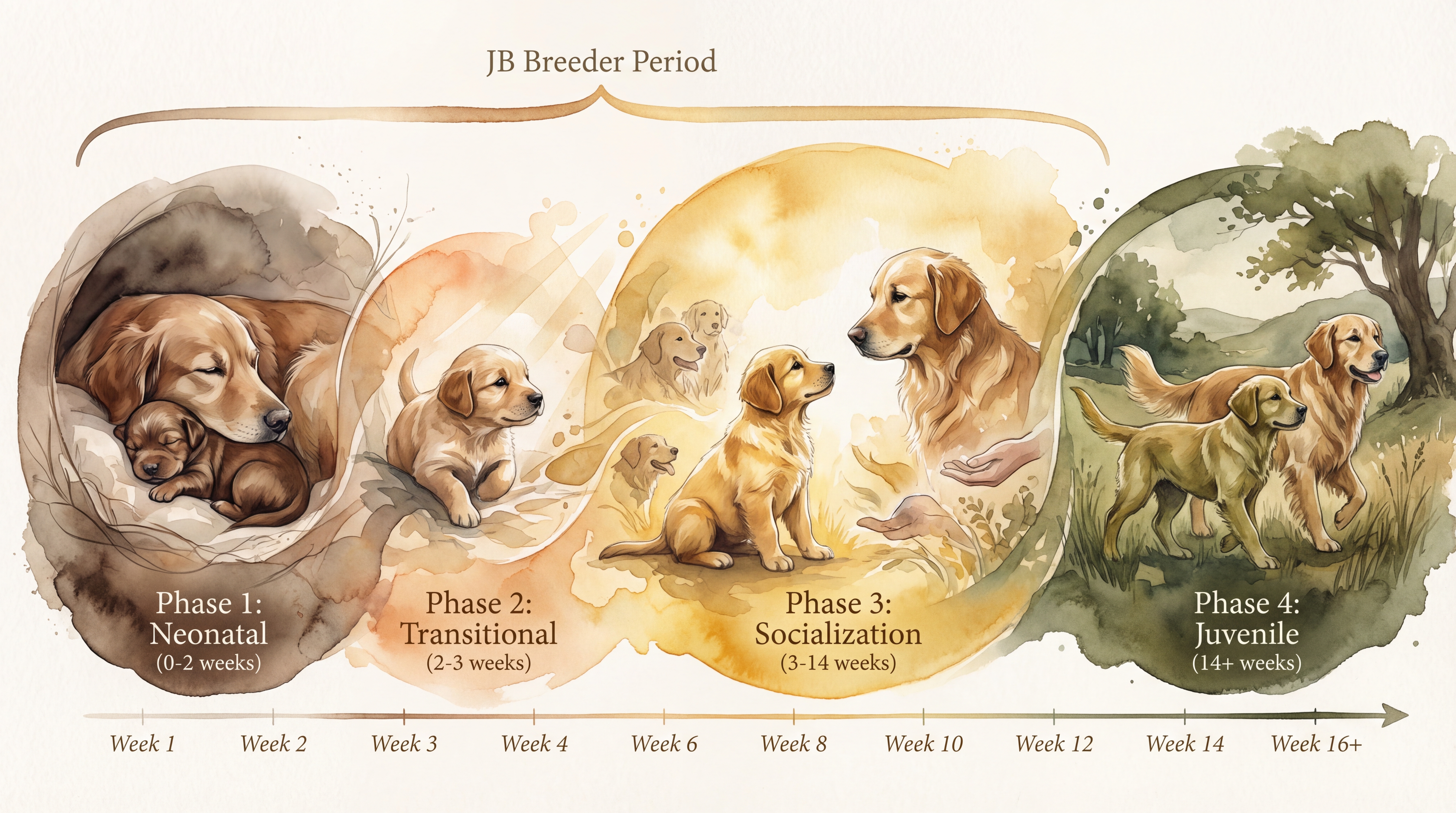
Development runs on a biologically fixed timeline with sensitive periods - early experiences build neural architecture that later intervention cannot fully reverse.
Key Takeaways
- A puppy is not a small adult dog - its nervous system develops on a biological timeline that determines when experiences carry the most weight, and that timeline is not flexible.
- The socialization window (roughly 3 to 14 weeks) is when the brain is most receptive to social information. Experiences during this period build the neural architecture the dog carries for life.
- Just Behaving retains puppies to approximately 12 weeks because the breeder period is when the foundational developmental work happens - mentorship, calm environment, prevention through structure.
- Honoring the developmental baseline is the prerequisite for every Pillar. Prevention, Mentorship, Calmness, Structured Leadership, and Indirect Correction all depend on a nervous system that was respected during its most sensitive period.
The Evidence
The developmental baseline rests on some of the most robust evidence in canine behavioral science. The foundational research is decades old, has been replicated and extended across multiple species, and represents a consensus position rather than an emerging or contested finding.
- Scott, J. P. & Fuller, J. L. (1965)domestic dogs
Genetics and the Social Behavior of the Dog established the developmental period framework (neonatal, transitional, socialization, juvenile) that remains the standard classification in canine behavioral science. Their work demonstrated that experiences during specific developmental windows shape behavioral trajectories in ways that later intervention cannot fully reverse. - Howell, T. J. et al. (2015)domestic dogs
Confirmed that the socialization window closes gradually rather than abruptly, making the quality of early experiences progressively more permanent as the window narrows. This gradual closure model has replaced the earlier all-or-nothing conception of critical periods.
- Harvey, N. D. et al. (2016, 2017)domestic dogs
Identified associations between early developmental environment quality and later behavioral outcomes in companion dogs, supporting the thesis that the breeder period is a high-leverage intervention window. - Serpell, J. A. & Duffy, D. L. (2016)domestic dogs
Demonstrated that early environmental variables predict later companion-dog behavioral profiles, reinforcing the developmental baseline as a causal factor rather than merely a correlational one. - Puurunen, J. et al. (2020)domestic dogs
Extended the early-environment findings to a large Finnish cohort, identifying developmental environment as one of the strongest prevention-relevant variables in later companion-dog behavior. - Guardini, G. et al. (2017)domestic dogs
Documented associations between early handling protocols and behavioral outcomes, contributing to the evidence base that the breeder-period environment has lasting effects on the developing nervous system.
- Knudsen, E. I. (2004)multiple species (birds, humans, mammals)
Reviewed sensitive periods across species, establishing the neurobiological mechanisms by which early experience has disproportionate influence on neural circuit formation. The principles of sensitive-period plasticity are conserved across vertebrate species, though the specific windows and modalities vary.
No published study has directly compared behavioral outcomes of puppies retained in structured breeder environments to 12 weeks versus puppies placed at 8 weeks into equivalently structured family homes. The JB practice of 12-week retention is supported by the developmental science on sensitive periods, but the specific claim that breeder retention produces superior outcomes to early placement into a high-quality family environment has not been isolated in a controlled study.
The interaction between breeder-environment quality and placement timing remains understudied. Most early-handling research treats the environment as a single variable rather than decomposing it into the specific elements (adult-dog mentorship, calm baseline, prevention-structured space) that JB identifies as the active ingredients.
SCR References
Sources
Scott, J. P. & Fuller, J. L. (1965). Genetics and the Social Behavior of the Dog. University of Chicago Press.
Howell, T. J., King, T., & Bennett, P. C. (2015). Puppy parties and beyond: The role of early age socialization practices on adult dog behavior. Veterinary Medicine: Research and Reports, 6, 143-153. https://doi.org/10.2147/VMRR.S62081
Harvey, N. D., Craigon, P. J., Brindle, S. A., England, G. C. W., & Asher, L. (2016). Social rearing environment influences dog behavioral development. Journal of Veterinary Behavior, 16, 13-21. https://doi.org/10.1016/j.jveb.2016.09.004
Harvey, N. D., Craigon, P. J., Sommerville, R., McMillan, C., Green, M., England, G. C. W., & Asher, L. (2017). Test-retest reliability and predictive validity of the Lincoln Infant Puppy Assessment Test (LIPAT). Veterinary Record, 181(22), 591. https://doi.org/10.1136/vr.104285
Serpell, J. A. & Duffy, D. L. (2016). Aspects of juvenile and adolescent environment predict aggression and fear in 12-month-old guide dogs. Frontiers in Veterinary Science, 3, 49. https://doi.org/10.3389/fvets.2016.00049
Puurunen, J., Tiira, K., Vapalahti, K., Lehtonen, M., Hanhineva, K., & Lohi, H. (2020). Fearful dogs have increased plasma glutamine and gamma-glutamyl glutamine. Scientific Reports, 10, 11077. https://doi.org/10.1038/s41598-020-68069-0
Guardini, G., Mariti, C., Bowen, J., Fatjo, J., Ruzzante, S., Kaminski, J., & Gazzano, A. (2017). Influence of morning maternal care on the behavioural responses of 8-week-old Beagle puppies to new environmental and social stimuli. Applied Animal Behaviour Science, 181, 137-144. https://doi.org/10.1016/j.applaam.2016.05.006
Knudsen, E. I. (2004). Sensitive periods in the development of the brain and behavior. Journal of Cognitive Neuroscience, 16(8), 1412-1425. https://doi.org/10.1162/0898929042304796