How the Foundations Wire Together
Compound evidence detail1 SCR / 2 parts
- Documentedthe cross-species behavioral principle that parasympathetic-dominant autonomic states support social engagement, with direct canine HRV evidence (Berg 2026, Wormald 2017, Koskela 2024)
- Ambiguousthe polyvagal-theory-specific neuroanatomical mechanism, with the Grossman 2026 critique and Porges 2026 rebuttal active in current literature
The seven Foundations are not seven separate arguments laid next to each other. They form a system. Each Foundation enables, protects, or sharpens the others, which is why understanding the integration logic matters almost as much as understanding any single foundation on its own. Heuristic
What It Means
Foundation 1 establishes what kind of young animal a puppy is. Heuristic Foundation 2 explains how that animal learns. Foundation 3 identifies the state in which that learning works best. Foundation 4 names the primary communication channel inside that state. Foundation 5 defines what happens when interruption becomes necessary. Foundation 6 decides how much interruption can be avoided through setup. Foundation 7 reminds us that all of this is happening through a body with real biological limits and needs.
That sequence produces a many-to-many map, not a one-foundation-to-one-pillar map. Calmness enables Mentorship because social learning works best in regulated states. Structured Leadership enables Prevention because someone has to define and maintain the environment the puppy is learning inside. Indirect Correction preserves what Calmness and Mentorship built by keeping the puppy in relationship while information is delivered. Prevention reduces the need for Correction by making fewer bad pathways available to begin with. The body-behavior foundation stabilizes all of them because none of the other six can operate well through chronic physical strain. Heuristic
The right analogy is wiring in a house. You can describe the kitchen circuit, the hallway circuit, and the living-room circuit separately, but the house only functions when they are understood as part of one electrical system. The Foundations work the same way. Study any one of them alone and you learn something real. Documented Study how they conduct into one another and the system becomes legible.
This entry is marked heuristic because the wiring logic is interpretive synthesis. The component pieces are heavily documented. The system-level map is the JB reading of how those pieces belong together.
Why It Matters for Your Dog
Families often encounter the JB philosophy one pillar at a time. Calmness makes sense. Prevention makes sense. Mentorship makes sense. But real life with a puppy never arrives one pillar at a time. The puppy is developing, learning, communicating, regulating, getting corrected, living in an environment, and doing all of that through a body at the same moment.
That is why partial adoption creates partial results. A family can love the Calmness idea and still struggle if it ignores Prevention. A family can admire Mentorship and still undermine it if the household environment is chaotic. A family can want gentle correction and still fail if the relationship is too noisy for the puppy to read the signal. Heuristic
Mentorship is the medium through which the rest of the system becomes visible. The adult demonstrates Calmness, embodies Structure, avoids inviting bad repetitions, and keeps correction proportional when interruption is needed.
The integration logic also makes the philosophy more forgiving, not less. It reminds families that a problem in one area may be supported by another area. An over-aroused puppy may need calmer companionship, tighter setup, more rest, and less verbal clutter all at once. Heuristic The system invites better diagnosis because it refuses to isolate what is actually connected.
The practical takeaway is to think in webs instead of silos. If one part of the system is struggling, look for the neighboring wires.
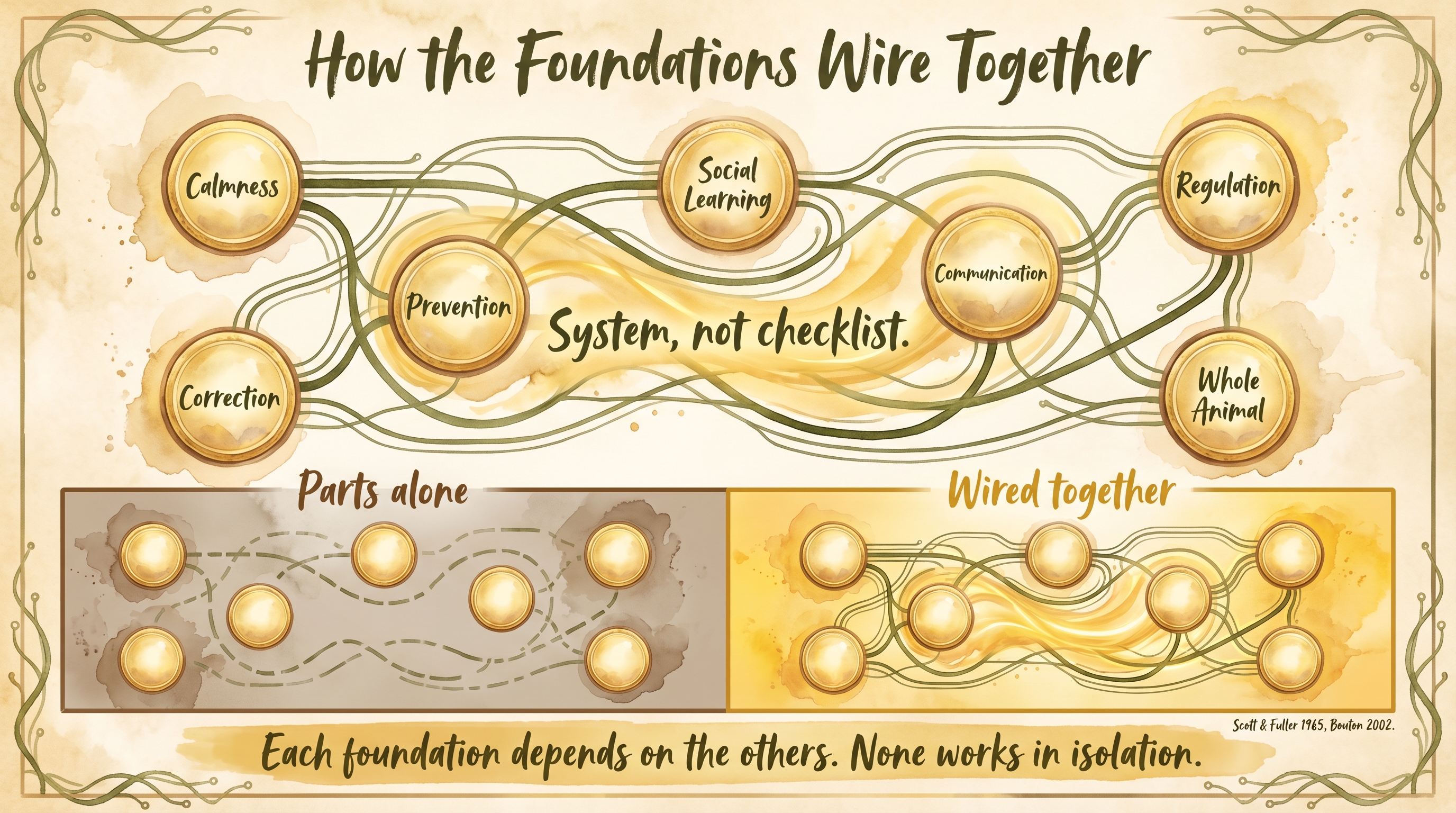
The seven Foundations form a connected system where each depends on the others - calmness enables social learning, structure enables prevention, correction preserves relationship.
Key Takeaways
- The seven Foundations form a system in which each one enables, protects, or strengthens the others.
- The component science is often documented, while the full wiring map is a JB interpretive synthesis of how those pieces fit together.
- Families get the best results when they think in connected patterns rather than treating calmness, prevention, communication, and health as unrelated projects.
- Partial adoption often creates partial results because the pillars draw strength from multiple foundations at once.
The Evidence
- Scott, J. P. & Fuller, J. L. (1965)domestic dogs
Established developmental periods, providing the starting point for the whole system. - Fugazza, C. et al. (2018)domestic dogs
Documented early social learning, providing the mechanism beneath mentorship. - Thayer, J. F. & Lane, R. D. (2000) and canine autonomic workmultiple species and domestic dogs
Support the role of regulated state in learning and social engagement. - Bouton, M. E. (2002, 2004) and Hebb, D. O. (1949)multiple species
Provide the strongest learning-and-prevention backbone for why setup matters. - Beerda, B. et al. (1999) and Kulka, M. et al. (2026)domestic dogs
Show that chronic stress has measurable body costs, anchoring the whole-animal foundation.
- JB foundations synthesisfamily-raised dogs
JB interprets the documented component findings as a connected system in which calmness, social learning, communication, correction, prevention, and whole-body health mutually reinforce one another.
No published intervention study has tested the full JB multi-foundation system as a package against alternative puppy-raising systems with comparable outcome tracking.
The literature documents many component effects, but it does not yet tell us which foundation failures create the biggest cascade effects when multiple parts of the system are weak at once.
SCR References
Sources
Beerda, B., et al. (1999). Chronic stress in dogs subjected to social and spatial restriction. II. Hormonal and immunological responses. Physiology & Behavior.
Bouton, M. E. (2002). Context, ambiguity, and unlearning: Sources of relapse after behavioral extinction. Biological Psychiatry, 52(10), 976-986.
Fugazza, C., Moesta, A., Pogany, A., & Miklosi, A. (2018). Social learning from conspecifics and humans in dog puppies. Scientific Reports, 8, 9257.
Hebb, D. O. (1949). The Organization of Behavior. Wiley.
Kulka, M., et al. (2026). Stress-related immunomodulation of canine lymphocyte responses and hematologic profiles. International Journal of Molecular Sciences.
Scott, J. P. & Fuller, J. L. (1965). Genetics and the Social Behavior of the Dog. University of Chicago Press.
Thayer, J. F., & Lane, R. D. (2000). A model of neurovisceral integration in emotion regulation and dysregulation. Journal of Affective Disorders, 61(3), 201-216.