The Body-Behavior Connection
Compound evidence detail1 SCR / 2 parts
- Documentedthe canine telomere-shortening evidence under documented chronic stressors such as kenneling, shelter conditions, low activity, and large group housing (Dutra 2025, N=250)
- Heuristicthe JB extrapolation that chronic household excitability produces equivalent telomere shortening to documented institutional stressors and reduces canine lifespan
The body-behavior connection is the reminder that behavior does not happen in abstraction. It happens through a nervous system housed in a body with immune demands, gastrointestinal signaling, inflammatory burden, sleep needs, and developmental physiology, which is why JB treats physical wellness as a behavioral prerequisite rather than as a separate department. Heuristic
What It Means
A dog that does not feel well rarely behaves as though nothing is wrong. Mixed Evidence That is the obvious part. The deeper point is that the mechanisms linking body and behavior extend beyond visible discomfort. Chronic stress modulates immune function. Illness alters energy, recovery, and tolerance. Gastrointestinal state influences signaling through the gut-brain axis. Sleep quality affects learning and emotional regulation. These are not parallel stories. They are one story told at different levels.
The strongest direct canine evidence in this Foundation sits in stress-immunity research. Documented Dogs exposed to chronic adverse stress show measurable immune-related changes, including altered cellular markers and mucosal-immune differences. That matters because it proves that prolonged dysregulation is not only behavioral noise. It leaves biological footprints.
The gut-brain side needs more caution. The canine gut microbiome is real, developmentally active, and responsive to diet, antibiotics, and disease state. Gut-brain pathways are biologically plausible through immune mediators, endocrine signaling, vagal communication, and microbial metabolites. What is not yet settled is the stronger family-facing promise that one food or one microbiome intervention will predictably create a calmer dog. Documented The axis is real. The marketing simplification is not.
The broader Foundation point is that the behavioral philosophy works through a body. Calmness is easier in a body that is not chronically inflamed, chronically sleep-deprived, or repeatedly pushed through physiologic disruption. Prevention is easier when pain and illness are not amplifying reactivity. Mentorship works better when the puppy has enough physical stability to stay socially open.
Why It Matters for Your Dog
Families often split the dog into categories without meaning to. Observed-JB Food belongs to one mental drawer. Vet care belongs to another. Behavior belongs to a third. The body-behavior connection is the insistence that the dog did not divide itself that way. The same puppy is carrying all of those variables at once.
This matters especially in a project like JB, because the entire system depends on regulation. A puppy with chronic digestive upset, poor-quality rest, recurrent low-grade illness, or ongoing physiologic stress has fewer resources available for the calm learning state the other Foundations depend on. That does not mean every behavior problem is secretly medical. It means the medical layer should not be treated as irrelevant background.
Calmness is easier to build in a body that is physically supported. The calmer household still matters, but the body has to be available for that calm household to work on.
The practical instruction is whole-animal stewardship. Feed with care. Transition diets thoughtfully. Protect sleep. Mixed Evidence Take recurrent illness seriously. Do not assume that every sign of dysregulation is only a training issue. And do not assume that physical wellness alone can replace developmental and relational work either.
The most honest summary is that the body-behavior connection is partly documented, partly still emerging, and impossible to ignore. Even where the exact causal chain is unfinished, the direction of the relationship is clear enough to matter in practice.
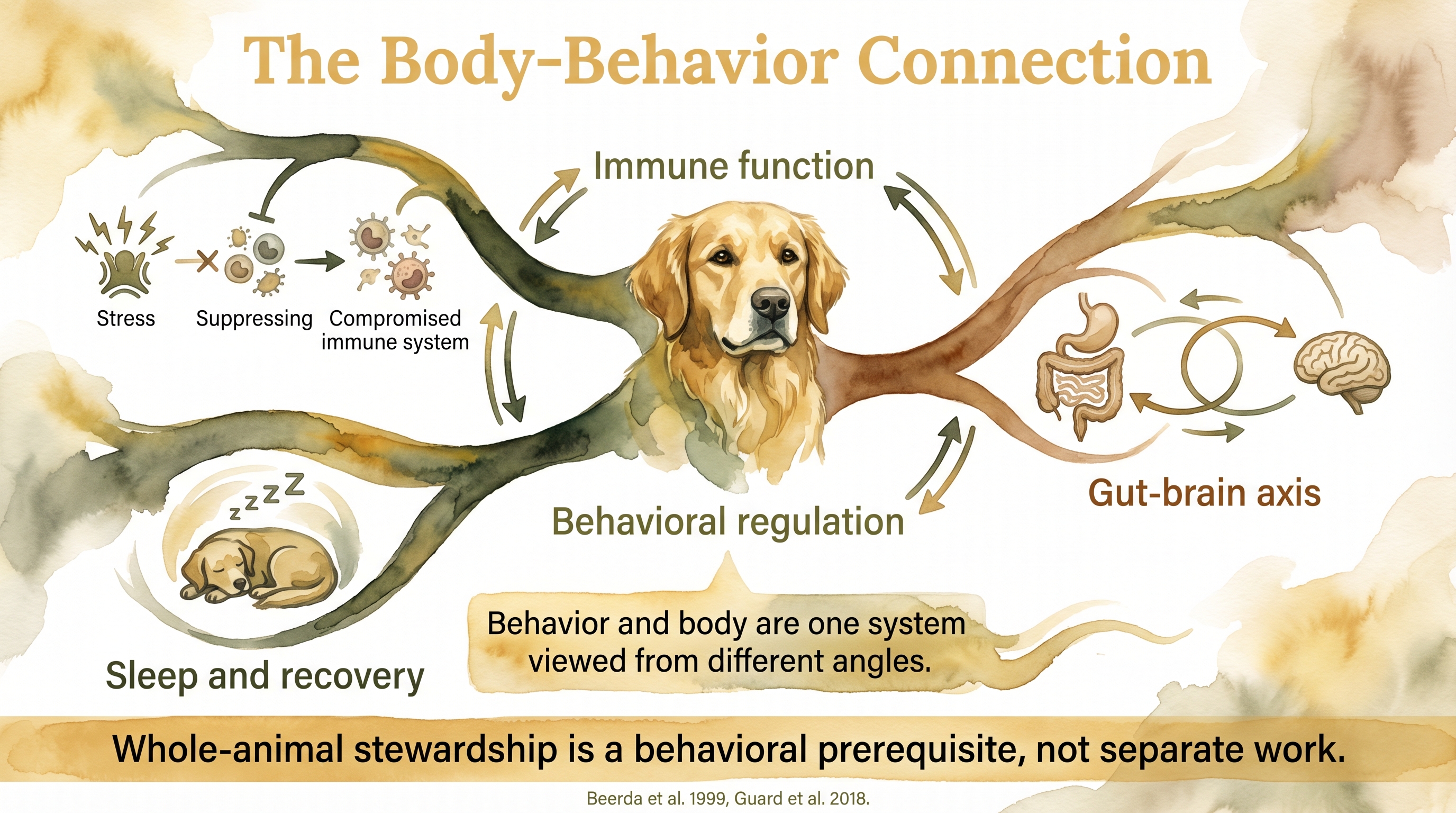
Behavior and body are one system viewed from different angles - immune function, gut-brain signaling, and sleep quality all feed directly into behavioral regulation.
Key Takeaways
- Behavior happens through the body, which means physical wellness and behavioral regulation are connected whether families plan for that or not.
- The strongest dog evidence here concerns chronic stress and immune effects, showing that dysregulation has measurable biological costs.
- Gut-brain pathways are biologically real, but stronger claims about specific dietary fixes for behavior still need much more restraint.
- JB whole-animal raising means treating health, nutrition, sleep, and behavior as connected parts of one developmental system.
The Evidence
This entry uses observed claim-level tags beyond the dedicated EvidenceBlocks below. These tags mark JB program observation or practice-derived claims that need dedicated EvidenceBlock coverage in a later content pass.
This entry uses heuristic claim-level tags beyond the dedicated EvidenceBlocks below. These tags mark JB interpretive application rather than direct study findings.
- Beerda, B. et al. (1999)domestic dogs
Showed that chronic social and spatial restriction altered hormonal and immunological responses in dogs. - Kulka, M. et al. (2026)domestic dogs
Found meaningful differences in canine lymphocyte response and apoptosis across stress-load conditions, reinforcing that chronic stress has cellular consequences. - Skandakumar, S. et al. (1995) and Svobodova, I. et al. (2014)domestic dogs
Linked cortisol with salivary IgA dynamics, adding a mucosal-immune layer to the canine stress picture.
- Guard, B. C. et al. (2018)domestic dogs
Characterized healthy and diarrhoeic canine fecal microbiota, supporting the reality of meaningful microbial pattern shifts in dogs. - Suchodolski, J. S. et al. (2009)domestic dogs
Showed that antibiotic exposure can measurably alter canine gastrointestinal microbiota. - Canine microbiome synthesisdomestic dogs
Gut-brain pathways are biologically plausible in dogs, but direct behavior-outcome intervention claims remain more emerging than settled.
- Dutra, L. M. L. et al. (2025)domestic dogs
Linked chronic adverse or institutional stress contexts in dogs with shorter telomeres, showing that stress-related biological cost can extend beyond behavior.
No published puppy-raising trial has measured whether a whole-animal JB-style health-and-regulation approach produces superior behavioral outcomes compared with behavior-only approaches.
The gut-brain axis is biologically plausible in dogs, but the field still lacks strong controlled evidence linking specific microbiome interventions to predictable household behavior changes.
SCR References
Sources
Beerda, B., et al. (1999). Chronic stress in dogs subjected to social and spatial restriction. II. Hormonal and immunological responses. Physiology & Behavior.
Dutra, L. M. L., et al. (2025). Telomere Tales: Exploring the impact of stress, sociality, and exercise on dogs cellular aging. Veterinary Sciences.
Guard, B. C., Honneffer, J. B., Jonika, M. M., Lidbury, J. A., Steiner, J. M., & Suchodolski, J. S. (2018). Characterization of the faecal microbiota of healthy and diarrhoeic dogs. Veterinary Journal, 241, 52-60.
Kulka, M., et al. (2026). Stress-related immunomodulation of canine lymphocyte responses and hematologic profiles. International Journal of Molecular Sciences.
Skandakumar, S., et al. (1995). Salivary IgA: A possible stress marker in dogs. Animal Welfare.
Suchodolski, J. S., Dowd, S. E., Westermarck, E., Steiner, J. M., Wolcott, R. D., Spillmann, T., & Harmoinen, J. A. (2009). The effect of azithromycin on the bacterial microbiota of the canine stomach as assessed by 16S rRNA gene analysis. FEMS Microbiology Ecology, 71(2), 313-326.
Svobodova, I., et al. (2014). Cortisol and secretory immunoglobulin A response to stress in German Shepherd dogs. PLOS ONE.