The Neurology of Correction vs. Punishment
Compound evidence detail1 SCR / 2 parts
- Documentedthe canine welfare evidence on aversive training methods (Vieira de Castro 2020, Ziv 2017, Hiby 2004) and the attachment-mediated stress modulation evidence (Schoberl 2015, Asher 2020, Brubaker and Udell 2023)
- Heuristicthe JB claim that secure attachment context measurably alters how dogs experience mechanically operant-identical correction procedures, RF-flagged in the SCR and formally untested in controlled canine studies
The correction-versus-punishment distinction matters because the nervous system does not process every intervention the same way. Two humans can do something that looks mechanically similar from the outside and still produce very different internal states in the dog, which is why JB treats the boundary as neurological first and terminological second. Heuristic
What It Means
In natural canine development, correction is brief, proportionate, and socially legible. A mother dog freezes, blocks, or interrupts. Mixed Evidence The moment passes. The relationship stays intact. The puppy receives information without being pushed into sustained fear. That is the model JB is trying to preserve when it talks about Indirect Correction.
The aversive-method literature shows clearly what happens when intervention crosses into punishment. Documented Dogs trained with aversive methods show more stress behavior, higher cortisol, and more pessimistic cognitive bias. Broader review work finds welfare risks without superior efficacy, and punishment use correlates with more reported behavior problems. Those are not semantic findings. They are nervous-system and welfare findings.
The stronger JB claim sits one layer higher. JB argues that relational context changes what a correction means to the dog. Heuristic In a calm, predictable relationship, a brief interruptive act may remain information. In a fearful or unstable relationship, a mechanically similar act may be processed as threat. That claim is biologically plausible and supported indirectly by attachment and caregiver-effect literature, but it is not directly settled by the aversive-method studies themselves. That is the precise place where slippage has to be controlled.
The cleanest way to hold the distinction is this: punishment drives survival. Correction tries to preserve cognition. Once the dog is organizing around self-protection, the teaching relationship is already collapsing.
Why It Matters for Your Dog
Families face this distinction in ordinary moments, not only in abstract philosophy. The puppy mouths a hand. Mixed Evidence Jumps onto a guest. Pushes through a doorway. The adult has to decide whether the response will keep the puppy inside a learnable state or tip it into alarm.
JB prefers prevention whenever possible because prevention avoids the moment entirely. But when correction is needed, the Foundation claim is that proportionality, brevity, and relational stability are what keep the act on the correction side of the line. Dragging, shaking, screaming, prolonged confinement in anger, and fear-heavy confrontation may suppress behavior in the short term while doing much more damage to the system around it. Documented
Indirect Correction works only if it preserves the relationship while delivering information. The moment fear becomes the main teaching medium, the system has already left the Pillar and entered something else.
This is also why JB does not hide behind operant labels. The question is not only whether something could be described in learning-theory terms. The question is what state the dog entered while it happened. A dog that feels briefly interrupted is in a different neurological place from a dog that feels cornered.
The practical instruction is sober rather than dramatic. If the human is angry, escalating, or losing proportion, the response is probably drifting out of correction and into punishment. The dog body will tell the truth even if the human language does not.
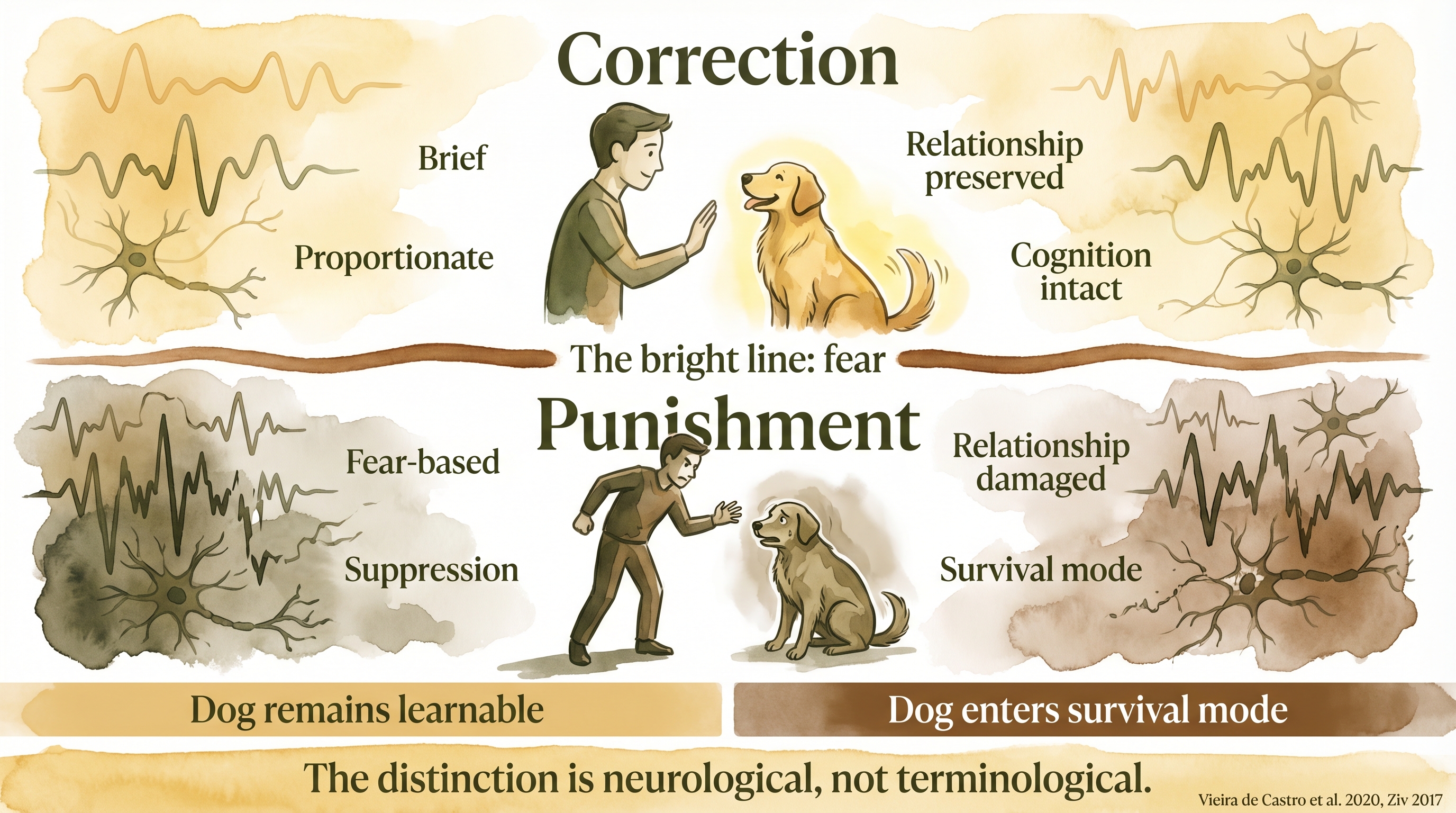
The distinction is neurological - correction preserves cognition and keeps the dog learnable, while punishment drives survival responses and collapses the teaching relationship.
Key Takeaways
- The strongest documented science shows that aversive punishment-heavy methods carry welfare and stress costs for dogs.
- JB uses the term correction for brief, proportionate, relationship-preserving interruption rather than for fear-based suppression.
- The stronger claim that relationship quality changes how mechanically similar interventions are processed is plausible but still more heuristic than directly proven.
- Families protect the system best by using prevention first and by treating fear as the bright line that signals a correction has gone too far.
The Evidence
This entry uses mixed-evidence claim-level tags beyond the dedicated EvidenceBlocks below. These tags mark claims that combine documented findings with observed practice, heuristic application, or unresolved gaps.
- Vieira de Castro, A. C. et al. (2020)domestic dogs
Found that aversive-trained dogs showed higher cortisol, more stress behavior, and more pessimistic cognitive bias than reward-trained dogs. - Ziv, G. (2017)domestic dogs
Reviewed the literature and concluded that aversive methods pose welfare risks without demonstrated superior efficacy. - Hiby, E. F. et al. (2004)domestic dogs
Reported that punishment use correlates with a greater number of behavior problems.
- SCR-005 synthesisdomestic dogs
The JB claim is that relationship depth and history modulate whether a low-magnitude correction is processed as information or as threat. That remains heuristic rather than directly settled by current intervention studies. - Powell, L. et al. (2021)domestic dogs
Owner personality and treatment outcome associations support the broader idea that caregiver variables matter to how interventions land, even though they do not prove the full JB correction boundary.
- Dale, F. C. et al. (2024)domestic dogs
Prospective longitudinal data linked punishment or aversive owner responses to increased odds of later separation-related behaviors, showing that the cost of punitive handling can extend beyond the original problem.
No published study has directly compared a narrowly defined low-magnitude relationship-mediated correction against punishment-heavy handling while holding relationship quality constant.
The literature documents harm from aversive methods, but it does not yet precisely map the threshold at which a mechanically similar act shifts from socially legible interruption into perceived threat for a developing puppy.
SCR References
Sources
Dale, F. C., Burn, C. C., Murray, J., & Casey, R. (2024). Canine separation-related behaviour at six months of age: Dog, owner and early-life risk factors identified using the Generation Pup longitudinal study. Animal Welfare, 33, e60.
Hiby, E. F., Rooney, N. J., & Bradshaw, J. W. S. (2004). Dog training methods: Their use, effectiveness and interaction with behaviour and welfare. Animal Welfare, 13(1), 63-69.
Powell, L., et al. (2021). Owner personality and treatment outcome in canine behavioral medicine cases. Journal of Veterinary Behavior, 45, 34-42.
Vieira de Castro, A. C., Fuchs, D., Morello, G. M., et al. (2020). Does training method matter? PLOS ONE, 15(12), e0225023.
Ziv, G. (2017). The effects of using aversive training methods in dogs. Journal of Veterinary Behavior, 19, 50-60.