The Extinction Problem
The Extinction Problem is the scientific heart of the Prevention pillar. Extinction does not erase original learning. Documented It creates new inhibitory learning layered over the first association, which means the original behavior remains capable of returning under the right conditions. JB's prevention argument rests heavily on this asymmetry: what never forms does not later have to be suppressed.
What It Means
In everyday dog language, extinction usually gets translated into something like "ignore it until it stops" or "correct it consistently until it goes away." Observed-JB The ordinary assumption underneath that advice is that once the behavior stops showing up, the learning itself has been removed.
The learning literature says otherwise.
Bouton's framework shows that extinction is not deletion. It is new learning that competes with the old learning. The original association remains in memory, while extinction adds an inhibitory layer that is more fragile and more context-dependent than the behavior it is suppressing. Documented
That single fact changes the whole emotional geometry of puppy raising.
A behavior that has been extinguished is not gone in the same sense that an unwired behavior is gone. It is better described as dormant, inhibited, context-bound, or managed. That does not make extinction useless. Extinction can be extremely valuable. It does mean, however, that correction is always playing defense against a trace that already exists.
This is the problem JB keeps pointing to. Once a behavior has a real learning history, you are no longer deciding whether the puppy should have the behavior. Documented You are deciding how long, how consistently, and in how many contexts you are willing to maintain the competing inhibition that keeps it from showing up.
That is a radically different project from prevention.
Prevention avoids the learning history. Extinction manages it after the fact.
The difference matters because daily life is exactly the kind of environment that exposes extinction's weaknesses. Homes change. routines shift. visitors arrive. people slip. stress rises. contexts multiply. A behavior that looks "fixed" in one setting can reappear in another not because the dog is stubborn, but because extinction was never erasure in the first place.
JB therefore treats extinction science less as a condemnation of all correction and more as a warning label. If you allow a behavior to establish itself, you are accepting a future of suppression, maintenance, and relapse management that may last much longer than families expect. Documented
Why It Matters for Your Dog
This is why Prevention is not simply the softer or easier option. It is the structurally cheaper option.
If jumping, mouthing, frantic greeting, or demand barking never gets sufficiently established:
- there is no original association to suppress
- there is no dormant trace waiting for the right context
- there is no relapse mechanism to manage later
Correction works on behavior that already has a history. Prevention works before that history exists. Extinction science is what makes the difference so important.
This is also why JB emphasizes first-sight intervention and environmental management. The goal is not moral purity. The goal is to keep a weak, emerging behavior from becoming a real learning problem that must later be extinguished across time and context.
The extinction problem does not mean dogs cannot improve. Documented They can. It means improvement is rarely the same thing as erasure.
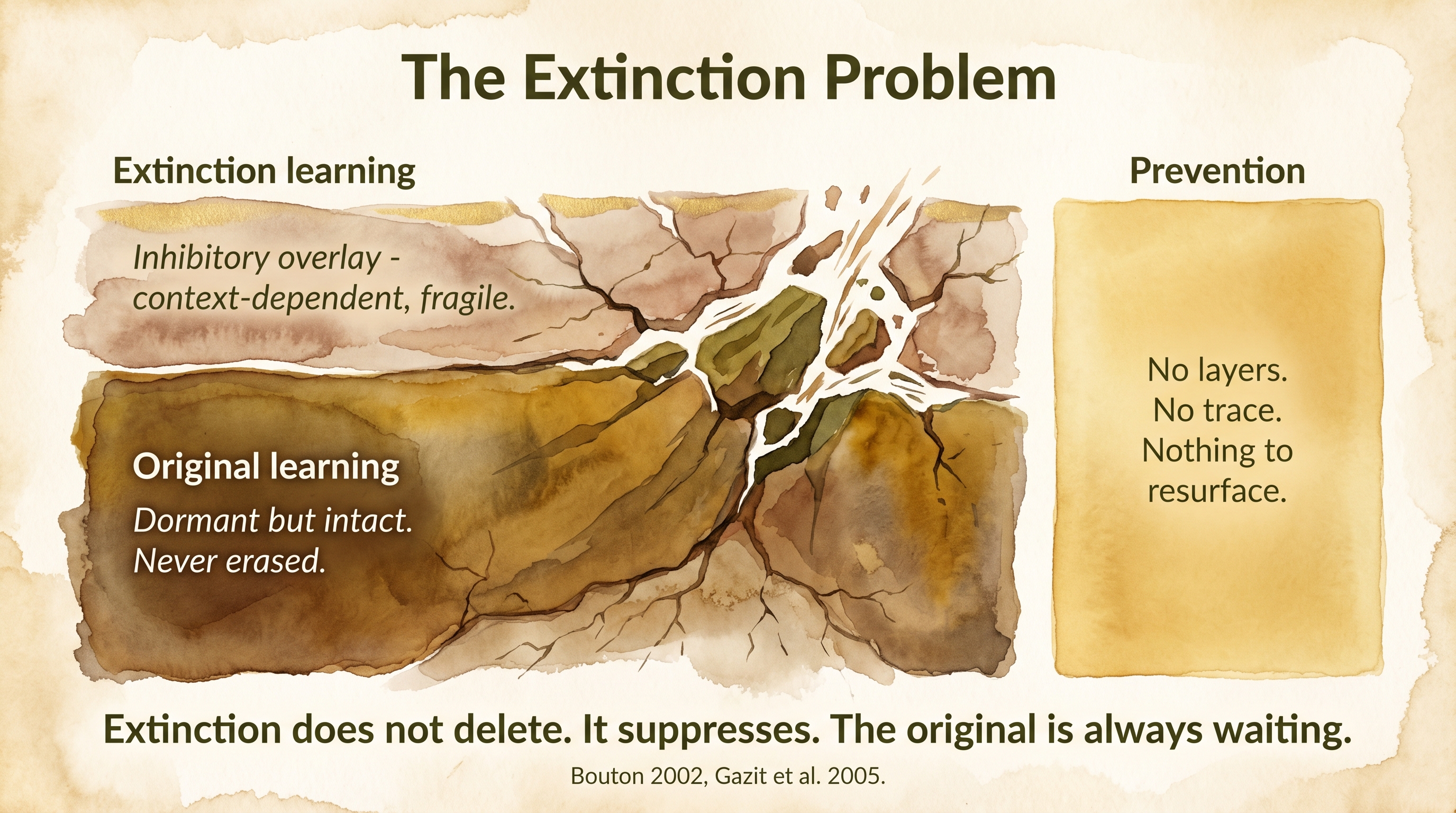
Extinction does not delete - it suppresses with a fragile, context-dependent overlay. The original is always waiting.
Key Takeaways
- Correcting a behavior stops it from showing up, but does not erase the learning underneath - the behavior stays dormant and can come back when conditions change.
- A puppy who has practiced jumping, mouthing, or pulling many times will always have that history in their nervous system, meaning families must maintain correction forever.
- Prevention works at the root: if a behavior never gets enough practice to become real learning in the first place, there is nothing dormant waiting to return.
The Evidence
This entry uses observed claim-level tags beyond the dedicated EvidenceBlocks below. These tags mark JB program observation or practice-derived claims that need dedicated EvidenceBlock coverage in a later content pass.
- Bouton, M. E. (2002)general learning models
Argued that extinction creates context-dependent inhibitory learning rather than deleting the original association. - Bouton, M. E. (2004)general learning models
Synthesized the relapse mechanisms that show why extinguished behavior is vulnerable to return. - Gazit, I., Goldblatt, A., & Terkel, J. (2005)domestic dogs
Provided direct canine evidence for renewal by showing that search behavior suppressed in one context re-emerged in a novel context. - Bentosela, M. et al. (2008)domestic dogs
Showed extinction-related behavioral change and frustration responses in dogs during reward withdrawal, supporting the reality of extinction dynamics in canine behavior.
JB's claim that prevention is fundamentally more efficient than later correction is a practical interpretation of extinction science. The documented finding is that extinction leaves the original trace intact; the raising implication follows from that.
No published study directly tests the specific claims or protocols described in this entry within a controlled canine trial.
SCR References
Sources
- Bouton, M. E. (2002). Context, ambiguity, and unlearning. Trends in Cognitive Sciences, 6(5), 227-233.
- Bentosela, M., et al. (2008). Discriminative mechanisms in an avoidance task in dogs. Behavioural Processes, 78(3), 375-383.
- Gazit, I., & Terkel, J. (2003). Explosives detection by sniffer dogs. Applied Animal Behaviour Science, 82(1), 65-73.