Extinction and Behavioral Persistence
When a behavior stops being reinforced, it doesn't disappear. Documented It goes underground. The original learning persists in memory, and under the right conditions it comes back - sometimes stronger than before. This is why Just Behaving emphasizes prevention over correction: a behavior never initiated is a circuit never built.
What It Means
Extinction is what happens when a behavior that was once reinforced stops producing a reward. Documented The dog jumps up and gets attention; then the family ignores the jumping; the jumping eventually decreases. In the traditional training model, that's the success story.
But the neuroscience tells a different story. Mark Bouton's research - spanning decades of work on conditioning and memory - demonstrates that extinction does not erase the original learning. Documented It creates a second memory that competes with the first. The original association (jumping = attention) remains intact. What extinction adds is a new, context-dependent memory (jumping = nothing in this setting).
This has three well-documented consequences:
Spontaneous recovery. After a period of no exposure, the extinguished behavior returns without any new reinforcement. The passage of time alone weakens the extinction memory more than the original learning. Documented
Renewal. Change the context - move to a new room, a new house, a new handler - and the extinguished behavior reappears. The extinction memory was tied to the context where it was learned; remove the context, and the original behavior resurfaces. Documented
Reinstatement. A single exposure to the original reinforcer can restore the full behavioral pattern even after successful extinction. One guest who pets the jumping dog undoes weeks of ignoring.
These are not training failures. They are features of how mammalian memory works. The brain is conservative - it doesn't delete successful strategies, it archives them.
Why It Matters for Your Dog
This is the scientific foundation beneath the strongest of the Five Pillars.
Never intentionally request, initiate, or encourage behaviors we would later correct. A behavior never initiated is a circuit never built. Prevention avoids the permanent residue that extinction leaves behind.
When a JB puppy comes home, families are asked to prevent unwanted behaviors from ever getting started - not because correction doesn't work in the short term, but because extinction science shows the original pattern never fully goes away. Documented The family who never lets jumping start doesn't need to extinguish it later. They avoid the spontaneous recovery, the renewal in new contexts, the reinstatement from a single slip.
This also explains why the transition matters so much. A puppy raised in a structured breeder environment may have certain behaviors well-managed through context. Move that puppy to a new home - a new context - and renewal can bring back anything the puppy learned but seemed to have stopped doing. The "soft landing" approach (continuing the breeder's calm, structured framework) keeps the context consistent. The "crash landing" (everything changes at once) maximizes renewal risk.
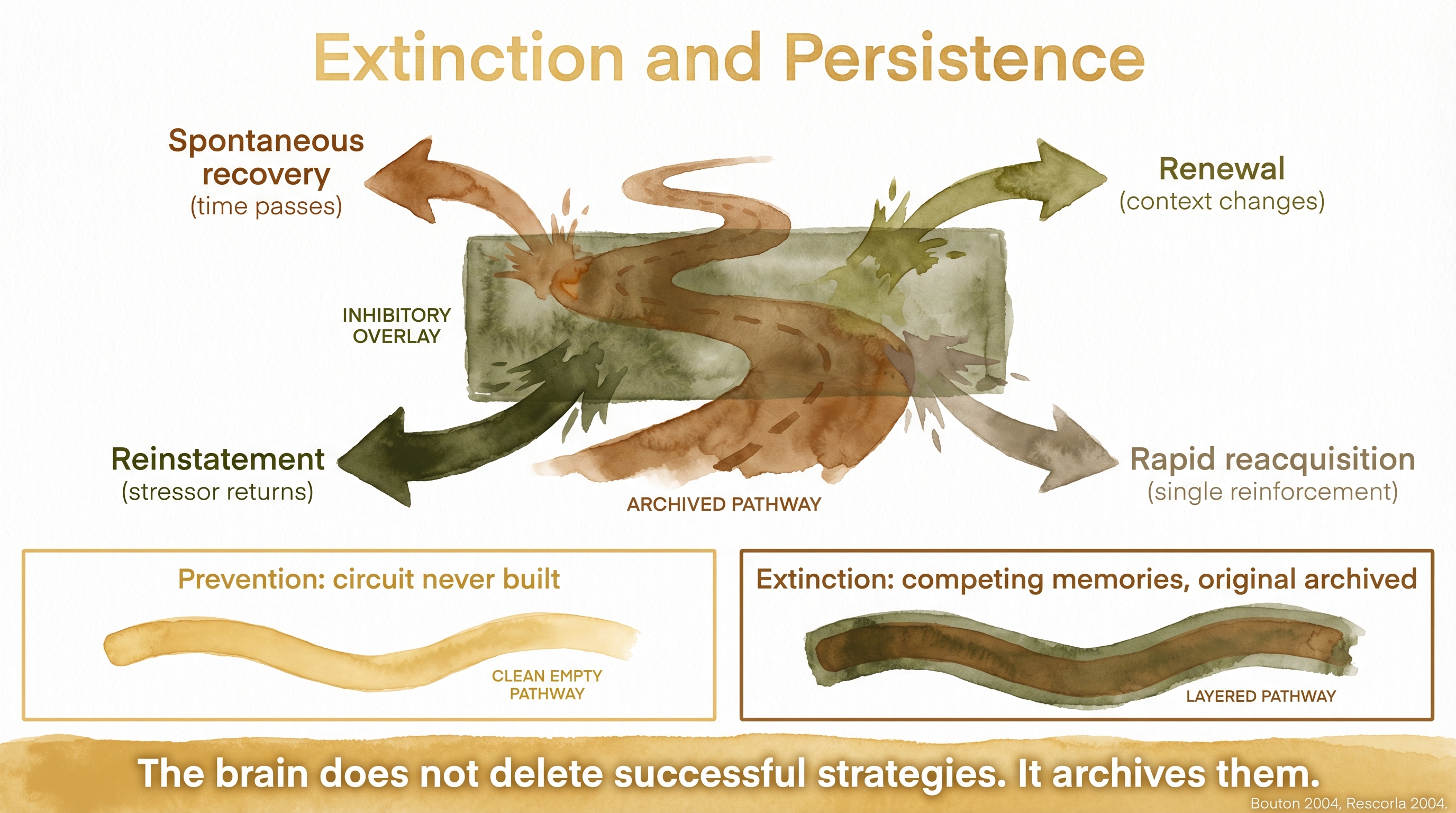
Extinction suppresses behavior but never erases the original learning - renewal, reinstatement, and spontaneous recovery persist.
Key Takeaways
- Extinction does not erase original learning - it creates a competing memory that is context-dependent and fragile.
- Three documented recovery phenomena (spontaneous recovery, renewal, reinstatement) explain why corrected behaviors return.
- Prevention avoids the permanent residue extinction leaves behind - a circuit never built cannot spontaneously recover.
- The transition from breeder to home is a context change that maximizes renewal risk without consistent structure.
The Evidence
- Bouton, M. E. (2004)rats, multiple species
Context and behavioral processes in extinction. Learning & Behavior, 32(4), 319-342. Demonstrated that extinction is context-dependent and does not erase original learning. The three recovery phenomena (spontaneous recovery, renewal, reinstatement) are robust across conditioning paradigms. - Bouton, M. E. (2002)rats, multiple species
Context, ambiguity, and unlearning. Psychological Review, 109(3), 375-403. Formal model of why extinction is inherently fragile: the extinction context serves as a "negative occasion setter" that must be continuously present for suppression to hold. - Gazit, I. & Terkel, J. (2005)domestic dogs
Domination of olfactory over visual cues in dogs. Applied Animal Behaviour Science. Demonstrated renewal of conditioned responses in domestic dogs when context was altered, confirming Bouton's framework extends to canines.
The JB claim that prevention avoids the "permanent residue" extinction leaves behind is an interpretive synthesis of Bouton's documented findings applied to the practical context of puppy raising. No published study directly compares prevention-first versus correction-first approaches in a randomized controlled trial with long-term behavioral follow-up.
No published study directly compares a prevention-based raising program against a correction-based training program in a randomized trial with long-term follow-up. This is the strongest research frontier identified in the JB evidence review. The absence applies bilaterally - it constrains claims for and against both approaches equally.
SCR References
Sources
- Bouton, M. E. (2002). Context, ambiguity, and unlearning: Sources of relapse after behavioral extinction. Biological Psychiatry, 52(10), 976-986.
- Bouton, M. E. (2004). Context and behavioral processes in extinction. Learning & Behavior, 32(4), 319-342.
- Gazit, I. & Terkel, J. (2005). Domination of olfactory over visual cues in dogs. Applied Animal Behaviour Science, 82(3), 201-211.
- Rescorla, R. A. (2004). Spontaneous recovery. Learning & Memory, 11(5), 501-509.mo