The Socialization Period (3 to 12 Weeks)
The socialization period is the best-known developmental phase in dogs for good reason. Between roughly three and twelve weeks, puppies form the first durable templates through which they read people, other dogs, novelty, space, and ordinary life. Learning remains possible after this period, but it does not remain equally easy, equally generalizable, or equally cheap. Documented
What It Means
When people say "socialization" casually, they often mean exposure: more people, more places, more noises, more surfaces, more everything. The scientific meaning is more specific. The socialization period is a sensitive developmental phase during which experience has unusually strong leverage over later behavior.
Historical framing
The foundation here is Scott and Fuller, supported by Freedman and colleagues. Their work established the idea that early life contains a bounded developmental window in which delayed social experience carries outsized later cost. Puppies deprived of timely human contact did not simply behave like undertrained normal puppies. They showed deeper and more persistent avoidance.
That original literature was powerful, but it also created some long-lived distortions. Modern reviews now emphasize three corrections this is better described as a sensitive period than an absolute critical period; the boundary is gradual rather than a single universal cliff; and the classic isolation studies used extreme conditions that do not map cleanly onto every modern pet setting.
Those corrections weaken sloppy rhetoric, not the core point. The core point remains strong: early experience matters disproportionately in this period.
Why the period opens around three weeks
The socialization period does not open because of a calendar convention. It opens because the puppy has just moved through the transitional period. Sensory systems are now open enough for richer learning, locomotion is developing, and the puppy can begin engaging more actively with the social and physical environment.
This is where the developmental-period framing matters. The socialization period is not a free-floating idea. It sits on top of the neonatal and transitional phases that made it possible.
The first half and the second half
One of the most useful distinctions in this period is between the earlier and later subphases.
From roughly three to eight weeks, the puppy is still in the breeder-and-litter world. Conspecific experience dominates. The puppy is learning bite modulation and body management; approach and withdrawal around littermates; sleeping and settling around others; how adult dogs move, interrupt, tolerate, and disengage; and the ordinary emotional tone of the environment.
From roughly eight to twelve weeks, the developmental center of gravity often shifts. Many puppies go to family homes in this interval. Human handling, household rhythm, unfamiliar spaces, car travel, new surfaces, and novel social situations begin to matter much more.
This is why the period cannot be reduced to "meet a lot of things." The puppy is not just collecting exposures. It is organizing a first model of what the world is like.
The real question is not exposure alone
The strongest critique of checklist-style socialization is not that exposure is irrelevant. Exposure clearly matters. The critique is that exposure quality matters as much as, and often more than, exposure quantity.
A puppy who experiences novelty in a calm, scaffolded, manageable way is not learning the same lesson as a puppy who is overwhelmed in the middle of the same nominal exposure. Documented The stimulus list may match. The developmental lesson does not.
This distinction becomes especially important in the second half of the period, when fear and caution begin to rise. A loud, chaotic outing may count as "socialization" on paper while functioning developmentally as fear learning.
Ordinary life versus event socialization
One practical mistake that follows from exposure-only thinking is the idea that socialization mainly happens in special events. Puppy classes, downtown walks, hardware-store trips, patio lunches, and carefully staged outings can all have value. But they are not the whole developmental picture, and sometimes they are not even the most important part of it.
For many puppies, the strongest developmental inputs during the socialization period are much more ordinary how adults move through the house; what rest looks like after activity; whether doorways are frantic or uneventful; whether handling is calm or dramatic; whether household sounds predict chaos or normalcy; and whether novelty arrives in tolerable doses. Documented
This matters because the puppy is not only learning "public confidence." The puppy is learning what life feels like.
That is also why later family disappointment can be so sharp. Families sometimes put large effort into special socialization outings while accidentally rehearsing chronic excitement, poor settling, or inconsistent boundaries in the ordinary home environment where the puppy spends most of its time. The socialization period does not care whether the input looked impressive to adults. It cares what was repeatedly experienced and how it was emotionally processed.
Mechanism without overclaiming
The socialization period invites mechanistic overstatement, so the SCR boundaries matter here.
It is fair to say that the period overlaps with rapid postnatal neural change, including myelination and broader developmental plasticity. It is not fair to say that dogs have a week-by-week pruning calendar proving which exact social experiences must happen on which exact days. SCR-025 explicitly blocks that move. Documented
The most responsible mechanism summary is that puppies are in a high-plasticity developmental state; that rapid neural maturation is ongoing in the same general age corridor; that fear and caution rise as the period proceeds; that experience is shaping later behavior with unusual leverage; and that the exact canine neural micro-timing remains less fully mapped than the behavioral facts.
Breed scope and timing variation
The general three-to-fourteen-week framework is well supported. What is not equally supported is pretending every breed shares the same fear-onset calendar.
Morrow and colleagues showed breed-dependent differences in fear-related avoidance onset. That matters because it confirms timing is not identical across all dogs. It does not provide a Golden Retriever-specific calendar, because Golden Retrievers were not included in that study. Documented
That is an important boundary for this category. JB works within a Golden Retriever program, and that makes it tempting to import exact numbers from nearby breeds. The conservative move is to cite the broad window confidently and treat fine-grained Golden-specific timing as a live research gap unless directly studied. Ambiguous
Early human readiness is already present
One of the most useful newer findings for this period is that retriever puppies, including Golden Retrievers, already show robust human social-communicative skill by eight to ten weeks without a learning curve across trials. That does not mean every later social problem is solved before placement. It does mean the puppy arrives with real biological preparedness for reading humans.
This is a helpful corrective to the idea that the family is starting from zero. It is also a corrective to the opposite idea that the bond is fully fixed before the family arrives. The puppy arrives prepared, plastic, and still very much inside the socialization period.
Why It Matters for Your Dog
For most families, the socialization period is the most important developmental window they will inherit directly.
That is because many puppies go home in the middle of it.
The family is not receiving a finished social dog. The family is receiving a puppy whose brain and behavior are still actively deciding what counts as ordinary, manageable, safe, interesting, threatening, and worth orienting toward.
The breeder-to-family handoff matters
The period from eight to twelve weeks is often treated as a happy transfer event. Developmentally, it is much more than that. It is a handoff in the middle of an active sensitive period.
That is why continuity matters so much. A puppy moving from a calm breeder environment into a loud, chaotic, highly stimulating home does not experience only novelty. The puppy experiences developmental translation from one set of social rules into another while still in the window where those rules are being absorbed fastest.
The soft-landing idea matters here because the puppy often enters the family home while still inside the socialization period. Continuity of calm structure supports the second half of the window better than excitement-heavy novelty for its own sake.
Socialization is not flooding
A common mistake is to treat the period as a deadline that justifies overloading the puppy "before it is too late." That can invert the developmental goal.
The best-supported version of socialization is not maximum intensity. It is timely, varied, manageable, and recovery-friendly experience. The puppy should meet the world while remaining able to process it.
That means controlled novelty beats chaotic novelty, short successful exposures beat endurance tests, calm human handling beats excited crowding, and ordinary household life matters, not only outings.
The first fear period sits inside this phase
This is also why the socialization period cannot be treated as uniformly open and carefree from start to finish. The first fear period overlaps the second half of the window. So does the most common go-home age.
That overlap changes what good socialization looks like. It makes quality, pacing, and stress management more important, not less.
Limits and open questions
The literature is strong enough to defend the period itself without hesitation. What it is not strong enough to defend are easy slogans such as "every exposure is good exposure"; "the door slams shut on one exact day"; "keeping puppies longer is always better regardless of environment"; and "one bad event determines everything".
There is also a real evidence gap between guide-dog, colony, and breeder settings on one hand and the full diversity of pet-home developmental pathways on the other. Ambiguous
There is a second gap as well: we know early life matters more than later life in this period, but the field is still relatively weak at ranking which exact classes of experience matter most for which exact adult outcomes. Social contact, handling quality, novelty pacing, and the emotional tone of the environment all appear important. What we do not yet have is a perfect comparative table saying which ingredient is most determinative for every breed, context, and behavioral endpoint.
That is one reason this category resists slogans. The science is strong enough to say timing matters enormously. It is weaker at rewarding one-size-fits-all recipes.
How this connects to the rest of the wiki
This page is the developmental-period overview. The companion socialization-window page focuses more tightly on mechanism and why timing changes the cost of later learning. Documented
The first-fear-period page narrows in on the late-window vulnerability that often overlaps with adoption.
After this period closes, juvenile-period picks up the story of consolidation, refinement, and the long road toward mature control.
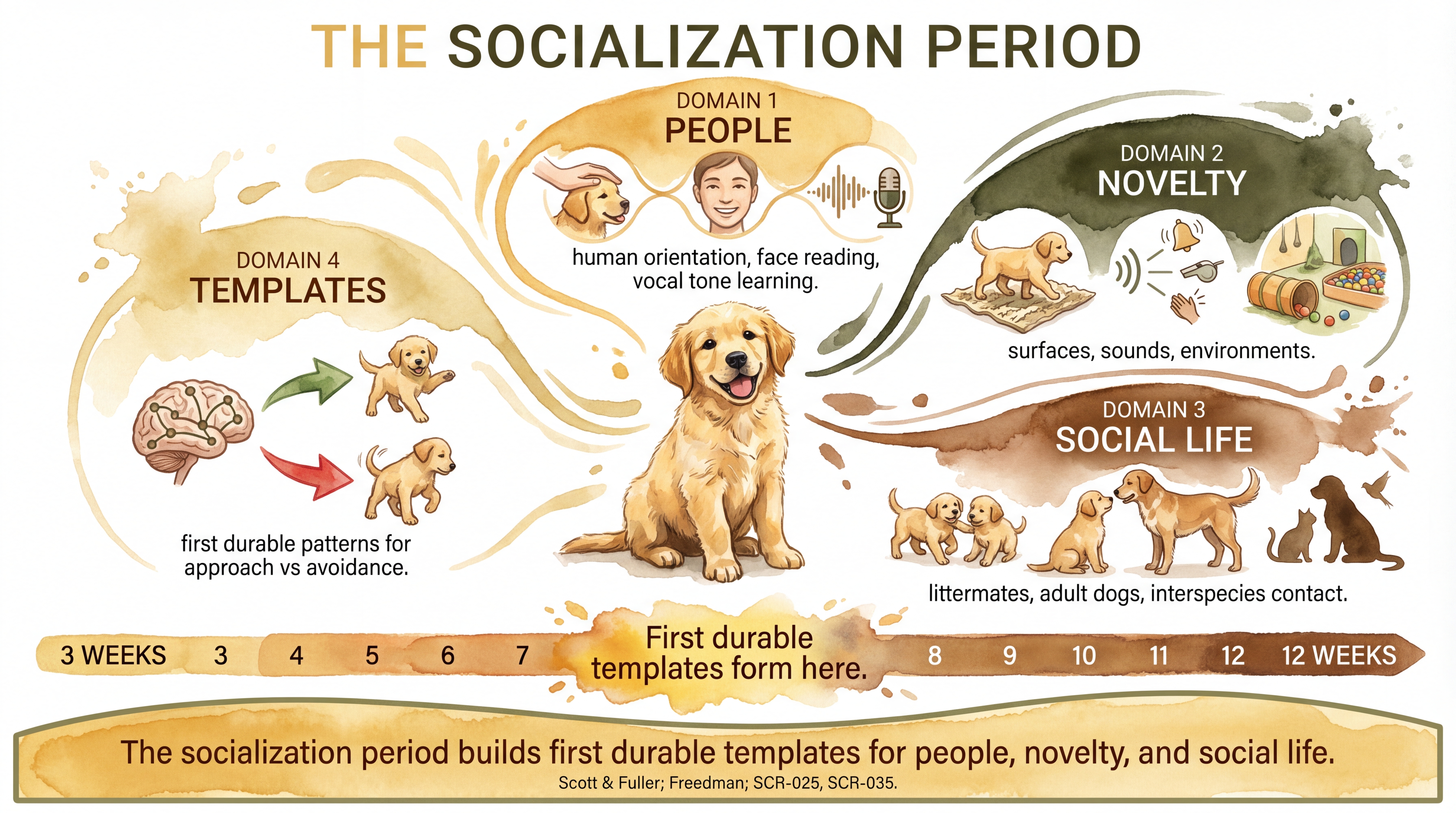
The socialization period builds first durable templates for people, novelty, and social life.
Key Takeaways
- The socialization period is a true sensitive developmental phase, not just a checklist of puppy outings.
- The first half is still centered on litter and breeder life, while the second half often shifts heavily toward human and household experience.
- Quality of experience matters as much as quantity of exposure, especially once fear and caution begin to rise.
- Many puppies go home in the middle of this period, which makes continuity and calm structure especially important.
The Evidence
This entry uses ambiguous claim-level tags beyond the dedicated EvidenceBlocks below. These tags mark claims where the literature remains unsettled or multiple interpretations coexist.
- Freedman, D. G., King, J. A., & Elliot, O. (1961)domestic dogs
Foundational experimental work showed that delayed human contact produced persistent social consequences, establishing the reality of a bounded early sensitive period. - Scott, J. P. & Fuller, J. L. (1965)domestic dogs
Provided the classic developmental framework for the puppy socialization period and its lasting behavioral significance. - Morrow, M. et al. (2015)domestic dogs
Showed breed-dependent differences in fear-related avoidance onset, confirming that the broad window is real while fine-grained timing varies across breeds. - Bray, E. E. et al. (2021)retriever puppies including Golden Retrievers
Eight-to-ten-week-old retriever puppies showed robust human gesture comprehension without conditioning history, documenting early human-directed social readiness inside JB's breed scope. - Vaterlaws-Whiteside, H., & Hartmann, A. (2017)domestic dogs
Structured early socialization from birth to six weeks was associated with measurable later behavioral differences.
- McEvoy, V. et al. (2022)domestic dogs
Narrative systematic review reinforced the central importance of early canine socialization while emphasizing evidence boundaries and terminology. - Howell, T. J. et al. (2015)domestic dogs
Review work supported the idea that the socialization window closes gradually rather than through a single universal cutoff. - General developmental neurosciencemultiple mammals
Sensitive periods reflect high plasticity combined with changing fear and exploratory systems, though the exact canine neural micro-timeline remains less directly mapped.
- SCR-035 internal dataGolden Retrievers in the JB program
Fearfulness at around three months correlated with later anxiety in JB observations, which is useful as a caution signal but remains an observed internal finding rather than published consensus.
- domestic dogs
No published study specifies the exact neural micro-timing that makes one socialization exposure succeed or fail within ordinary breeder and family environments.
SCR References
Sources
- Bray, E. E., et al. (2021). Early-emerging and highly heritable sensitivity to human communication in dogs. Current Biology, 31(14), 3132-3136.
- Freedman, D. G., King, J. A., & Elliot, O. (1961). Critical period in the social development of dogs. Science, 133(3457), 1016-1017.
- Howell, T. J., King, T., & Bennett, P. C. (2015). Puppy parties and beyond: The role of early age socialization practices on adult dog behavior. Veterinary Medicine: Research and Reports, 6, 143-153.
- McEvoy, V., et al. (2022). Canine socialisation: A narrative systematic review.
- Morrow, M., Ottobre, J. S., Ottobre, A. C.,