The Neonatal Period (Birth to 2 Weeks)
Compound evidence detail1 SCR / 2 parts
- DocumentedAwalt 2024 canine association between early-life history and NR3C1 or OXTR methylation patterns
- Heuristicinference that neonatal caregiving differences produce specific later health or behavior profiles
The neonatal period is the first two weeks of canine life. It is the least social-looking stage of development, but it is not biologically trivial. Puppies are born neurologically immature, almost entirely dependent on maternal regulation, and limited to a narrow set of reflexive behaviors organized around warmth, milk, sleep, and contact. Documented
What It Means
Scott and Fuller treated the neonatal period as its own developmental phase because the puppy at this stage is not yet operating as a small social learner in the everyday sense. It is operating as a highly immature mammalian infant whose survival depends on external regulation. Eyes are closed. Ear canals are closed. Locomotion is limited to crawling and pushing. Thermoregulation is weak. Elimination depends heavily on maternal licking. The behavioral repertoire is narrow: rooting, nursing, huddling, distress vocalization, and sleep.
That narrow repertoire is exactly why the phase matters so much. A neonatal puppy is not choosing between many different behavioral strategies. It is being built.
Historical framing
Classic canine developmental work from Fox, together with Scott and Fuller's periodization, established the first weeks as a distinct biological state rather than just the boring prelude to "real" puppy behavior. The point of separating it out is that almost every major system is still coming online sensory channels are not fully open; voluntary movement is minimal; cortical integration is limited; autonomic stability is immature; and maternal buffering is doing much of the work.
This is also where sloppy popular shorthand begins to cause problems. People often hear that puppies develop "very fast" and mentally collapse that into "mostly done early." The current SCR blocks that move explicitly. The dog brain develops rapidly after birth, but the commonly repeated claim that it reaches about 70 percent of adult size by six weeks is not verified against a primary canine growth series. Ambiguous
The neonatal sensory and behavioral profile
Neonatal puppies live through touch, temperature, smell, and contact. Olfactory and tactile information matter far more than sight or hearing because the visual and auditory systems are not yet open for ordinary environmental processing.
That has several consequences.
First, proximity matters. Puppies orient to warmth, milk, and the dam's body. Separation is not just a social inconvenience. It is a physiological problem.
Second, the day is dominated by sleep and feeding. The neonatal period is not a training opportunity and not a socialization checklist phase. The puppy spends most of its time sleeping, nursing, or moving between brief bursts of reflexive activity and return to rest.
Third, maternal behavior is not optional support around the edges. It is the regulatory environment itself. The dam provides warmth and temperature stabilization; milk and hydration; tactile stimulation; grooming; anogenital stimulation for elimination; and contact-based calming.
When people later talk about puppies needing calm co-regulation, this is the earliest form of it.
The neural state
The neuroscience pages in this wiki matter here because they prevent overstatement. The early puppy brain is not merely small. It is immature in a structured way. Direct canine imaging and histology support rapid postnatal maturation with early change in the brainstem and cerebellum before broader cerebral maturation. Myelination is present only in limited early pathways and proceeds in stages after birth.
That means neonatal behavior is dominated much more by basic survival circuitry and reflexive organization than by integrated, flexible cortical control.
The safest way to say it is this the neonatal brain is developing fast; the developmental sequence is real and measurable; adult-like integration is not present; and precise overconfident percentages should be avoided.
This is why the period can look simple from the outside while still being biologically decisive. A great deal of future developmental capacity depends on what happens before the puppy can visibly "do" much at all.
Physiological vulnerability and breeder management
The neonatal period also deserves its own emphasis because the puppy's problems are so basic. A seven-day-old puppy cannot simply compensate for a poor environment by "being resilient." It cannot move away effectively from chronic disturbance. It cannot regulate body heat well. It cannot eliminate independently in the ordinary sense. It cannot keep itself fed without successful maternal access or careful human support when maternal care is compromised.
That is why the breeder environment during this phase is more like neonatal care than like enrichment design.
Several ordinary management details matter more than later readers often realize ambient warmth and draft control; access to the dam without crowding or smothering risk; clean bedding and low pathogen load; monitoring of nursing success and hydration; and minimizing unnecessary disruption of sleep. Observed-JB
What is striking about these variables is that they sound simple. They are simple. But simplicity here is not triviality. It is biological priority. The puppy is not yet ready for a rich lifestyle. The puppy is ready for safety, metabolic stability, and organized care.
This is also where early handling claims need discipline. The literature on neonatal handling and early stimulation is not a clean story of "more handling equals better puppy." Some early interventions may help under some conditions. Some effects are modest or context-dependent. And an enriched, well-run baseline environment may blunt dramatic intervention effects. The most defensible view is not that neonatal puppies should be treated as untouchable, nor that they should be constantly "optimized." The more defensible view is that the basic regulatory environment still matters more than any performance-oriented micro-protocol layered onto it.
Maternal regulation is the developmental mechanism
The dam is not simply feeding the litter. She is regulating the litter.
Across mammals, early caregiver presence buffers physiological stress and organizes immature offspring systems. In dogs and canids, maternal attendance, grooming, contact, nursing posture, and tolerance structure the early environment that the puppy's nervous system is calibrating against.
That does not mean every later-life outcome can be reduced to one maternal variable. It does mean the neonatal period is not empty time. It is the stage in which external regulation is closest to total.
This is also where a common misconception begins: because the puppy is not yet "learning commands," people assume the early environment is less important than later training. The developmental literature points the other direction. The earliest environment is not less important because it is pre-verbal and pre-formal. It is important for exactly that reason.
Early environment and later stress reactivity
The strongest canine epigenetic evidence does not let us say that one specific event on day four or day six permanently writes a known adult temperament. That would exceed the evidence ceiling. What it does let us say is that early-life history in dogs is associated with methylation differences on stress- and bonding-related genes, including NR3C1 and OXTR.
That matters for the neonatal period because it narrows the old translational gap. The classic rodent story from Weaver and Meaney showed that early caregiving could alter glucocorticoid-receptor expression through methylation-related mechanisms. Documented The dog literature now supports the broader claim that early developmental conditions can leave lasting molecular traces in stress-regulation systems, even if the full canine pathway is not yet mapped with rodent-level precision.
So the careful developmental conclusion is not "the first two weeks determine the whole dog." It is that early environment contributes to later regulatory trajectory; that maternal care is part of that early environment; that canine evidence now supports lasting molecular association with early life; and that the exact neonatal timetable of those mechanisms remains incompletely mapped.
What the period is not
The neonatal period is not the socialization period.
It is not where families should imagine "confidence-building exposures" matter most in the way they will matter later.
It is not where puppies benefit from maximal novelty.
It is also not the right place to smuggle in the false precision of pop-neuroscience slogans. The most responsible language is slower and more biological: the puppy is being kept alive, regulated, and built by a maternal and environmental system before later social learning accelerates.
Why It Matters for Your Dog
By the time people meet a puppy at eight or nine weeks, the neonatal period is already over. But the effects of that period are not gone.
What happened in those first two weeks helps set the tone for what comes after physiological stability or fragility; stress-load versus calm regulation; quality of maternal buffering; and exposure to consistent versus chaotic husbandry. Documented
This is one reason breeder environment matters long before a family can see the puppy's personality clearly. The period is less about displaying future traits than about laying the conditions under which later traits will emerge.
The neonatal period is the earliest example of calm regulation as a biological fact rather than a style preference. The puppy survives and develops inside a state of external co-regulation before it can regulate much of anything on its own.
For breeder practice, the most defensible implications are practical and narrow stable warmth and clean husbandry matter; maternal access matters; excessive disturbance is not neutral; and handling should be organized around the puppy's immaturity, not around human curiosity.
The point is not to romanticize every minute of early litter life. It is to recognize that development begins before visible training or visible sociality.
Limits and open questions
There are still real limits to what the science can say.
The canine literature is stronger on broad postnatal maturation than on fine-grained neonatal neural timing. The epigenetic bridge in dogs is real, but it is newer and less experimentally controlled than the classic rodent work. Direct dog data isolating which features of the neonatal environment matter most, and through which exact molecular pathways, remain incomplete.
That means we should avoid three tempting overclaims that one exact neonatal experience predicts one exact adult behavior; that canine neonatal methylation pathways are fully mapped; and that the puppy brain is already mostly mature by six weeks in any precise numeric sense.
How this connects to the rest of the wiki
This page is the starting point for the whole canine-development category.
The next page, transitional-period, covers the short but crucial handoff when the eyes and ears open and the puppy begins moving from reflex-dominant life into early social responsiveness. Documented
The later socialization-period is easier to see because behavior becomes richer, but it sits on top of the biological groundwork laid here.
If you want the mechanism side, canine-brain-development-timeline and epigenetics-overview extend the neural and molecular story in more detail.
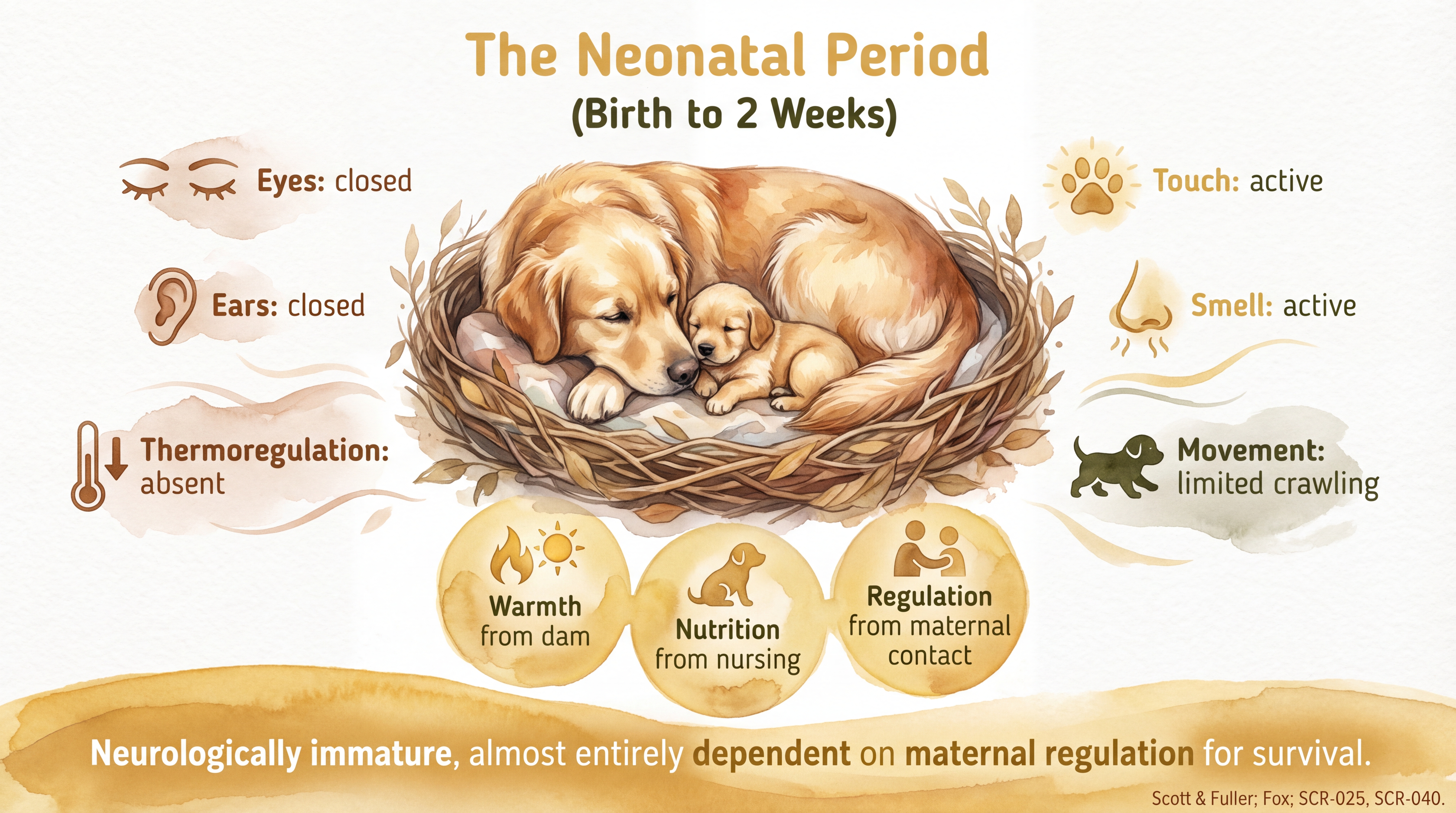
Neurologically immature and almost entirely dependent on maternal regulation for survival.
Key Takeaways
- The neonatal period is a distinct developmental phase centered on survival, sleep, feeding, and maternal regulation rather than later-style social learning.
- Neonatal puppies are neurologically immature, with limited sensory access and only early-stage postnatal brain maturation.
- Maternal buffering is not just care around the edges. It is the regulatory environment the puppy develops inside.
- Early-life conditions are developmentally meaningful for later stress regulation, but exact neonatal molecular timelines in dogs still require careful wording.
The Evidence
This entry uses observed claim-level tags beyond the dedicated EvidenceBlocks below. These tags mark JB program observation or practice-derived claims that need dedicated EvidenceBlock coverage in a later content pass.
- Fox, M. W. (1964, 1971)domestic dogs
Classic canine developmental work separated the neonatal period as a distinct early phase characterized by immature sensory systems, reflexive behavior, and rapid early brain growth. - Gross, B. et al. (2010)domestic dogs
MRI and histology correlation showed that canine postnatal brain maturation proceeds in stages, with early brainstem and cerebellar change preceding broader cerebral maturation. - Hong, H. et al. (2022)domestic dogs
Dog brain proteomics confirmed strong developmental regulation across newborn, juvenile, and adult stages, supporting rapid early biological change rather than a finished neonatal brain. - Awalt, S. L. et al. (2024)domestic dogs
Early-life adversity in dogs was associated with altered NR3C1 and OXTR methylation, along with cortisol and attachment-related differences, supporting lasting molecular relevance of early developmental conditions.
- Weaver, I. C. G. et al. (2004)rats
Maternal care altered glucocorticoid-receptor methylation and later stress physiology in offspring, providing the classic mechanistic template for early-life stress programming. - Hostinar, C. E. et al. (2013)multiple mammals
Reviewed social buffering as a widespread caregiver-mediated regulator of offspring stress physiology across mammalian development. - Guardini, G. et al. (2017)domestic dogs
Variation in maternal care in dogs was associated with later offspring behavioral differences, supporting the developmental significance of early maternal environment.
- SCR-041 boundarydomestic dogs
Rapid early brain development is documented, but the commonly repeated claim that the puppy brain reaches about 70 percent of adult size by six weeks is not currently verified. - Canine epigenetic boundarydomestic dogs
Dog evidence supports early-life-associated methylation differences, but the exact neonatal timetable and specific causal chain remain incompletely mapped.
No direct canine research located for this specific topic. Current understanding relies on related research, clinical observation, and cross-species inference.
SCR References
Sources
- Awalt, S. L., et al. (2024). A dog's life: Early life histories influence methylation of glucocorticoid (NR3C1) and oxytocin (OXTR) receptor genes, cortisol levels, and attachment styles. Developmental Psychobiology.
- Fox, M. W. (1964). The postnatal growth of the canine brain and correlated anatomical and behavioral changes during neuro-ontogenesis. Growth, 28, 135-141.
- Fox, M. W. (1971). Integrative development of brain and behavior in the dog. University of Chicago Press.
- Gross, B., Garcia-Tapia, D., Riedesel, E., Ellinwood, N. M., & Jens, J. K. (2010). Normal canine brain maturation at magnetic resonance imaging. Veterinary Radiology & Ultrasound, 51(4), 361-373.
- Guardini, G., et al. (2017). Influence of maternal care on the behavioral development of domestic dogs. Physiology and Behavior.
- Hong, H., et al. (2022). Comparative proteome and cis-regulatory element analysis reveals specific molecular pathways conserved in dog and human brains.
- Hostinar, C. E., Sullivan, R. M., & Gunnar, M. R. (2013). Psychobiological mechanisms underlying the social buffering of the HPA axis. Psychological Bulletin, 140(