The Canine Gut Microbiome and Nutrition
Compound evidence detail1 SCR / 2 parts
- Documentedcanine digestive anatomy and physiology evidence covering GI organs, AMY2B-linked starch adaptation, gastric acidity, transit-range variability, and microbiome fermentation
- Documentedthe bounded comparison to humans and wolves, where canine pH, transit, and starch-digestion findings support difference-from-wolf framing without diet absolutism
The canine gut microbiome is one of the most exciting and one of the easiest scientific areas to overstate. We now know that dogs carry complex microbial communities that interact with diet, stool quality, immune signaling, and gastrointestinal disease. We do not yet know enough to treat every microbiome theory as a personalized feeding certainty. This is a field where the promising parts are real and the hype problem is real too. Mixed Evidence
What It Means
The gut microbiome is the community of bacteria, archaea, fungi, and viruses living in the gastrointestinal tract. In dogs, the densest and most functionally important populations are concentrated in the distal small intestine and colon.
In broad terms, these organisms help shape fermentation of undigested substrate, short-chain fatty acid production, barrier integrity, bile-acid metabolism, and immune education.
That list is useful because it turns "microbiome" from a vague wellness buzzword into an actual biologic system. The microbes influence digestion, local immune tone, and what metabolic byproducts are being generated in the gut. When the community shifts, the effects can show up as stool changes, altered fermentation, different bile-acid handling, or a changed inflammatory environment. Documented
Diet therefore matters twice. It feeds the dog directly, and it also feeds the microbial ecosystem indirectly by changing which substrates reach the distal gut.
The Basic Community Pattern
Healthy dogs do not all have one identical microbiome. There is meaningful individual variation. Even so, canine microbiome studies repeatedly identify large recurring groups such as Firmicutes, Bacteroidetes, Fusobacteria, and Proteobacteria. Documented
The precise balance shifts with age, diet, health status, antibiotic exposure, and study method. Documented
That individual variation is one reason microbiome science can be oversold so easily. If healthy dogs vary from one another, then a single "normal" target community is not always clinically realistic. Population-level patterns are informative. Individual stool-readout interpretation is much harder.
The recurring phyla still matter. Firmicutes and Bacteroidetes are frequent anchors in broader mammalian microbiome work. Fusobacteria are particularly notable in dogs and help remind us that canine microbial ecology is not just a smaller version of the human story. Proteobacteria also belong in the normal picture, though shifts in their relative abundance can sometimes accompany disturbance or disease states.
How the Science Changed
Microbiome science used to rely heavily on culture-based methods, which missed much of the actual ecosystem. Modern work uses tools such as 16S rRNA sequencing, metagenomics, and metabolomics.
That upgrade matters because it allows researchers to study community structure and metabolic outputs more directly, rather than only asking which organisms can be cultured easily in a lab. Documented
The methodological shift is a major reason the field has accelerated. Culture-based methods only captured the organisms that would grow under laboratory conditions. 16S rRNA sequencing made it possible to characterize much broader taxonomic patterns. Shotgun metagenomics went further by examining genetic potential and functional capacity in more detail. Metabolomics then helped connect community structure to what the microbiome is actually producing.
That progression explains why newer microbiome papers often feel richer and more mechanistic than older ones. In many cases, the dogs did not suddenly become more complex. The tools finally got better at seeing what was already there.
Diet Really Does Matter
Diet changes the substrate that reaches the colon, and substrate changes the community. That part is well supported.
Higher-protein, lower-carbohydrate patterns and more carbohydrate-inclusive, fiber-bearing patterns can produce different microbial profiles and different fermentation products. That does not automatically tell us which exact profile is ideal for every dog, but it does establish that diet is not microbiome neutral. Documented
Fiber is especially important here because it is one of the main levers families use to influence fermentation. Fermentable fibers can help support production of short-chain fatty acids such as butyrate, acetate, and propionate.
Protein matters too, especially when more undigested protein reaches the distal gut. Different substrate patterns can shift microbial metabolism in different directions, which is one reason absolute slogans like "more protein is always better" or "carbohydrates always damage the microbiome" are not strong scientific summaries. What matters is the total dietary pattern, how digestible the diet is upstream, and what substrate actually arrives in the colon.
This is also why abrupt food changes can produce very visible stool changes. The microbial community is reacting to a changed substrate mix even before the family has had time to decide whether the new food is a keeper.
Puppyhood Is a Developmental Window
One of the strongest dog-specific microbiome findings is that puppy microbiomes are not just small adult microbiomes. They are actively developing ecosystems. Diversity and composition change rapidly across the neonatal and weaning period, and diet transition is one of the forces shaping that process.
That matters because it makes early feeding and abrupt-change decisions more consequential than families often realize.
Puppy microbiomes are therefore not just interesting from a research perspective. Documented They are directly relevant to routine breeder and family decisions. A puppy leaving the breeder is carrying a microbial ecosystem that is still stabilizing after weaning. That is part of why change stacking can be so disruptive during the first days in a new home.
Dysbiosis Is a Real Thing, but Not a Magic Diagnosis
Dysbiosis refers to microbial imbalance or community disruption. It is a useful concept, but it should be handled carefully. It does not mean every soft stool is a microbiome crisis, and it does not mean every commercial product claiming to "fix the microbiome" is delivering a meaningful clinical outcome.
What is supported more clearly is that microbiome disruption is associated with GI disease states, antibiotic exposure, major diet changes, and some chronic endocrine or inflammatory conditions.
Atopic disease belongs in that broader association map as well. Canine studies increasingly link dysbiosis not only with gastrointestinal illness, but also with inflammatory and allergic patterns. Documented The exact causal direction is not always clear. Sometimes disease perturbs the microbiome. Sometimes the microbiome may participate in disease expression. Often both are true at once.
That is why "associated with" is the right phrase. It captures a meaningful signal without pretending the field has closed every causal loop.
The Behavioral Boundary
The gut-brain axis is scientifically real. Microbial metabolites, immune signaling, vagal pathways, and endocrine pathways plausibly connect gastrointestinal ecology with behavior and stress physiology. Documented
But this is a good place to slow down and be precise. In dogs, microbiome-behavior associations exist, but the evidence is still emerging and the causal story is not closed. That means a page like this should not imply that a specific food will predictably create a calmer or better-behaved dog through microbiome engineering alone.
That caution matters in a JB project because calmness and regulation are central themes. The gut-brain axis is real. Microbial metabolites, immune mediators, endocrine signaling, and vagal pathways plausibly connect gut ecology to stress and behavior. What we do not yet have is a finished canine evidence base that lets us promise a specific behavioral outcome from a specific microbiome intervention. This is exactly where slippage happens if wording is not kept disciplined.
Probiotics and Prebiotics
Probiotics and prebiotics deserve separate pages, but the big-picture view is useful here.
Prebiotics are substrates that feed selected microbes. Probiotics are live organisms given with the goal of benefit. Some canine evidence exists for specific strains and outcomes, but this is not a category where "contains probiotics" should be read as a blanket proof of meaningful effect.
One of the better-known canine examples is Enterococcus faecium SF68, which does have some randomized controlled trial evidence in dogs for selected gastrointestinal outcomes. Even that example should be read carefully. Strain specificity matters. A result for SF68 is not proof that every product marketed as a probiotic will do the same thing.
The regulatory picture is also more awkward than families often realize. In the United States, probiotics have not always fit neatly into AAFCO ingredient recognition in the same way as conventional nutrients. Market language and state-level treatment can therefore run ahead of a fully settled governance framework. That does not mean probiotics are fictional. It means the category is scientifically and regulatorily uneven.
Where the Honest Ceiling Is
The most JB-safe summary is that diet shapes the canine microbiome, the puppy microbiome develops rapidly, fiber and substrate pattern matter, dysbiosis is associated with disease and antibiotic exposure, and behavior-related claims require much more restraint. Heuristic
The practical translation is that microbiome science is most useful when it makes feeding calmer rather than more frantic. Stable diet patterns, measured transitions, and thoughtful use of fiber or targeted products usually matter more than chasing every new marketing narrative about "optimizing the microbiome."
Why It Matters for Your Dog
Families hear "microbiome" constantly now, often in language that makes it sound like one supplement away from solving every GI and behavioral problem. The actual value of microbiome science is more grounded.
It helps explain why abrupt food changes can upset the gut, why antibiotics can leave weeks-long GI ripples, why fiber decisions matter, and why GI health and immune tone are not separate worlds.
It also helps explain why recovery from digestive disruption can lag behind the moment a trigger is removed. Even after the offending food is gone or the acute illness has passed, the microbial ecosystem may still be rebalancing. That is part of why stool quality sometimes normalizes gradually rather than instantly.
The microbiome does not prove every JB calmness claim, but it does reinforce a larger stewardship principle: dogs do better when the body is not being pushed through constant physiologic disruption. Stable routines, careful diet transitions, and conservative intervention all respect that biology.
That may be the highest-value family takeaway from this page. The microbiome is a reason to become more measured, not more reactive.
That calmer message is worth emphasizing because the microbiome marketplace is built to provoke action. The science often points in the other direction. Stable diet patterns, careful transitions, and selective rather than frantic intervention are usually the more biologically respectful approach.
A big part of microbiome discipline is accepting that population patterns can be real without turning into simple household rules. A strain may have evidence in a defined canine context and still not become a universal daily habit for every healthy dog. A community shift may correlate with disease and still not serve as a stand-alone explanation. Families who understand this stay interested in the science without becoming trapped by the need for a simple miracle answer.
That is part of why the page treats probiotics and microbiome products with caution rather than cynicism. Some tools in this space are promising and genuinely useful. The problem is not that the category is fake. The problem is that the marketplace routinely behaves as though every product has the same level of evidence and the same level of relevance for every dog. The evidence does not support that kind of flattening.
For families, the safest takeaway is that microbiome stewardship usually starts with the basics that are already in their control: stable food patterns, paced transitions, careful antibiotic conversations, and a reluctance to stack interventions without a clear reason. Those habits are not flashy, but they fit the biology unusually well.
A connected system is not the same as a solved system. That sentence protects the page from hype. It allows families to take gut ecology seriously while still asking whether a given intervention is actually supported in dogs, in this context, for this goal.
That is what lets families stay interested without becoming credulous. The microbiome is important enough to deserve attention and complex enough to deserve restraint.
It is promising enough to watch and unfinished enough to handle carefully, which is exactly why the page stays measured.
The field is real enough to deserve attention and complex enough to deserve patience.
That is ultimately the standard this page is trying to model: respect the science without overselling the application.
Promising science still benefits from disciplined language, and that discipline is part of what this page is protecting.
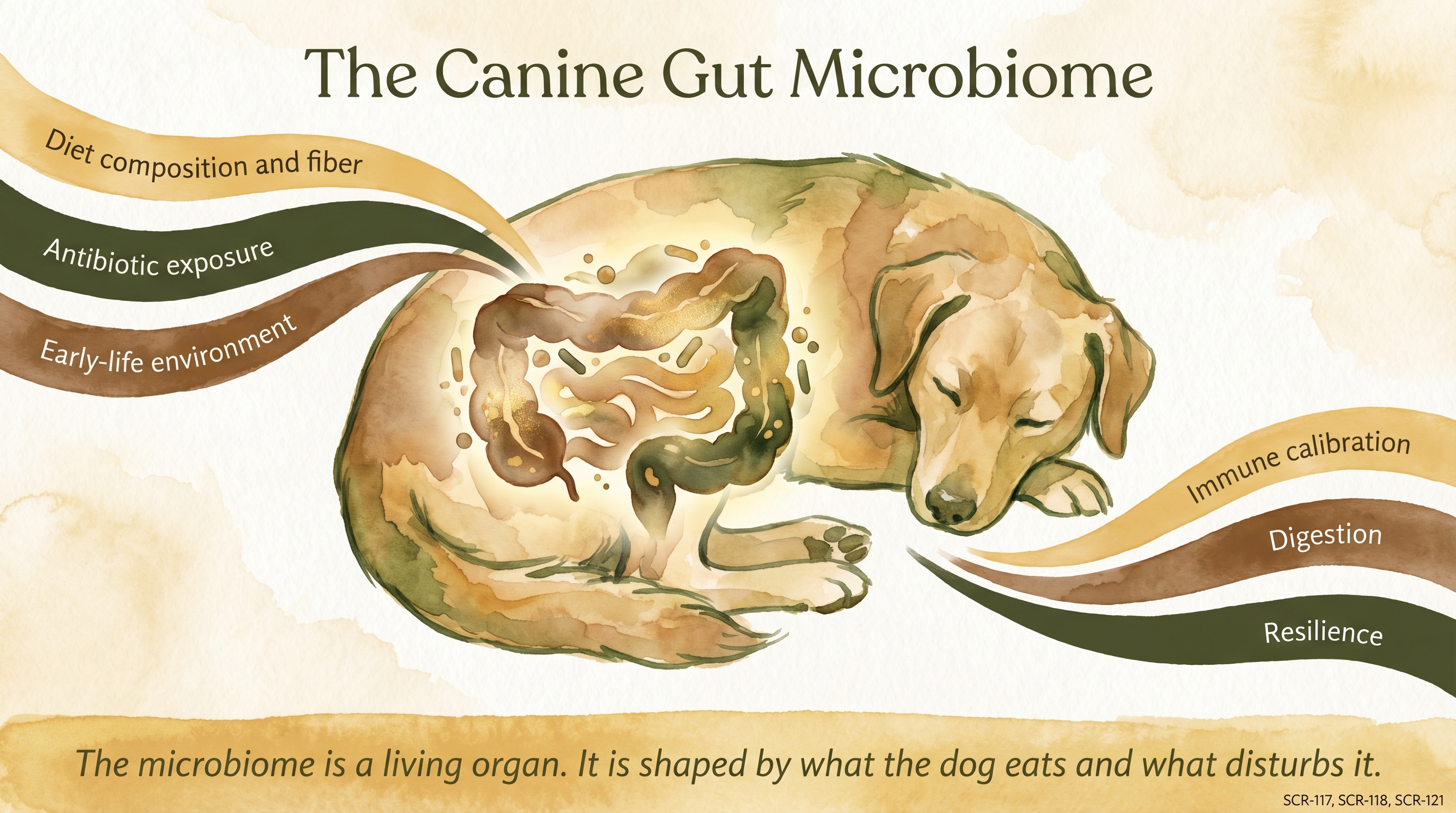
The microbiome is a living organ shaped by what the dog eats and what disturbs it.
Key Takeaways
- The canine gut microbiome is a real and biologically important ecosystem, but it is not simple enough to support sweeping one-product claims.
- Diet, fiber pattern, antibiotics, and early developmental transitions all shape the microbiome in dogs.
- Puppy microbiomes are developmentally active, which makes early diet transitions and disruptions more meaningful.
- Behavior and microbiome links are promising but should still be framed as emerging rather than settled canine science.
The Evidence
This entry uses mixed-evidence claim-level tags beyond the dedicated EvidenceBlocks below. These tags mark claims that combine documented findings with observed practice, heuristic application, or unresolved gaps.
- Guard et al. and related canine microbiome literaturedogs
The puppy microbiome develops rapidly across the neonatal and weaning period, with major shifts in diversity and taxonomic pattern over the first weeks of life. - Canine GI source synthesisdogs
Diet composition and antibiotic exposure measurably alter canine microbiome structure and metabolomic outputs. - Canine nutrition source synthesisdogs
Fermentable fiber influences colonic fermentation and short-chain fatty acid production, linking diet form to microbiome function.
- SCR-121 supportdogs
Claims that broader dietary variety or microbiome manipulation reliably produce superior behavioral or whole-dog outcomes remain more suggestive than settled in the current canine evidence base. - Gut-brain axis reviewsdogs and cross-species context
Microbiome-behavior pathways are plausible and increasingly studied, but causal dog-specific behavior recommendations remain an emerging area rather than a finished science.
The mixed evidence tag is doing real work here. The documented portion includes the existence of a complex canine gut microbiome, the dominant phyla commonly described in healthy dogs, the developmental instability of the puppy microbiome, the measurable effect of diet and antibiotics on microbial composition, and the association between dysbiosis and several disease states. The less-settled portion includes broad individual-dog optimization claims, sweeping product promises, and behavior-specific recommendations extrapolated beyond what current canine studies can carry.
That is why the page intentionally stays conservative. Microbiome science is promising and rapidly moving. It is not yet mature enough to justify every personalized feeding claim being made in the marketplace.
No published study directly tests the practical implications of the canine gut microbiome and nutrition for domestic dog raising programs. The application to household dog raising remains an interpretive synthesis rather than a directly tested intervention finding.
SCR References
Sources
- National Research Council. (2006). Nutrient Requirements of Dogs and Cats. Washington, DC: The National Academies Press.
- Guard, B. C., Honneffer, J. B., Jonika, M. M., Lidbury, J. A., Steiner, J. M., & Suchodolski, J. S. (2018). Characterization of the faecal microbiota of healthy and diarrhoeic dogs. Veterinary Journal, 241, 52-60.
- Suchodolski, J. S., Dowd, S. E., Westermarck, E., Steiner, J. M., Wolcott, R. D., Spillmann, T., & Harmoinen, J. A. (2009). The effect of the macrolide antibiotic azithromycin on the bacterial microbiota of the canine stomach as assessed by 16S rRNA gene analysis. FEMS Microbiology Ecology, 71(2), 313-326.
- Frantz, L. A., Schraiber, J. G., Madore, B., et al. (2016). Ancient DNA reveals rapid replacement of Native American populations. Nature, 532(7599), 265-268.
- Ley, R. E., Bäckhed, F., Turnbaugh, P., Lozupone, C. A., Knight, R. D., & Gordon, J. I. (2005). Obesity alters gut microbial ecology. Proceedings of the National Academy of Sciences, 102(31), 11070-11075.