Chronic Stress and Immune Function in Dogs
Chronic stress does not stay confined to behavior. In dogs, longer-duration adverse stress states are associated with measurable immune-related changes, including altered leukocyte patterns, mucosal-immune differences, and impaired cellular immune responsiveness. The strongest science sits inside psychoneuroimmunology, the field that studies how stress, endocrine regulation, and immune function interact. Documented
What It Means
The Basic Mechanism
The central route runs through glucocorticoids. In dogs, cortisol is the primary HPA-axis glucocorticoid. Cortisol acts through glucocorticoid receptors and can alter immune-cell trafficking, activation, apoptosis, and broader inflammatory balance. Documented
The source literature also emphasizes an important distinction: not every immune change is simple "up" or "down." Documented Some changes reflect cell redistribution rather than straightforward immune collapse. That is why immune interpretation in stress science needs more nuance than slogans such as "stress kills the immune system."
What Dog Studies Actually Show
The canine evidence is strongest in chronic adverse-environment paradigms.
Beerda's chronic housing work showed that social and spatial restriction changed hormonal and immunological measures in dogs. Shelter studies then extended the picture. Dogs entering shelters often show elevated cortisol along with altered leukocyte counts or NLR-type stress profiles, and some of those measures shift again as the dogs adapt over time.
More recent immune-cell work deepened the mechanistic side. In shelter versus client-owned comparisons, dogs from more stressful environments showed blunted T-cell expansion capacity and higher apoptosis. Documented That is stronger than simply saying they "seemed stressed." It shows altered immune-cell function.
The Mucosal-Immunity Piece
SCR-093 adds a particularly important layer because it brings mucosal defense into the picture. Salivary cortisol correlates negatively with salivary secretory IgA, and delayed sIgA recovery after stress correlates with more fearful or anxious phenotypes in dogs. Documented
This matters because mucosal immunity is relevant to the respiratory and GI entry points where pathogens actually arrive. It still needs discipline, though. The source document is clear that the strong correlation value comes from a specific context, puppy responses are age-dependent, and sIgA is one immune marker, not the immune system as a whole.
Why It Matters for Your Dog
What This Does Not Prove
The strongest direct dog evidence comes from shelters, restriction paradigms, chronic environmental adversity, and glucocorticoid-heavy contexts. That means the science supports a real connection between chronic stress and immune-related consequences in dogs, but it does not prove every household-level calmness claim in its strongest form.
In particular, the evidence does not yet establish that an ordinary stimulating household automatically causes measurable immunosuppression, that a single calming intervention necessarily changes downstream infection risk, or that puppy calm-transition protocols have already been proven to reduce real-world disease incidence. Documented Those are more ambitious claims than the current dog literature can carry on its own.
The pillar layer argues that calmness is protective. This page supports the narrower scientific claim: chronic adverse stress in dogs is associated with measurable immune-related changes, while the strongest household-level outcome claims still need more direct testing.
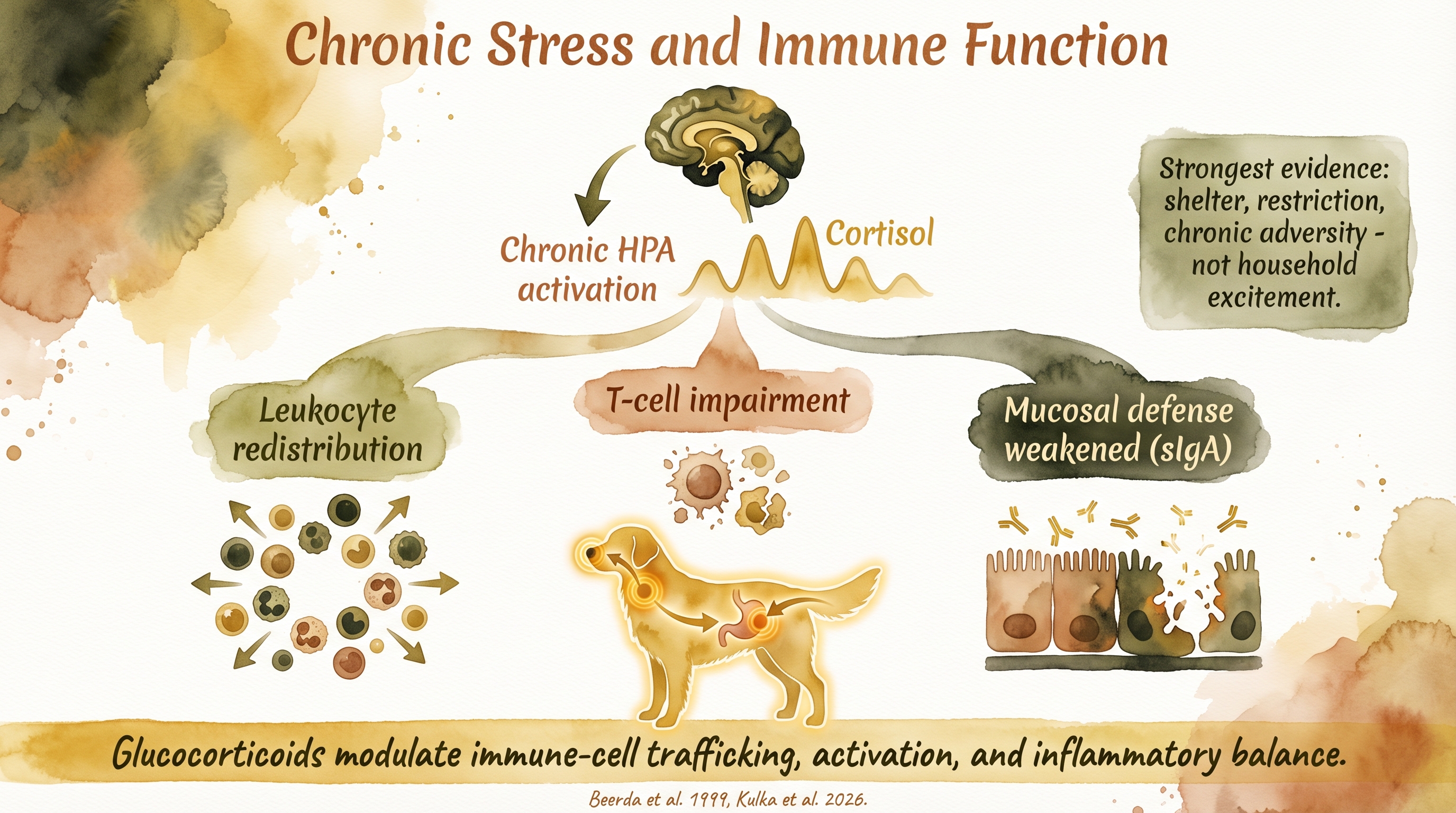
Chronic stress suppresses immune function through sustained cortisol elevation and inflammatory dysregulation.
Key Takeaways
- Chronic stress in dogs is associated with real immune-related changes, not only behavioral signs.
- The strongest dog evidence comes from shelter, restriction, and other adverse-environment paradigms.
- Mucosal markers such as sIgA add useful detail but should not be treated as a complete summary of immunity.
- The science supports immunological cost from chronic stress more strongly than it supports any one household management slogan.
The Evidence
- Beerda, B. et al. (1999)domestic dogs
Chronic social and spatial restriction altered hormonal and immunological responses in dogs. - Dudley, E. S. et al. (2015)domestic dogs
Shelter dogs showed cortisol differences and leukocyte-related shifts, with limited downstream change from a simple petting intervention. - Kulka, M. et al. (2026)domestic dogs
Compared shelter and client-owned dogs and found major differences in T-cell expansion capacity, activation, and apoptosis. - Skandakumar, S. et al. (1995) and Svobodova, I. et al. (2014)domestic dogs
Linked cortisol and sIgA in dog stress contexts, including delayed sIgA recovery in more fearful phenotypes.
- Sapolsky, R. M. et al. (2000)multiple mammals
Outlined the broader glucocorticoid role in stress physiology and immune modulation. - Cain, D. W., & Cidlowski, J. A. (2017)multiple mammals
Reviewed glucocorticoid control of immune signaling and immune-cell function.
- Stress-immunity source synthesisdomestic dogs
The broad principle that chronic stress is immunologically costly is strong, but the stronger household-level claim 'a calmer puppy is measurably more disease-resistant' remains more interpretive without direct clinical outcome trials.
No published study has measured whether immune-marker improvements from environmental enrichment in dogs correlate with reduced disease incidence, limiting evidence to marker shift rather than clinical outcome.
No controlled study has compared immune markers in dogs living under different household stimulation levels while controlling for other stress sources, making it difficult to isolate the effect of one variable.
SCR References
Sources
- Beerda, B., et al. (1999). Chronic stress in dogs subjected to social and spatial restriction. II. Hormonal and immunological responses. Physiology & Behavior.
- Cain, D. W., & Cidlowski, J. A. (2017). Immune regulation by glucocorticoids. Nature Reviews Immunology, 17(4), 233-247.
- Dudley, E. S., et al. (2015). Effects of repeated petting sessions on leukocyte counts, parasite prevalence, and plasma cortisol concentration of dogs housed in a county animal shelter. JAVMA.
- Kulka, M., et al. (2026). Stress-related immunomodulation of canine lymphocyte responses and hematologic profiles. International Journal of Molecular Sciences.
- Skandakumar, S., et al. (1995). Salivary IgA: A possible stress marker in dogs. Animal Welfare.
- Svobodova, I., et al. (2014). Cortisol and secretory immunoglobulin A response to stress in German Shepherd dogs. PLoS ONE.