The 12-Week Breeder Period
The 12-week breeder period is not an added delay before real life begins. It is part of real life - the stretch of puppyhood when the social environment is still writing itself into the nervous system, which is why Just Behaving treats retention to about twelve weeks as a developmental decision rather than a sales one. Heuristic
What It Means
Twelve weeks matters because of what happens inside those weeks, not because the number itself is magical. A puppy kept to twelve weeks in a chaotic, overstimulating environment is not receiving the benefit JB is talking about. Mixed Evidence The value of the breeder period comes from the curriculum-through-environment logic: adult dogs model the household standard, the human sets the rhythm, structure is consistent, and arousal is not treated as entertainment.
That timing overlaps the most sensitive part of the socialization window. Scott and Fuller established the developmental framework that makes this period so consequential, and later canine-development research confirmed that early experience during this window shapes later behavioral trajectory in durable ways. Documented The simplest analogy is wet concrete. Early in the pour, footprints hold. Later, the same pressure leaves far less impression. The breeder period is when the concrete is still taking shape.
This is why JB argues that the breeder environment is not a holding area. It is school, household, and nervous-system architecture all at once. The puppy watches calm adult dogs settle when visitors arrive, respect spatial boundaries, recover after brief challenge, and move through routine without constant prompting. Mixed Evidence Those repetitions are not neutral. They are the raw material of later defaults.
The point is not that families cannot raise excellent dogs if placement happens earlier. The stronger claim - that twelve-week breeder retention is categorically superior to eight-week placement into an equally calm, equally structured, equally skilled family home - has not been isolated in a direct controlled study. Documented The documented science supports the importance of developmental timing and early environment. The JB application is that a well-run breeder environment can use that window with unusual consistency, because the puppies live inside the same carefully managed system all day, every day.
Why It Matters for Your Dog
Families often imagine that raising starts on go-home day. In reality, they are stepping into a process already underway. A Just Behaving puppy has spent its first weeks absorbing calm adult-dog mentorship, environmental prevention, predictable rhythm, and low-drama correction. Mixed Evidence The family does not need to invent the process from scratch. It needs to continue it.
That is where the soft-landing distinction becomes practical. When the family understands the breeder period correctly, it stops asking how quickly it can replace breeder structure with its own preferences. The better question is how faithfully it can preserve the grammar the puppy already knows. The calmer and more continuous that handoff is, the more developmental work survives the transition.
The breeder period is where Mentorship has its highest leverage. Adult dogs are not explaining household rules to puppies. They are living them in front of developing minds that are primed to absorb what they see.
This is also why early removal has a cost even when the receiving family means well. The cost is not only one fewer week with the breeder. It is one fewer week inside a total environment where every hour reinforces the same message. Puppies do not learn from single lectures. They learn from what surrounds them repeatedly. The breeder period works by repetition without noise.
The breeder period is Prevention before the family ever sees the puppy. Behaviors that are never invited during the sensitive window do not need to be corrected later, because the relevant pathway was never rehearsed into strength.
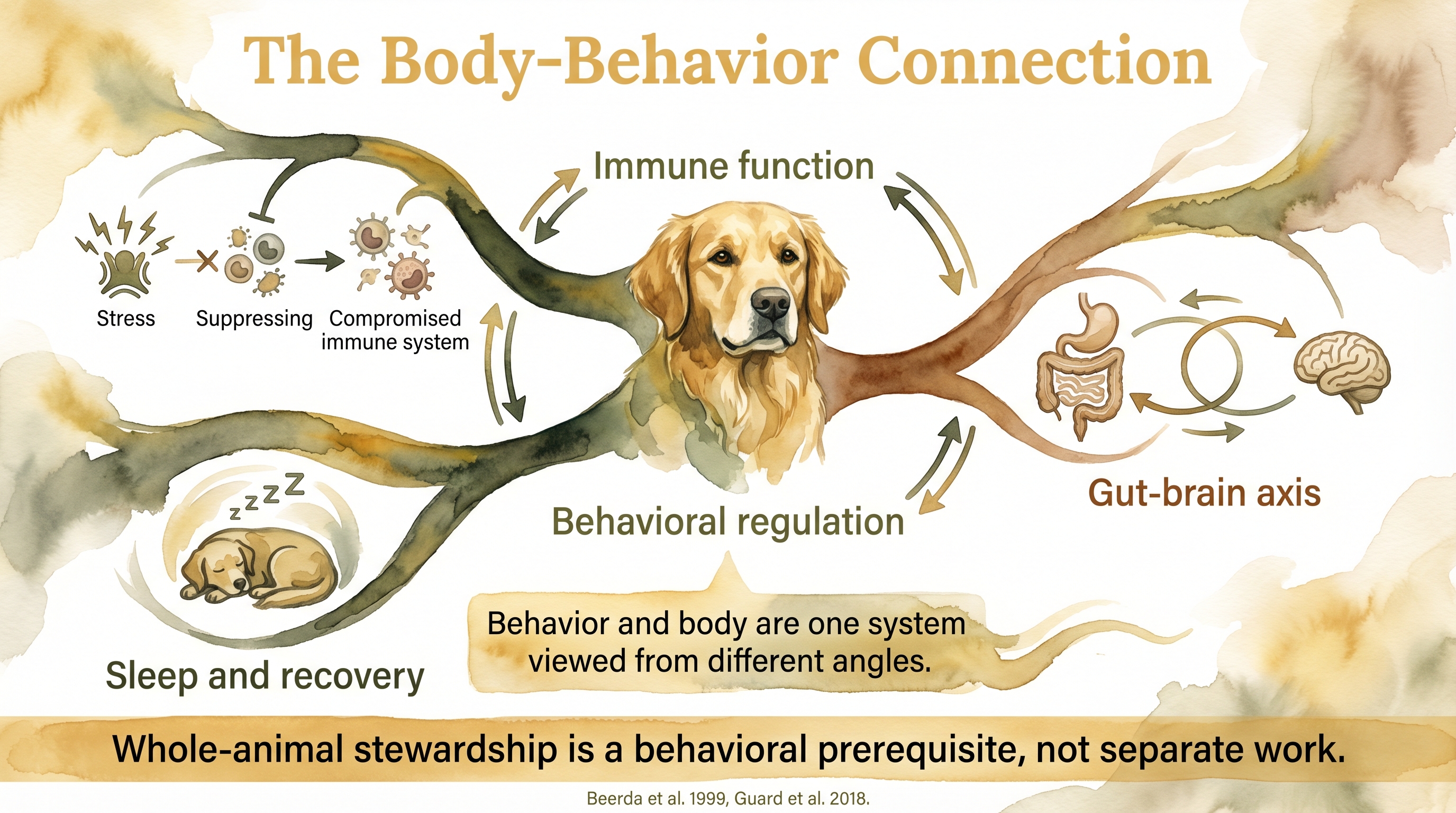
The value is the developmental environment, not the calendar number - mentorship, structure, and prevention wire into nervous system defaults before families arrive.
Key Takeaways
- The value of the 12-week breeder period comes from the developmental environment inside it, not from the calendar number by itself.
- The breeder period overlaps the most sensitive part of the socialization window, when repeated social experience writes deeply into the developing nervous system.
- Just Behaving treats the breeder environment as the curriculum: calm adult dogs, consistent structure, and prevention through setup are doing real developmental work.
- Families benefit most when they continue the breeder-period grammar at home rather than treating go-home day as a full reset.
The Evidence
This entry uses heuristic claim-level tags beyond the dedicated EvidenceBlocks below. These tags mark JB interpretive application rather than direct study findings.
This entry uses mixed-evidence claim-level tags beyond the dedicated EvidenceBlocks below. These tags mark claims that combine documented findings with observed practice, heuristic application, or unresolved gaps.
- Scott, J. P. & Fuller, J. L. (1965)domestic dogs
Established the developmental-period framework showing that early-life windows shape later behavioral outcomes in durable ways. - Howell, T. J. et al. (2015)domestic dogs
Confirmed that the socialization window closes gradually, making the quality of experience during the early breeder period increasingly consequential as the window narrows.
- Harvey, N. D. et al. (2016, 2017)domestic dogs
Linked early rearing environment to later behavioral outcomes, reinforcing the breeder period as a meaningful developmental intervention window. - Serpell, J. A. & Duffy, D. L. (2016)domestic dogs
Showed that juvenile and adolescent environmental variables predict later fear and aggression profiles, supporting the importance of early household conditions. - Guardini, G. et al. (2017)domestic dogs
Documented associations between maternal care and later puppy responses, showing that early caregiving style has measurable behavioral consequences.
- JB program observationfamily-raised Golden Retrievers
JB consistently observes that puppies retained through approximately twelve weeks in a calm, mentor-rich breeder environment arrive with more stable baseline patterns than puppies whose early environment was noisier or more fragmented. - JB developmental synthesisfamily-raised Golden Retrievers
The curriculum-through-environment concept treats the breeder home as a continuous teaching system rather than a waiting room before formal family life begins.
No published study directly compares puppies retained to approximately twelve weeks in a structured breeder environment against puppies placed at eight weeks into equivalently structured and equally skilled family homes.
The literature does not yet decompose breeder environment into its separate active ingredients well enough to isolate the relative contributions of adult-dog mentorship, calm baseline, handling style, and prevention-based setup.
SCR References
Sources
Scott, J. P. & Fuller, J. L. (1965). Genetics and the Social Behavior of the Dog. University of Chicago Press.
Howell, T. J., King, T., & Bennett, P. C. (2015). Puppy parties and beyond: The role of early age socialization practices on adult dog behavior. Veterinary Medicine: Research and Reports, 6, 143-153. https://doi.org/10.2147/VMRR.S62081
Harvey, N. D., Craigon, P. J., Brindle, S. A., England, G. C. W., & Asher, L. (2016). Social rearing environment influences dog behavioral development. Journal of Veterinary Behavior, 16, 13-21. https://doi.org/10.1016/j.jveb.2016.09.004
Harvey, N. D., Craigon, P. J., Sommerville, R., McMillan, C., Green, M., England, G. C. W., & Asher, L. (2017). Test-retest reliability and predictive validity of the Lincoln Infant Puppy Assessment Test (LIPAT). Veterinary Record, 181(22), 591. https://doi.org/10.1136/vr.104285
Serpell, J. A. & Duffy, D. L. (2016). Aspects of juvenile and adolescent environment predict aggression and fear in 12-month-old guide dogs. Frontiers in Veterinary Science, 3, 49. https://doi.org/10.3389/fvets.2016.00049
Guardini, G., Mariti, C., Bowen, J., Fatjo, J., Ruzzante, S., Kaminski, J., & Gazzano, A. (2017). Influence of morning maternal care on the behavioural responses of 8-week-old Beagle puppies to new environmental and social stimuli. Applied Animal Behaviour Science, 181, 137-144. https://doi.org/10.1016/j.applanim.2016.05.006