Breeder Environment Effects on Puppy Development
Breeder environment effects are real, but they are difficult to partition into neat single-practice claims. Puppies develop inside total environments: space, sound, social density, caregiver state, predictability, novelty, adult-dog presence, sleep quality, handling style, and transition quality all interact. The strongest scientific conclusion is therefore broad rather than hyper-specific. Environment clearly matters. Exact attribution to one favorite breeder practice is much harder to prove. Observed-JB
What It Means
What Counts as "Environment"
Breeder environment is more than where the whelping box sits. It includes the emotional tone of adult caregiving, predictability versus chaos, degree of social richness or isolation, quality of rest and recovery, how novelty is introduced, and how abrupt or gentle later transitions will be. Observed-JB
This is one reason the topic is scientifically slippery. These factors do not arrive one at a time in real life.
The Strongest Direct Supports
SCR-060 is the clearest direct anchor. Novel kennel, shelter, and rehoming contexts produce marked cortisol disruption, while quieter and more stable home environments are associated with improved recovery over time. Documented
SCR-057 and SCR-059 deepen the point. Familiar caregiver proximity improves sleep quality in novel environments, and caregiver variables relate to canine HPA flexibility. Together, those findings support a simple conclusion: regulation is environmental and relational, not only internal.
That does not prove every breeder practice claim. It does prove that stability, familiarity, and caregiver quality are not cosmetic extras. Observed-JB
Why Specific Practice Claims Are Harder
A breeder may correctly observe that puppies from calm, rich, structured environments do better later. Observed-JB The harder scientific question is which exact part of that environment produced which exact part of the outcome.
Was it lower chronic stress; better sleep; more adult-dog modeling; better maternal condition; less abrupt novelty; and more consistent human rhythms. Observed-JB
Often the honest answer is "some combination."
That is why this page stays observed. The existence of breeder-environment effect is plausible and well supported in broad principle. Fine-grained causal decomposition remains much less settled.
Why It Matters for Your Dog
Why the Topic Still Matters
Difficulty of attribution does not mean the topic is weak. In some ways it means the opposite. Developmental environments are powerful precisely because they are total systems rather than isolated tricks.
This is where the-soft-landing becomes relevant. The handoff from breeder to family is not leaving the environment story behind. It is continuing it in a new place.
The safest science-backed version of the breeder claim is not "our puppies succeed because of one special protocol." It is "the developmental environment matters, and stable regulated systems produce different outcomes than unstable dysregulated ones."
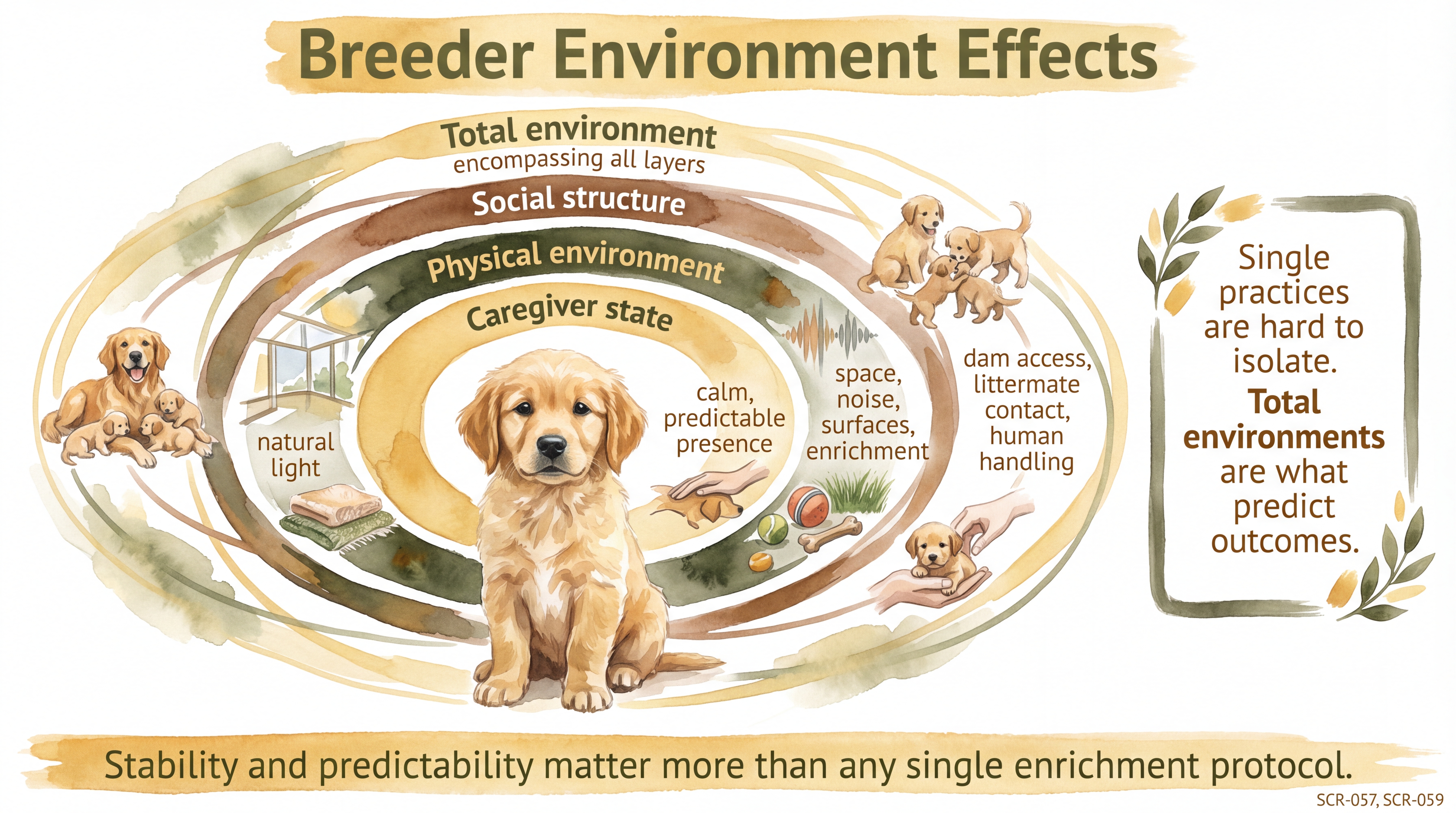
Stability and predictability of the total environment matter more than any single enrichment protocol.
Key Takeaways
- Breeder environment clearly matters, but it acts as a total developmental system rather than as one isolated trick.
- The strongest direct supports involve transition stress, familiar-proximity buffering, and caregiver-linked physiological flexibility.
- Stable, predictable, relationally secure environments differ biologically from unstable and dysregulated ones.
- The hardest scientific problem is not whether environment matters, but how to attribute specific portions of effect to specific breeder practices.
The Evidence
This entry uses observed claim-level tags beyond the dedicated EvidenceBlocks below. These tags mark JB program observation or practice-derived claims that need dedicated EvidenceBlock coverage in a later content pass.
- Hennessy, M. B. et al. (1997) and van der Laan, J. E. et al. (2022)domestic dogs
Novel shelter and rehoming contexts produced marked cortisol disruption, with calmer and more stable environments associated with recovery over time. - Baranyai, E. et al. (2025)domestic dogs
In novel environments, dogs slept better with familiar own​er presence than with stranger presence. - Schoberl, I. et al. (2017)dog-human dyads
Own​er profile predicted canine HPA-axis flexibility, supporting the role of caregiver state in the regulatory environment.
- Breeder-environment synthesisdomestic dogs
The broad importance of developmental environment is clear, but the literature does not yet isolate most breeder-practice components cleanly enough to assign exact causal credit to one favored practice.
- domestic dogs
No published study cleanly isolates which specific breeder-environment components drive later behavioral differences once maternal style, genetics, handling, and transition quality all interact.
SCR References
Sources
- Baranyai, L., Iotchev, I., Gombos, F., & Kis, A. (2025). Family dogs' sleep macrostructure reflects worsened sleep quality when sleeping in the absence of their owners: A non-invasive polysomnography study. Animals, 15(21), 3182. DOI: 10.3390/ani15213182.
- Hennessy, M. B. (1997). Plasma cortisol levels of dogs at a county animal shelter. Physiology & Behavior, 62(3), 485-490. DOI: 10.1016/S0031-9384(97)80328-9.
- van der Laan, J. E., Vinke, C. M., & Arndt, S. S. (2022). Evaluation of hair cortisol as an indicator of long-term stress responses in dogs in an animal shelter and after subsequent adoption. Scientific Reports, 12(1), 5117. DOI: 10.1038/s41598-022-09140-w.
- Schoberl, I., Wedl, M., Beetz, A., & Kotrschal, K. (2017). Psychobiological factors affecting cortisol variability in human-dog dyads. PLOS ONE, 12(2), e0170707. DOI: 10.1371/journal.pone.0170707.