Grooming as a Bonding Practice
Grooming is often talked about as maintenance: brushing, bathing, trimming, drying, nails, ears. All of that is true, but it misses something important. In a JB household, grooming can also be one of the clearest forms of calm affiliative contact between dog and human. A Golden lying quietly while being brushed, handled, and cared for is participating in more than hygiene. The dog is learning that human hands on the body predict steadiness, usefulness, and low-arousal companionship. Cross-species caregiving and allogrooming literature makes that idea intellectually serious, even though the exact JB application to a family brushing routine remains observational rather than experimentally demonstrated. Observed-JB
What It Means
Grooming as bonding means the session is approached as relationship time, not as a race to finish a chore. That changes the whole tone: the handler is calm, the dog begins from a calm state, the session is brief enough to succeed, the touch is readable, and the dog is allowed to step away when needed. Observed-JB This is not indulgence. It is good relational craftsmanship.
Why Grooming Maps So Naturally onto Bonding
Across social mammals, affiliative touch and body care are not trivial. They help regulate stress, maintain social bonds, and communicate safety. Observed-JB Primates provide the classic research frame, but the broader point is not species-specific trivia. Social bodies are calmed and connected by calm touch.
Dogs are not primates, and brushing a Golden Retriever is not literally equivalent to primate allogrooming. That boundary matters. But the cross-species logic still helps explain why grooming done well feels so different from grooming done under pressure. The dog experiences the difference immediately.
What Calm Grooming Looks Like
A calm grooming session often looks very simple: the dog is already at rest, the handler sits or kneels nearby, the brush comes out without fanfare, a few minutes of brushing happen, and the session ends before the dog becomes mentally thin. No bribery is required, no wrestling is justified, and no pinning is acceptable. If the dog shifts, pauses, or walks away, the handler reads that information and either softens the session or stops for now. Over time, many dogs come to enjoy the predictability of the contact itself.
Why This Matters So Much for Goldens
Golden Retrievers need regular coat care. Observed-JB Their feathering mats, their double coat sheds, and their ears and body surface benefit from routine handling. Because grooming is not optional in the breed, the emotional meaning of grooming matters greatly. A Golden that experiences handling as calm relationship time often carries that tolerance for life. A Golden that learns body care means restraint, frustration, rushing, or conflict often carries that too.
The difference is cumulative.
Why It Matters for Your Dog
Grooming done this way helps on several levels at once: the coat is maintained, the dog stays easy to handle, the human notices skin, ears, paws, and body changes earlier, and the bond deepens through calm repeated contact.
Mentorship is not only guidance in movement and manners. It is also how the adult lays hands on the young body. Calm grooming teaches the dog that care from the human is steady, useful, and safe.
There is also something deeply pleasant about reclaiming grooming from the category of unwanted chores. Many families discover that a five-minute evening brushing session becomes one of the most peaceful parts of the day. The dog relaxes. The human relaxes. The coat gets attended to almost incidentally while the relationship gets reinforced directly.
That is very JB.
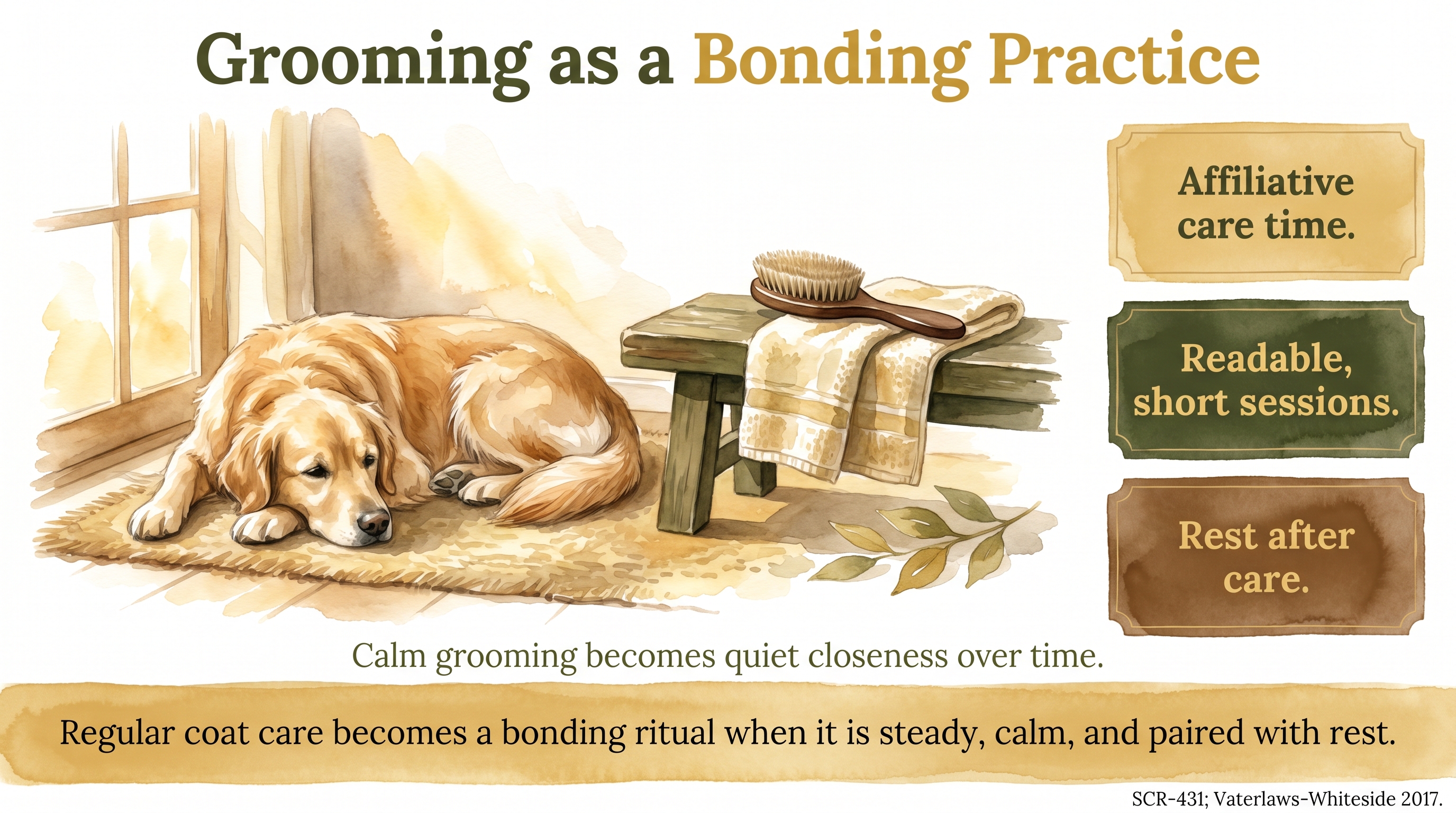
Regular coat care becomes a bonding ritual when it is steady, calm, and paired with rest.
Key Takeaways
- JB treats grooming as affiliative care time, not only as a maintenance chore.
- Calm grooming is built through readable touch, short successful sessions, and respect for the dogs state rather than through restraint and urgency.
- Because Goldens require regular coat care, the emotional meaning of grooming compounds across a lifetime.
- The stronger JB bonding claim is observational and cross-species informed, not a direct canine grooming trial.
The Evidence
- Allogrooming literatureprimates and social mammals
Social grooming supports bond maintenance, stress reduction, and affiliative regulation across many mammalian species. - Caregiving-touch literaturehumans and social mammals
Calm touch and caregiving contact can function as co-regulatory signals that alter stress experience and social security.
- JB breeder and family observationGolden Retrievers
Goldens handled through brief calm grooming sessions often show better lifetime tolerance than dogs whose coat care is rushed, forced, or delayed until mats and resistance are already present. - JB observationfamily dogs
When brushing is integrated into calm evening or household rhythm, many dogs experience it as pleasant contact rather than as an imposed procedure.
- JB synthesisfamily-dog grooming practice
The claim that regular brushing functions as an affiliative bonding practice comparable in spirit to broader mammalian grooming traditions is a cross-species interpretation rather than a direct canine experiment.
No published study directly tests the practical implications of grooming as a bonding practice for domestic dog raising programs. The application to household dog raising remains an interpretive synthesis rather than a directly tested intervention finding.
SCR References
Sources
- Payne, E., Bennett, P. C., & McGreevy, P. D. (2015). Current perspectives on attachment and bonding in the dog-human dyad. Psychology Research and Behavior Management, 8, 71-79. https://doi.org/10.2147/PRBM.S74972
- Nagasawa, M., Mitsui, S., En, S., Ohtani, N., Ohta, M., Sakuma, Y., Onaka, T., Mogi, K., & Kikusui, T. (2015). Oxytocin-gaze positive loop and the coevolution of human-dog bonds. Science, 348(6232), 333-336. https://doi.org/10.1126/science.1261022
- Boundary approved by Queue1-DecisionTree: Romero, T., Nagasawa, M., Mogi, K., Hasegawa, T., & Kikusui, T. (2014). Oxytocin promotes social bonding in dogs. Proceedings of the National Academy of Sciences, 111(25), 9085-9090. https://doi.org/10.1073/pnas.1322868111. This supports canine social-bonding physiology and complements the existing dog-human bond citations, but no dog-specific allogrooming source for the grooming-as-bonding claim was located. SCR-431 remains an [Observed] JB-practice claim.