What Canine Adolescence Actually Is
Compound evidence detail1 SCR / 2 parts
- Documenteddevelopmental research on canine adolescence including neurodevelopmental, hormonal, and behavioral markers
- HeuristicJB framing of adolescence as an extended mentorship phase rather than a phase of training breakdown or behavioral regression
Canine adolescence is not a vague excuse owners make when a young dog gets harder to live with. It is a real developmental period with a recognizable biological and behavioral signature. In Golden Retrievers, families usually begin to feel it somewhere around six to nine months, and many dogs do not look fully settled until eighteen to twenty four months. The body is maturing, the endocrine system is changing, the brain is still reorganizing, and the dogs relationship to the world becomes temporarily less simple. Documented
That last part matters. Families often imagine adolescence as a moral event. The dog was good, then the dog became difficult. The calmer and more useful frame is developmental. The dog is running a new nervous system. That new state often produces more novelty-seeking, more environmental scanning, less smooth inhibition, less reliable responsiveness to familiar human requests, and a more visible tension between curiosity and regulation. Observed-JB None of that means the relationship failed. It means the puppy has crossed into the next stage of growth.
The canine literature is now strong enough to say this directly. Mammalian adolescence is well documented as a period of continued prefrontal maturation, reward-system recalibration, and changing social priorities. In dogs, the best-known direct marker is the guide-dog cohort work showing a carer-specific drop in trainability and responsiveness around puberty and adolescence. In plain language, adolescent dogs may listen worse to the person they are most attached to while appearing more responsive to strangers or testers. That pattern looks personal to families. The data suggests it is developmental.
What It Means
What Adolescence Includes
The easiest mistake is to treat adolescence as a single behavior problem. It is better understood as a bundle of changes that travel together.
At the biological level, puberty and adolescence are not identical, but they overlap. Sexual maturation begins. Hormonal patterns shift. Ongoing myelination and inhibitory-system refinement continue. Sleep architecture changes. The balance between exploratory drive and settled regulation becomes less stable than it was in the late puppy months.
At the behavioral level, families often report more interest in the environment than in the household, more startle or overreaction to ordinary novelty, reduced reliability around recall and familiar routines, more testing of thresholds, doors, counters, guests, and leash tension, stronger attraction to other dogs, scents, movement, and distance, and periods of restlessness that did not define the earlier puppy. Observed-JB
These are not identical in every dog. Some Golden Retrievers become socially pushy. Some become briefly suspicious. Some mainly become distractible. Some simply feel louder, looser, and harder to settle. But the family experience is often the same: the dog they thought they understood has shifted shape.
What the Science Can Say Clearly
There are three levels here, and it helps to keep them separate.
First, mammalian adolescent neurobiology is documented. Across species, adolescence is a period of continued frontal-system maturation, reward sensitivity, emotional volatility, and imperfect inhibitory control. That is the strongest floor.
Second, the dog-specific behavioral signature is now documented enough to use carefully. The best direct findings support a temporary adolescent dip in responsiveness and trainability, especially in relation to the primary carer, along with the larger developmental reality that juvenile and adolescent environmental variables continue to matter for later fear and aggression outcomes.
Third, the full Just Behaving interpretation is partly observational. JB does not merely say that adolescence exists. It says families should stop moralizing the phase and instead hold the calm floor through it. That part is not a laboratory finding. It is a breeder and family-management conclusion built on the science plus repeated program experience.
Why Families Misread It
Adolescence often arrives after a deceptively encouraging stretch. The puppy has integrated into the household. Rest is easier. The family feels like the hard part is over. Then the dog begins to seem less available. Recall gets thinner. Settle becomes less automatic. Outside distractions suddenly matter more. Guests create more charge. Walks feel more like negotiations than quiet participation.
Because the earlier months felt like progress, families often experience the adolescent shift as regression. They assume the dog forgot what it knew, or worse, stopped caring.
But the better frame is baseline change.
The adolescent dog has not returned to a worse version of itself. It has moved into a more demanding version of itself. The environmental world has become more rewarding. Self-regulation has not caught up yet. The household now has to carry more of the regulation load from the outside while the internal system matures from the inside.
That is why punitive interpretations are so costly here. If the family reads development as defiance, they tend to escalate. The dog is pulled into more correction, more pressure, more performance expectations, and more emotionally loaded interactions at precisely the moment its nervous system is least helped by that approach.
The JB Frame
JB treats adolescence as a passage, not a betrayal.
The task is not to out-train the phase. The task is to hold the household steady while the phase passes. Calmness still matters. Mentorship matters more, not less. Structured Leadership becomes more visible because the dog is now large enough and driven enough to test edges actively. Prevention remains critical because adolescence is when a family can accidentally build the exact habits it will resent later by responding to energy with more energy.
Adolescence is the period when a family discovers whether it has been raising a dog or merely managing a puppy. The young dog still needs the same calm adult beside it. It simply needs that adult more consciously now.
JB also asks families to preserve perspective. The adolescent dog is still inside the same bond. It is still reading the same humans. It is still teachable. It is just temporarily more influenced by motion, novelty, peers, scent, and internal drive than it was at five months.
That difference matters because it changes what success looks like.
During adolescence, success is not a perfectly obedient young dog performing maturity early. Success is a dog who keeps moving through the phase without being pushed into chronic overarousal, adversarial correction, or social chaos. The long arc matters more than the week-to-week mood.
What This Is Not
Canine adolescence is not proof that the puppy months were wasted, evidence that the dog has become dominant, a sign that the family now needs a harsher method, a guarantee that every challenge is temporary and harmless, or a reason to stop managing the environment.
Calling something developmental does not mean ignoring it. A dog in adolescence may be less reliable around traffic, wildlife, guests, food, or other dogs than it was weeks earlier. The developmental explanation should make the family calmer, not less serious. Management usually needs to tighten while adolescence is active.
Why It Matters for Your Dog
If a family understands adolescence for what it is, it tends to make better decisions in the exact weeks when people are most tempted to panic.
They shorten the dogs freedom before the dog proves unreliable in a dangerous place.
They re-protect rest before overtired behavior becomes the daily baseline. Documented
They lengthen calm walks instead of adding frantic exercise.
They read responsiveness changes as developmental load, not as moral disrespect.
They preserve attachment while still holding boundaries.
Most of all, they stop trying to make the adolescent look finished.
That matters because adolescence is not where a Golden Retriever proves itself. It is where the dogs final adult form is still being assembled. A family that reads this phase well usually arrives at adulthood with more patience, better management, and a dog that was allowed to mature rather than forced into a theatrical version of maturity too early.
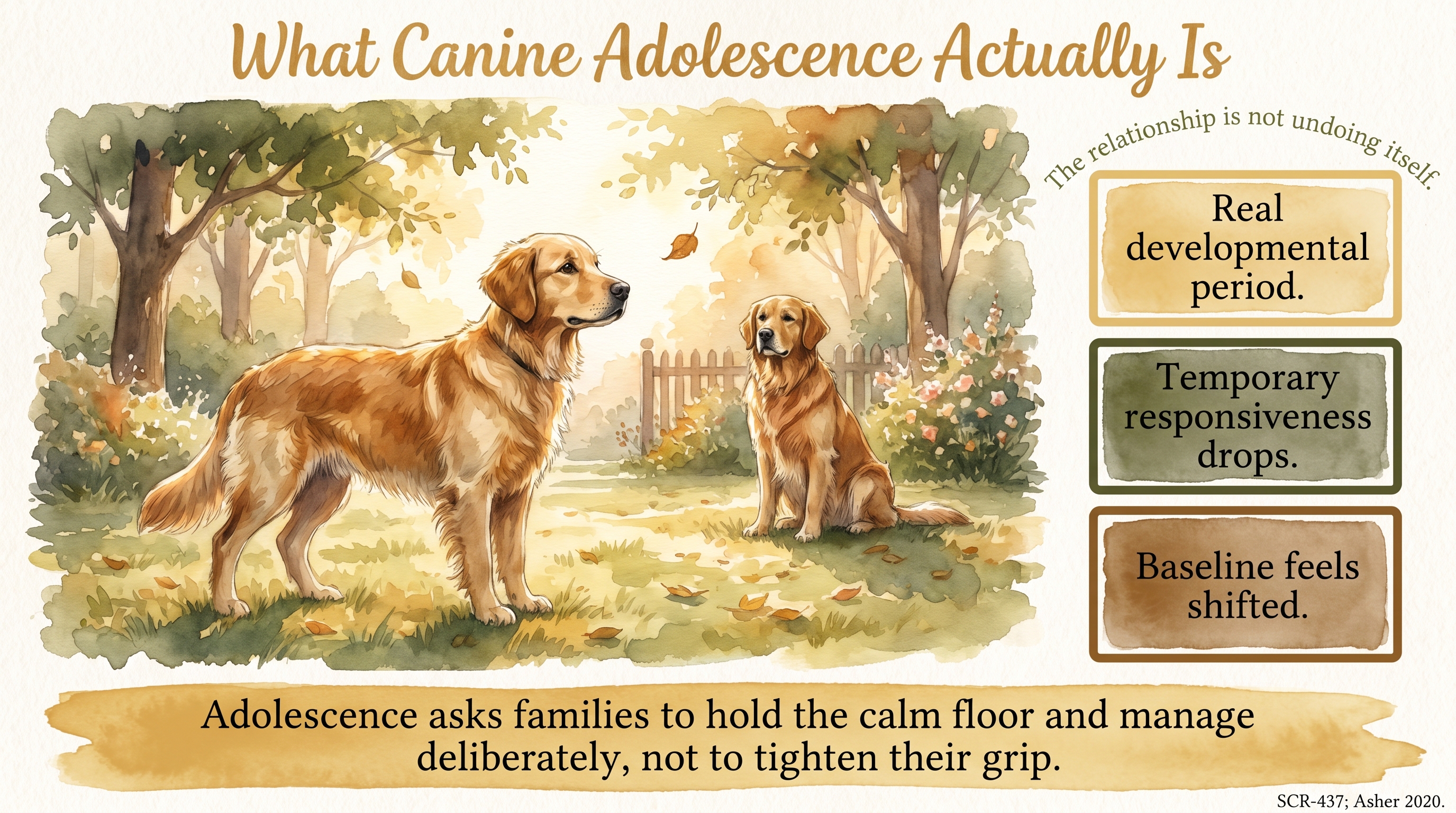
Adolescence asks families to hold the calm floor and manage deliberately, not to tighten their grip.
Key Takeaways
- Canine adolescence is a real developmental period, not a made-up excuse for difficult behavior.
- The strongest direct dog evidence supports temporary drops in responsiveness and trainability during adolescence, especially with the primary carer.
- Families usually feel adolescence as a baseline shift, not because the relationship disappeared but because the dogs nervous system is changing.
- The JB response is to hold the calm floor and manage more deliberately, not to treat the entire phase as disobedience.
The Evidence
- general mammalian adolescence literaturemammals
Adolescence is characterized by continued frontal-system maturation, changing reward salience, and incomplete inhibitory control relative to adulthood. - prefrontal maturation frameworkmammals
The gap between stronger emotional and reward drives and still-maturing control systems is a core developmental feature of adolescence rather than a character defect.
- Asher et al. (2020)domestic dogs
Adolescent dogs showed a carer-specific reduction in responsiveness and trainability around puberty, supporting adolescence as a genuine developmental phase in the species. - guide-dog longitudinal studies summarized in the development referencedomestic dogs
Juvenile and adolescent experiences continue to influence later fear and aggression outcomes, indicating that development remains highly active after the early puppy window.
- JB breeder observationGolden Retrievers
Families often experience adolescence as a baseline shift marked by more environmental pull, more testing, and less seamless settling, while the underlying relationship remains intact. - JB program synthesisfamily-raised Golden Retrievers
The most stable adolescent outcomes tend to come from families that re-tighten rhythm and management while keeping the emotional tone calm.
No published study directly tests the practical implications of what canine adolescence actually is for domestic dog raising programs. The application to household dog raising remains an interpretive synthesis rather than a directly tested intervention finding.
SCR References
Sources
- Asher, L., England, G. C. W., Sommerville, R., & Harvey, N. D. (2020). Teenage dogs? Evidence for adolescent-phase conflict behaviour and an association between attachment to humans and pubertal timing in the domestic dog. Biology Letters, 16(5), 20200097. https://doi.org/10.1098/rsbl.2020.0097
- Bray, E. E., Gruen, M. E., Gnanadesikan, G. E., Horschler, D. J., Levy, K. M., Kennedy, B. S., Hare, B. A., & MacLean, E. L. (2021). Dog cognitive development: A longitudinal study across the first 2 years of life. Animal Cognition, 24, 311-328. https://doi.org/10.1007/s10071-020-01443-7
- Reicher, V., Kis, A., Simor, P., Bodizs, R., Gacsi, M., & Topal, J. (2021). Developmental features of sleep electrophysiology in family dogs. Scientific Reports, 11, 22760. https://doi.org/10.1038/s41598-021-02117-1
- Asher, L., England, G. C. W., Sommerville, R., & Harvey, N. D. (2020). Teenage dogs? Evidence for adolescent-phase conflict behaviour and an association between attachment to humans and pubertal timing in the domestic dog. Biology Letters, 16(5), 20200097. https://doi.org/10.1098/rsbl.2020.0097
- Serpell, J. A., & Duffy, D. L. (2016). Aspects of juvenile and adolescent environment predict aggression and fear in 12-month-old guide dogs. Frontiers in Veterinary Science, 3, 49. https://doi.org/10.3389/fvets.2016.00049