The Do As I Do Protocol
The Do As I Do protocol, usually shortened to DAID, is one of the most important developments in canine social-learning research. Observed-JB It turned a vague question - "can dogs imitate?" - into a testable one. Instead of only watching whether a dog happened to copy a single demonstration, researchers taught the dog a generalized rule: after a human action, reproduce what the human just did.
That shift was decisive. Once dogs learned the abstract copying rule, researchers could test novel actions, delayed recall, generalization, and the difference between imitation and simpler explanations such as enhancement or emulation.
What It Means
Topal and colleagues introduced the paradigm in 2006. The basic idea was elegant: train the dog on a generalized "Do it!" command that means "repeat the action I just performed", establish that the dog can use that rule across multiple familiar actions, and test whether the dog can transfer the rule to a novel demonstrated action. If the dog succeeds only on trained actions, the result is weaker. If the dog succeeds on novel actions after learning the abstract rule, then imitation is much harder to dismiss as mere enhancement.
That is why DAID matters. It does not claim that dogs spontaneously imitate every behavior they see in ordinary life. Documented It does show that dogs can represent another individual's action as something they themselves can later reproduce.
The later Fugazza work expanded the paradigm in several directions. Deferred-imitation studies asked whether dogs could encode an action, wait through a delay, and then reproduce it. Documented Social-learning comparison studies asked whether DAID led to different retention and generalization profiles than shaping or clicker training. Goal-directed action studies asked whether dogs copied the exact method or only the outcome. Together, these studies shifted canine social-learning research from anecdote to controlled mechanism testing.
Why It Matters for Your Dog
How the Protocol Works
In DAID training, the dog first learns a set of actions it can already perform on cue, such as touching an object, jumping, spinning, or moving around an obstacle. The human demonstrator then performs one of those actions. The command follows, asking the dog to "do what I just did." Over repeated training, the dog learns that the relevant information is the demonstrator's action itself.
Only after that abstraction is established do the key tests begin. Researchers then ask whether the dog can reproduce a novel action that was not part of the original copying set. That is the important leap, because it tests whether the dog learned an action-specific association or a more general imitation rule.
DAID studies also became useful for memory questions. Documented If the demonstration is encoded and reproduced later, then the dog is not merely reacting in the moment. It has retained a representation of what the human did.
This point is especially important when DAID is compared with shaping. In shaping, the dog discovers the target behavior gradually through reinforcement of successive approximations. In DAID, the dog begins with a social model. The two systems can reach the same endpoint, but they do so through different informational pathways.
What the Findings Show
The central finding is that dogs can reliably use a generalized copy rule and apply it to new demonstrated human actions. That alone places dogs above the older claim that they only learn socially through simple attention effects.
The later literature added two especially important findings.
First, dogs trained through DAID often showed stronger retention and broader generalization than dogs taught equivalent object tasks through shaping or clicker procedures. This does not mean DAID is always superior for every task. It does mean that social demonstration can produce durable learning in a distinct way.
Second, the DAID literature helped set the stage for overimitation. Once dogs can copy demonstrated actions in a generalized framework, researchers can ask whether they copy only what is instrumentally necessary. The answer is no. In some studies, dogs copied irrelevant actions from caregivers even when those actions were not required for obtaining the reward. Documented
That matters because it expands the meaning of imitation. The dog is not simply extracting a bare causal recipe. In at least some contexts, the demonstrated method itself matters.
Why It Matters
DAID matters scientifically because it gave the dog literature a clean way to argue for true imitation. It matters conceptually because it separates three things that often get blurred: seeing another individual do something, becoming interested in the same object or place, and representing the observed action as something to reproduce. Only the third is what makes imitation the strongest explanation.
The DAID literature does not prove that ordinary family life is identical to a laboratory imitation task. It does prove that dogs can treat another individual's action as instruction, not just background movement.
That distinction is especially useful in dog discussions because training culture often reduces learning to reinforcement histories. DAID does not erase the role of consequences, but it shows that observation can be the gateway into behavior in its own right.
Important Limits
This page needs several limits stated clearly. DAID evidence comes from trained laboratory or research-context dogs. Documented The dog has to learn the copy rule first. That means the claim is not "all puppies automatically imitate anything they see." It is that dogs have the cognitive capacity to learn and use an imitation rule when the paradigm is set up to test it.
The protocol also does not settle the broader question of what dominates natural puppy development. A dog proving imitation in DAID is strong evidence for social-learning capacity. It is not, by itself, a direct naturalistic study of breeder litters or family households.
Finally, DAID does not require mirror-neuron theory to remain valid. The behavior stands even if the underlying mechanism is explained through associative or distributed action-observation processes rather than specialized mirror cells.
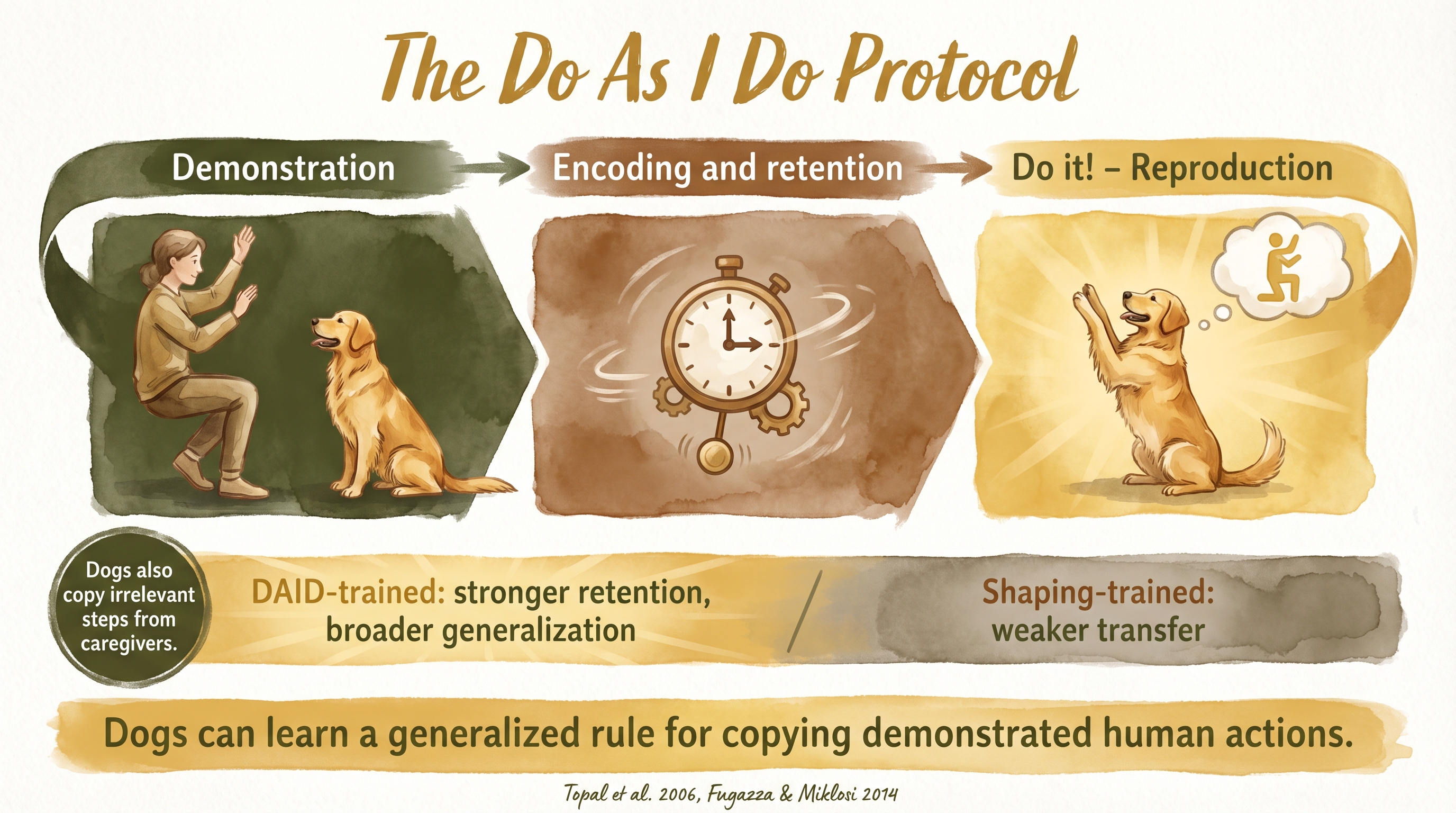
Do As I Do demonstrates that dogs can learn novel actions through observation and deferred imitation of human models.
Key Takeaways
- The Do As I Do protocol taught dogs a generalized rule for copying demonstrated human actions.
- That paradigm gave researchers a much stronger way to test true imitation than older one-off copying anecdotes.
- DAID studies show that dogs can remember and reproduce demonstrated actions, not only become interested in the same place or object.
- The protocol proves imitation capacity in controlled settings, but it should not be overstated into a full natural-home developmental theory by itself.
The Evidence
This entry uses observed claim-level tags beyond the dedicated EvidenceBlocks below. These tags mark JB program observation or practice-derived claims that need dedicated EvidenceBlock coverage in a later content pass.
- Topal, J. et al. (2006)domestic dogs
Established the original Do As I Do paradigm and showed that dogs can reproduce demonstrated human actions. - Fugazza, C., & Miklosi, A. (2014)domestic dogs
Showed deferred imitation, supporting memory for demonstrated actions rather than simple immediate mimicry. - Fugazza, C., & Miklosi, A. (2015)domestic dogs
Compared Do As I Do with shaping and clicker methods and found stronger retention and generalization for some socially learned tasks. - Fugazza, C., Pogany, A., & Miklosi, A. (2016)domestic dogs
Extended the evidence for incidental encoding and later recall of others' actions.
- Fugazza, C. et al. (2019)domestic dogs
Asked whether dogs copied goal-directed actions by imitation or emulation, refining the mechanism question. - Huber, L. et al. (2018)domestic dogs
Showed overimitation of caregiver-demonstrated irrelevant actions, indicating that dogs do not always strip away unnecessary demonstrated steps.
- SCR synthesisdomestic dogs
DAID establishes canine imitation capacity in controlled settings, but the spontaneous use claim for ordinary household development remains more observational than experimentally isolated.
No long-term developmental study has tracked whether puppies trained in DAID paradigms show different naturalistic observational-learning profiles compared to untrained controls in family settings.
SCR References
Sources
- Fugazza, C., & Miklosi, A. (2014). Deferred imitation and declarative memory in domestic dogs. Animal Cognition, 17(2), 237-247.
- Fugazza, C., & Miklosi, A. (2015). Social learning in dog training: The effectiveness of the Do As I Do method compared to shaping or clicker training. Applied Animal Behaviour Science, 171, 146-151.
- Fugazza, C., Pogany, A., & Miklosi, A. (2016). Recall of others' actions after incidental encoding reveals episodic-like memory in dogs. Current Biology, 26(3), 320-324.
- Fugazza, C., Colbert-White, E. N., & Pongracz, P. (2019). Social learning of goal-directed actions in dogs: Imitation or emulation? Journal of Comparative Psychology, 133(2), 195-205.
- Topal, J., Byrne, R. W., Miklosi, A., & Csanyi, V. (2006). Reproducing human actions and action sequences: Do as I Do in a dog. Animal Cognition, 9(4), 355-367. https://doi.org/10.1007/s10071-006-0051-6