Social Learning in Dogs: An Overview
Compound evidence detail1 SCR / 2 parts
- Documentedthe cross-species evidence for mentorship convergence in non-canid mammals, including chimpanzee tool-use transmission (Inoue-Nakamura and Matsuzawa 1997), dolphin foraging transmission, meerkat prey-handling teaching, and elephant matriarchal knowledge transfer
- Heuristicthe JB application of the cross-species convergence to dog raising, mapping the pattern in function rather than mechanism, with no formal canine teaching study under the strict definition
Social learning is learning from others. Instead of discovering everything through direct trial and error, the learner watches another individual, extracts information, and then changes what it tries, how quickly it succeeds, or how it interprets a situation. In dogs, that capacity is well documented. Puppies as young as eight weeks can acquire novel behavior from both canine and human demonstrators, adult dogs can reproduce demonstrated actions in controlled tests, and dogs sometimes copy even inefficient actions when those actions come from a trusted caregiver. Documented
That combination makes social learning one of the most important scientific foundations for understanding canine development. It also explains why the topic sits at the boundary between behavioral science and the Five Pillars. The science pages establish what dogs are documented to do. The pillar pages then ask what those findings mean for raising a family dog.
What It Means
At the broadest level, social learning means that another individual's behavior changes the learner's own behavior in a durable way. Documented That sounds simple, but it covers several different mechanisms: local enhancement (the observer is drawn to a place where another individual acted), stimulus enhancement (the observer is drawn to a specific object another individual handled), emulation (the observer learns about the goal or result without copying the exact motor pattern), imitation (the observer copies the demonstrator's method as well as the outcome), overimitation (the observer copies causally irrelevant steps along with useful ones), and social referencing (the observer uses another individual's emotional response as information about how to respond).
These mechanisms do not all require the same level of cognition, and they do not all show up with the same strength in every species. That is one reason comparative work matters. It helps place dogs inside the larger literature instead of treating them as an isolated case.
For a long time, dog cognition debates got stuck on a narrow question: do dogs really imitate, or do they only show simpler forms of social influence such as local enhancement? The modern answer is more nuanced. Dogs clearly show the simpler mechanisms, and under controlled conditions they also satisfy stronger imitation criteria. The safest summary is not "dogs only emulate" or "dogs imitate exactly like humans." It is that dogs show a meaningful spectrum of social-learning capacities, and the exact mechanism depends on the task, the demonstrator, and the methodology used to test it.
The developmental evidence is especially important. Fugazza and colleagues showed that eight-week-old puppies learned from both canine and human demonstrators in a puzzle-box task, and that the effect persisted after a delay. Earlier work by Adler and Adler and by Slabbert and Rasa also found observational learning in young dogs. This means social learning is not a late, special-case talent that appears only after heavy experience. It is present very early in life.
Adult dog evidence deepens the picture. The Do As I Do paradigm showed that dogs can learn a generalized rule to reproduce demonstrated human actions and later apply it to novel behaviors. In later work, dogs trained through social-learning paradigms showed stronger retention and better generalization than dogs taught the same object tasks through shaping or clicker methods. That does not prove that social learning always dominates every other learning system, but it does show that observation can be a powerful and distinctive route to acquisition.
Overimitation complicates the story in a useful way. Dogs do not always copy with strict efficiency. In classic caregiver-demonstration tasks, some dogs copied causally irrelevant actions before solving the actual problem. That matters because it shows that canine social learning is not only about extracting the shortest path to reward. Social relationship and demonstrator identity affect what gets copied.
No published study has directly tested whether JB-style social-learning mentorship produces measurably better learning outcomes or behavioral flexibility in puppies compared to operant-only or clicker-based training approaches.
Social referencing expands the domain further. Dogs not only copy actions. They also use other individuals' emotional responses as information. In ambiguous situations, dogs look to their owners, read the response, and then approach or avoid accordingly. Puppies also show this capacity early. Documented That makes social learning partly cognitive, partly emotional, and partly regulatory.
Why It Matters for Your Dog
Dogs in the Comparative Literature
Dogs sit in a fascinating middle position in the comparative literature.
Compared with great apes, dogs often look less focused on pure causal efficiency and more sensitive to human social cues. In overimitation tasks, great apes usually strip away irrelevant steps, while dogs sometimes preserve them. That does not mean dogs have identical human-style norm psychology. The stronger claim that canine overimitation reflects fully human-like cultural conformity goes too far. But it does mean dogs sometimes prioritize the social meaning of the demonstration rather than only the mechanical goal.
Compared with wolves, domestic dogs often look less attentive to conspecific action copying and more prepared for human-directed cue use. Wolf pups can outperform dogs in some conspecific imitation paradigms, while dogs outperform wolves in many human gesture and cooperative-communication tasks. This is one reason the canine literature keeps returning to domestication. The social-learning profile of dogs appears to have been reshaped by selection for life with humans rather than simply inherited unchanged from wolves.
Compared with corvids, dogs are not the dominant example of technical problem solving. Corvid work often highlights causal reasoning, innovation, and object manipulation in species such as crows and ravens. Dogs, by contrast, look especially strong in socially mediated learning and in taking information from a partner. The comparative point is not that dogs are smarter or simpler overall. It is that their learning system appears unusually tuned to social channels, especially human ones.
That comparative framing matters because it prevents two common errors:
- understating dogs by pretending they are only trial-and-error learners
- overstating dogs by claiming they possess every advanced social-cognitive mechanism in the same form as humans
The documented position is stronger and cleaner than either extreme. Dogs are capable social learners, but each mechanism must be described at its own evidence level.
The Major Paradigms
The science of canine social learning depends on careful experimental design. Researchers do not simply watch a dog copy a behavior and assume imitation happened. They try to separate different explanations.
In local-enhancement tasks, the demonstrator makes a place interesting. The observer then approaches that place more readily. In stimulus-enhancement tasks, the demonstrator makes a particular object salient. In emulation tasks, the question is whether the observer reproduces the same result without necessarily reproducing the same action. In true-imitation designs, researchers look for copying of specific movement patterns, often using two-action or bidirectional-control methods that rule out simpler explanations.
The Do As I Do line of work became influential because it pushed dogs past the older claim that they only showed enhancement or emulation. After first learning a generalized rule, dogs could copy novel human actions, recall them later, and reproduce them in new contexts. This is why the DAID literature appears so often in modern discussion. It offered a more stringent route to testing imitation in dogs.
Overimitation studies then pushed the question again. Documented If a dog copies a clearly unnecessary action, that is hard to explain purely as efficient goal learning. It suggests that at least in some contexts, the demonstrated method itself carries value.
Social referencing studies use a different structure. Documented Here the key question is not "Will the dog copy the action?" but "Will the dog use the demonstrator's emotional reaction as information?" Merola's fan-with-streamers paradigm became the classic example: dogs checked the owner, read the response, and changed their own approach accordingly. Later puppy work showed that this process appears surprisingly early.
What Is Well Documented, and What Is Not
Several things are on firm ground.
- Puppies from eight weeks onward can learn novel behavior through social learning. Documented
- Dogs can overimitate caregiver-demonstrated actions.
- Cross-species adult-to-young competence transfer is a documented pattern across social mammals.
- Breed selection history affects which demonstrator carries the strongest advantage.
Several other things need tighter framing.
Mirror-neuron explanations remain uncertain. Dogs show behavioral and neuroimaging findings consistent with action-observation networks, but no direct single-cell mirror-neuron recording has been published in canines. That means mirror neurons are a candidate mechanism, not a confirmed foundation. The social-learning evidence does not depend on mirror-neuron theory to remain valid.
The stronger developmental claim that social learning is the dominant natural pathway by which puppies become functional adults is still more interpretive than directly tested. The evidence strongly supports observation, demonstrator effects, caregiver influence, and emotional guidance. But there is no study that cleanly partitions natural puppy development into "mostly social learning" versus "mostly consequence-driven learning" under ordinary rearing conditions. That broader claim therefore belongs at a heuristic ceiling, not a documented one.
Cross-species comparison also needs discipline. It is documented that chimpanzees, dolphins, meerkats, and elephants all show forms of adult-to-young competence transmission. It is heuristic to say that these examples prove domestic dogs are raised through the same mechanisms. The pattern is conserved. The mechanism varies.
Why It Matters for Understanding Dogs
This page matters because it changes the baseline model of how dogs acquire behavior.
If dogs were mainly trial-and-error learners, then the main scientific story would center on consequences arranged after the dog acts. Social-learning research shows that this is incomplete. Dogs can learn before they act, by watching. They can use another individual's success, failure, attention, emotion, and even unnecessary method as information.
The science layer does not prove every JB claim. It does show that dogs are built to learn socially, and that adult models are part of the developmental picture rather than background decoration.
That matters whether or not one adopts any particular philosophy of raising. It matters for developmental science, for comparative cognition, for handler-dog teamwork, and for how early-life environments are interpreted. Once observation and demonstrator identity are recognized as causal variables, the environment stops looking like neutral scenery and starts looking like a teaching environment.
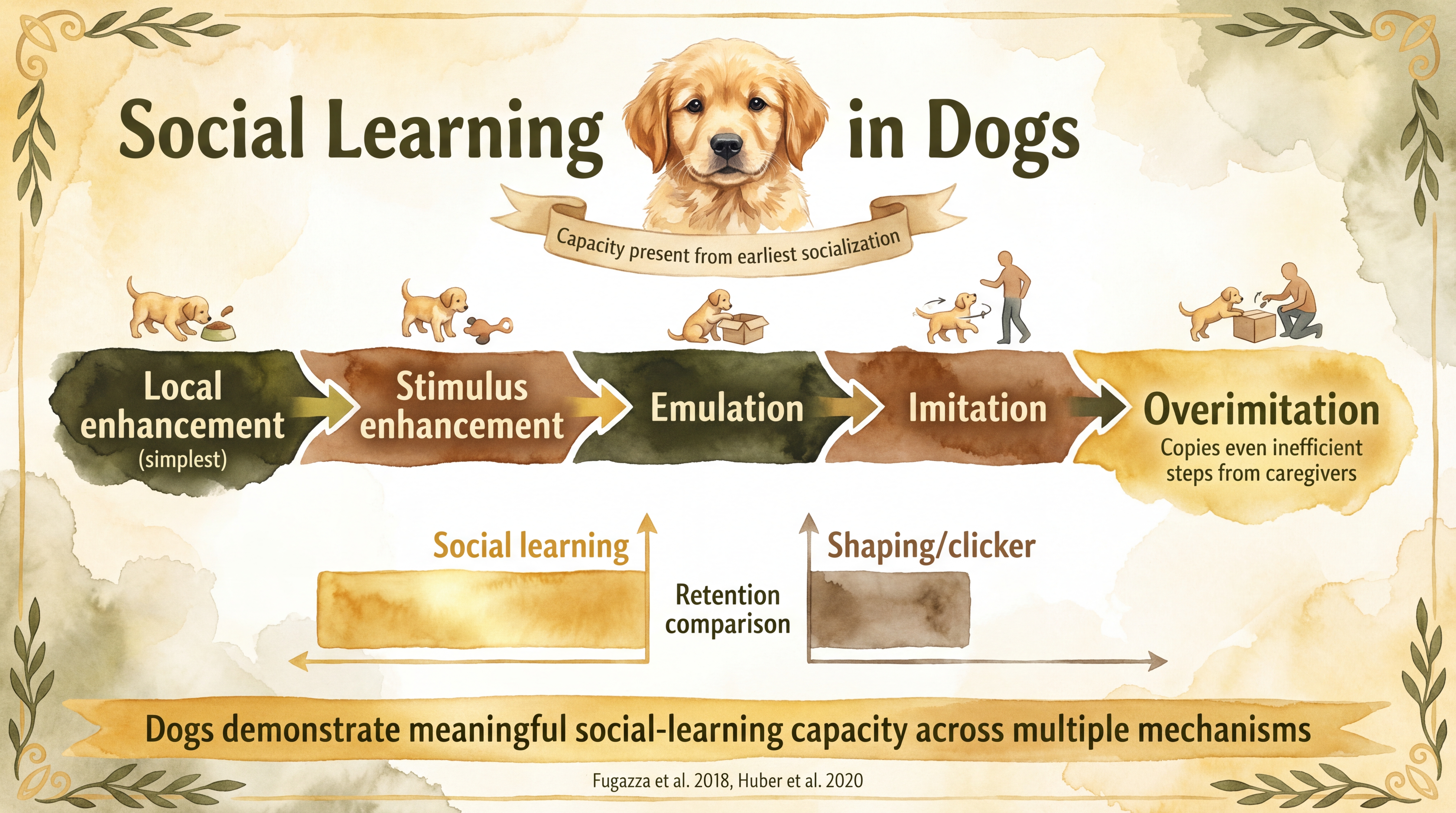
Social learning encompasses multiple mechanisms - from local enhancement through emulation to true imitation - not a single process.
Key Takeaways
- Dogs do not learn only through direct trial and error. They can learn by watching other dogs and humans.
- The canine social-learning toolkit includes enhancement, emulation, imitation, overimitation, and social referencing.
- Puppies show social-learning capacity early, which means observation is developmentally relevant from the start of family life.
- The documented science supports strong social-learning capacity, but the broader claim that it is the dominant natural developmental pathway remains heuristic rather than fully proven.
The Evidence
- Fugazza, C. et al. (2018)domestic dogs
Eight-week-old puppies learned puzzle-box solutions from canine and human demonstrators, with retention after delay. - Adler, L. L., & Adler, H. E. (1977)domestic dogs
Miniature Dachshund puppies with observer exposure solved a task faster than controls, supporting early observational learning. - Slabbert, J. M., & Rasa, O. A. E. (1997)domestic dogs
Working-dog puppies learned maternal behavior patterns more effectively with observational exposure. - Fugazza, C., & Miklosi, A. (2015)domestic dogs
Dogs trained with Do As I Do showed stronger retention and generalization on object tasks than shaping or clicker-trained dogs.
- Huber, L. et al. (2018, 2020, 2022)domestic dogs
Overimitation findings showed socially influenced copying of inefficient actions from caregivers. - Inoue-Nakamura, N., & Matsuzawa, T. (1997)chimpanzees
Documented adult-to-young transfer of tool-use competence. - Krutzen, M. et al. (2005)bottlenose dolphins
Documented vertical transmission of foraging traditions. - Thornton, A., & McAuliffe, K. (2006)meerkats
Adults scaffolded prey handling in young through graded social support.
- SCR synthesisdomestic dogs
The stronger claim that social learning is the dominant developmental pathway in natural canine raising remains a reasoned interpretation rather than a directly isolated empirical result. - SCR-031 boundarydomestic dogs
Mirror-neuron explanations remain candidate mechanisms only. The documented social-learning findings do not depend on proving mirror neurons in dogs.
No study has measured the relative contribution of social learning versus consequences-based learning in natural puppy development, making it impossible to quantify which pathway dominates early life without controlled isolation of variables.
SCR References
Sources
- Adler, L. L., & Adler, H. E. (1977). Ontogeny of observational learning in the dog (Canis familiaris). Developmental Psychobiology, 10(3), 267-271.
- Fugazza, C., & Miklosi, A. (2015). Social learning in dog training: The effectiveness of the Do As I Do method compared to shaping or clicker training. Applied Animal Behaviour Science, 171, 146-151.
- Fugazza, C., Moesta, A., Pogany, A., & Miklosi, A. (2018). Social learning from conspecifics and humans in dog puppies. Scientific Reports, 8, 9257.
- Huber, L., Popovova, N., Riener, S., Salobir, K., & Cimarelli, G. (2018). Would dogs copy irrelevant actions from their human caregiver? Learning & Behavior, 46(4), 387-397.
- Krutzen, M., Mann, J., Heithaus, M. R., Connor, R. C., Bejder, L., & Sherwin, W. B. (2005). Cultural transmission of tool use in bottlenose dolphins. Proceedings of the National Academy of Sciences, 102(25), 8939-8943.
- Slabbert, J. M., & Rasa, O. A. E. (1997). Observational learning of an acquired maternal behaviour pattern by working dog pups. Applied Animal Behaviour Science, 53(4), 309-316.
- Thornton, A., & McAuliffe, K. (2006). Teaching in wild meerkats. Science, 313(5784), 227-229. https://doi.org/10.1126/science.1128727