Spatial Pressure
Compound evidence detail1 SCR / 2 parts
- Observed-JBthe ethological evidence that adult dogs deploy specific social signals with situational selectivity and brief contextual deployment (Abrantes, Bekoff, Mech) together with the Bray, MacLean et al. 2021 retriever puppy demonstration that canine attention to human gestural cues is biologically pre-loaded
- Heuristicthe JB application generalizing the dog signal-precision pattern into a universal social-signaling principle and the corollary claim that high-frequency human verbal praise categorically degrades communicative information in household contexts
Spatial Pressure is calm movement toward the puppy to create distance from an unwanted behavior or location. It is related to body blocking, but it is not the same thing. Body blocking closes a path. Spatial pressure moves the puppy away. The ethological backdrop is documented through canine spatial signaling. The JB technique remains observed practice layered on top of that foundation. Observed-JB
What It Means
The image is simple: the adult moves calmly into the puppy's space just enough to make "move away from here" the obvious answer.
This can be used when a puppy is:
- crowding a threshold
- hovering over something it should leave
- pestering another dog
- planting itself in the middle of an activity it needs to exit
The movement is measured, not theatrical. There is no charge, no chase, and no cornering. The pressure stops the moment the puppy yields space. Observed-JB That last part is the whole point. Pressure that continues after the dog has already moved is no longer informative. It is just sustained stress.
The documented support comes from the fact that dogs do treat orientation, approach angle, and positioning as meaningful signals. Documented The JB signal-precision overlay adds a further claim: the pressure carries information partly because it is rare, contextual, and precisely timed rather than constant. Heuristic
JB also treats proportionality as essential. The intensity should match the significance of the boundary. Minor issues need very little. Observed-JB More important boundaries may justify a slightly firmer step. But the movement never becomes a chase scene. If the dog cannot choose an easy exit, the technique has already gone wrong.
Why It Matters for Your Dog
Spatial Pressure gives the human a way to organize space without turning every interruption into hand contact or verbal control. Observed-JB That can keep the interaction calmer and more readable for puppies that are already overstimulated.
Spatial pressure should create clarity, not panic. The puppy should feel guided out of the space, not hunted through it.
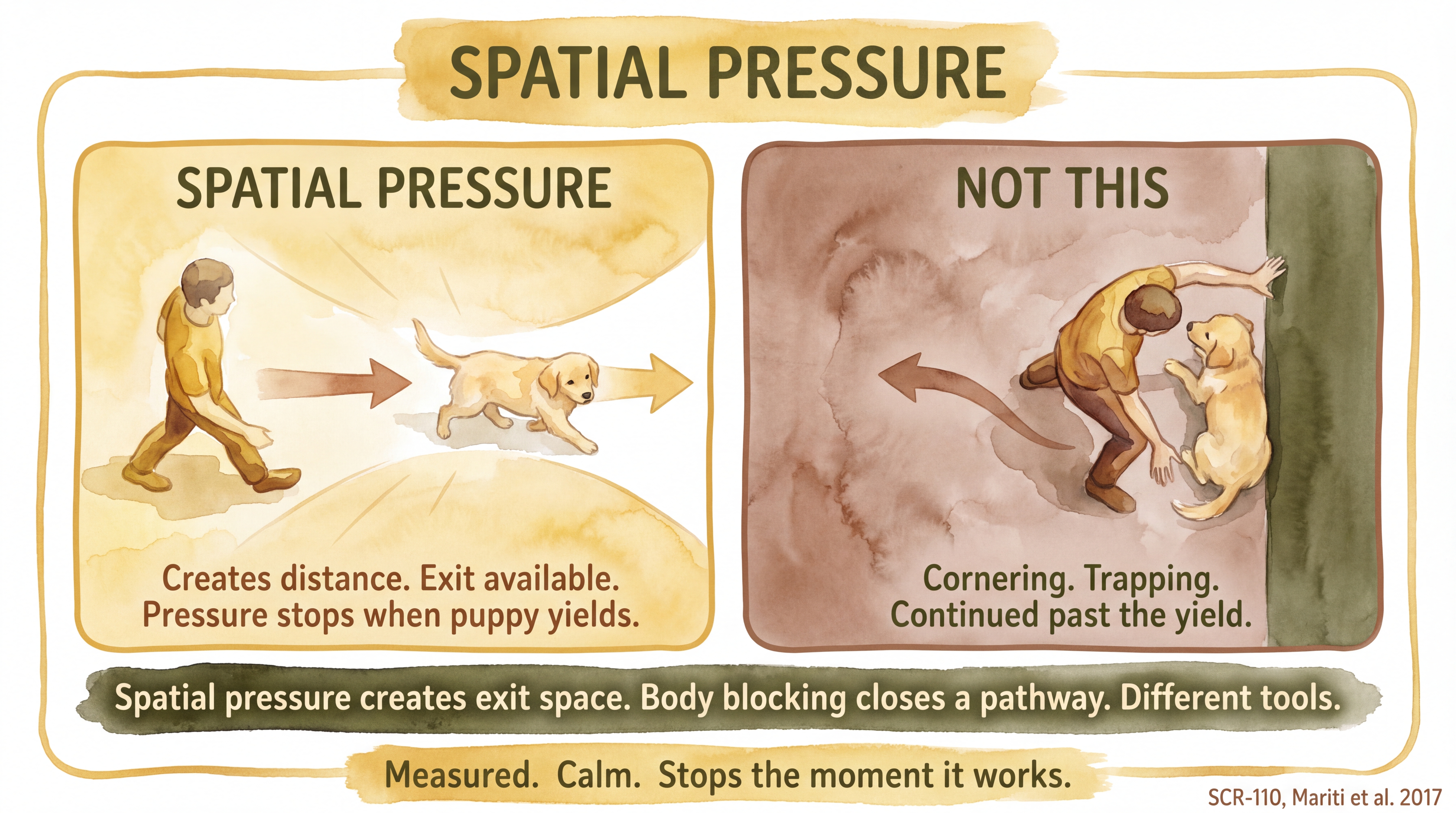
Spatial pressure creates distance with an exit available - measured, calm, stops the moment it works.
Key Takeaways
- Spatial pressure moves the puppy away from something, while body blocking prevents the puppy from reaching something.
- The pressure stops the moment the puppy yields space - anything beyond that is no longer informative.
- Dogs naturally read approach angle and positioning as social signals, giving this technique an ethological foundation.
- If the puppy cannot choose an easy exit, the technique has already gone wrong.
The Evidence
- Canine communication literature summarized in SCR-110domestic dogs
Dogs use approach angle, body orientation, and spatial positioning as meaningful social signals, supporting the idea that movement through space can itself communicate meaning. - Mariti, C. et al. (2017)domestic dogs
Pilot data support subtle de-escalatory signaling in dog social interaction, giving low-intensity pressure more credibility than folk intuition alone.
- domestic dogs and JB synthesis
The claim that spatial pressure works partly because it is sparse, contextual, and precisely timed is consistent with JB's signal-precision framework, which remains observed and heuristic rather than directly quantified.
- Golden Retrievers in program practice
The specific JB guidance about how far to move, when to stop, and how to keep the technique non-threatening is observed program practice rather than a tested published protocol.
No published study directly tests the specific claims or protocols described in this entry within a controlled canine trial.
SCR References
Sources
- Mariti, C., et al. (2017). Analysis of the intraspecific visual communication in the domestic dog. Journal of Veterinary Behavior, 18, 49-57.
- Vieira de Cas
- Canine communication literature summarized in SCR-110. Supports canine spatial-signal communication as ethological background. The spatial-pressure technique-level protocol remains [Observed/Heuristic] (anchor: SCR-110).