Quiet Disengagement
Compound evidence detail1 SCR / 2 parts
- Observed-JBthe ethological evidence that adult dogs deploy specific social signals with situational selectivity and brief contextual deployment (Abrantes, Bekoff, Mech) together with the Bray, MacLean et al. 2021 retriever puppy demonstration that canine attention to human gestural cues is biologically pre-loaded
- Heuristicthe JB application generalizing the dog signal-precision pattern into a universal social-signaling principle and the corollary claim that high-frequency human verbal praise categorically degrades communicative information in household contexts
Quiet Disengagement is the selective withdrawal of engagement to end an interaction without anger or spectacle. The adult turns away, goes still, or becomes briefly unavailable to the demanding behavior. The core JB technique is observed practice. The supporting backdrop comes from signal precision and from documented de-escalatory signaling in dogs. Observed-JB
What It Means
Quiet disengagement is not general detachment. It is not the cold shoulder as a lifestyle. It is a momentary social answer to pushy, demanding, or rude behavior. Observed-JB
The adult says, in effect, "that way of asking does not keep the conversation going."
This is most useful when a puppy is:
- jumping for social access
- pestering for attention
- demanding play when the answer is no
- escalating because any response counts as fuel
The technique is quiet on purpose. A loud withdrawal defeats the point. JB wants the interaction to lose oxygen, not catch fire. Observed-JB
The larger logic fits the signal-precision framework. A selective interruption of engagement can carry meaning because it is contextual, brief, and unusual rather than constant. Heuristic The documented support is indirect but meaningful through the literature on canine calming and de-escalatory behavior. Documented
Why It Matters for Your Dog
Some puppies learn very quickly that human attention itself is the prize. If every rude attempt produces more words, more eye contact, more reaching, or more emotional charge, the puppy still got the thing it wanted: a bigger interaction.
Quiet disengagement is selective. It is not "be unavailable all the time." It is "this way of asking does not keep the conversation going."
That is why the page must stay connected to Structured Companionship and Sensitive Responsiveness. JB is not promoting coldness. Calm approach should reopen the relationship. Demanding behavior should briefly close it. Observed-JB
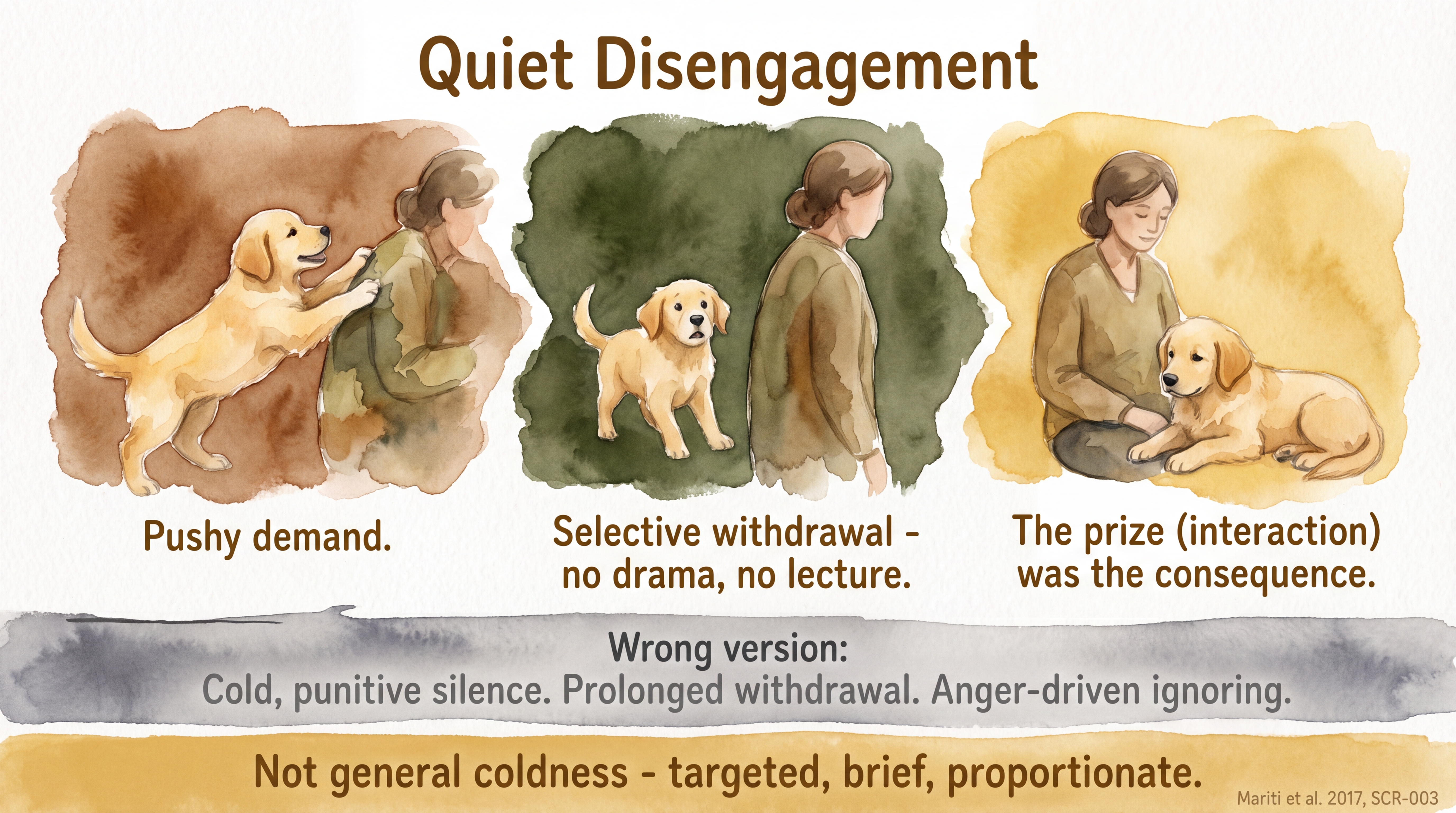
Not general coldness - targeted, brief, proportionate withdrawal where the lost interaction is the consequence.
Key Takeaways
- Quiet disengagement is selective withdrawal, not general coldness or ignoring.
- The technique works because pushy behavior loses the thing it wanted most: the interaction itself.
- A calm approach should reopen the relationship - demanding behavior should briefly close it.
- The documented canine de-escalation literature supports low-intensity social signals as meaningful communication.
The Evidence
- Mariti, C. et al. (2017)domestic dogs
Pilot evidence supports calming and de-escalatory signals as part of real dog social behavior, giving quiet low-intensity interaction shifts more credibility than folk theory alone.
- SCR-003 synthesisdomestic dogs and JB observation
JB's signal-precision model supports the idea that rare, contextual withdrawal of engagement can carry information better than constant chatter or nagging.
- Golden Retrievers in program practice
The specific JB use of quiet disengagement as an indirect-correction tool is observed practice rather than a directly tested intervention protocol.
No published study directly tests the specific claims or protocols described in this entry within a controlled canine trial.
SCR References
Sources
- Mariti, C., et al. (2017). Analysis of the intraspecific visual communication in the domestic dog. Journal of Veterinary Behavior, 18, 49-57.
- SCR-003 synthesis. Supports observed canine signal precision as ethological background. The quiet-disengagement technique-level claim remains [Observed/Heuristic] (anchor: SCR-003).