Body Blocking
Body Blocking is the most familiar JB indirect-correction technique: the adult steps calmly into the puppy's path to redirect movement or prevent access. The body communicates the boundary. No grab, no chase, no lecture. The documented support is the larger literature on canine spatial communication. The specific JB delivery protocol is observed program practice. Observed-JB
What It Means
Body blocking works by changing the path, not by overpowering the puppy.
The human steps between the puppy and the thing it is trying to reach:
- the couch
- a doorway
- another dog's bowl
- a visitor
- a hallway the puppy should not charge through
The movement is calm and deliberate. The point is not to startle. The point is to make the boundary physically readable.
This is why JB prefers stepping into the path over reaching for the dog. Reaching tends to turn the interaction into pursuit, grabbing, or wrestling. Stepping into the path lets the body say, "not through here," in a form dogs are more likely to read as spatial information rather than chaotic human interference. Observed-JB
The literature on canine communication supports the broader background. Dogs do use approach angle, body orientation, and positioning as social signals. Documented That does not prove the whole JB application package. It does show that space and posture are meaningful channels in canine life.
JB then adds technique-level discipline:
- calm body
- neutral face
- no dramatic leaning
- no trapping
- no raised voice
- once the puppy yields, the block is over
Why It Matters for Your Dog
Body blocking lets the human set a boundary in a language that is quieter than grabbing or shouting. Observed-JB For many puppies, that keeps the moment clear and small instead of turning it into a whole emotional event.
Body blocking should feel like a closed door, not a collision.
Done well, it teaches that not every path is open and that access is structured. Done badly, it becomes looming or intimidation, which means the technique has already left the indirect-correction category.
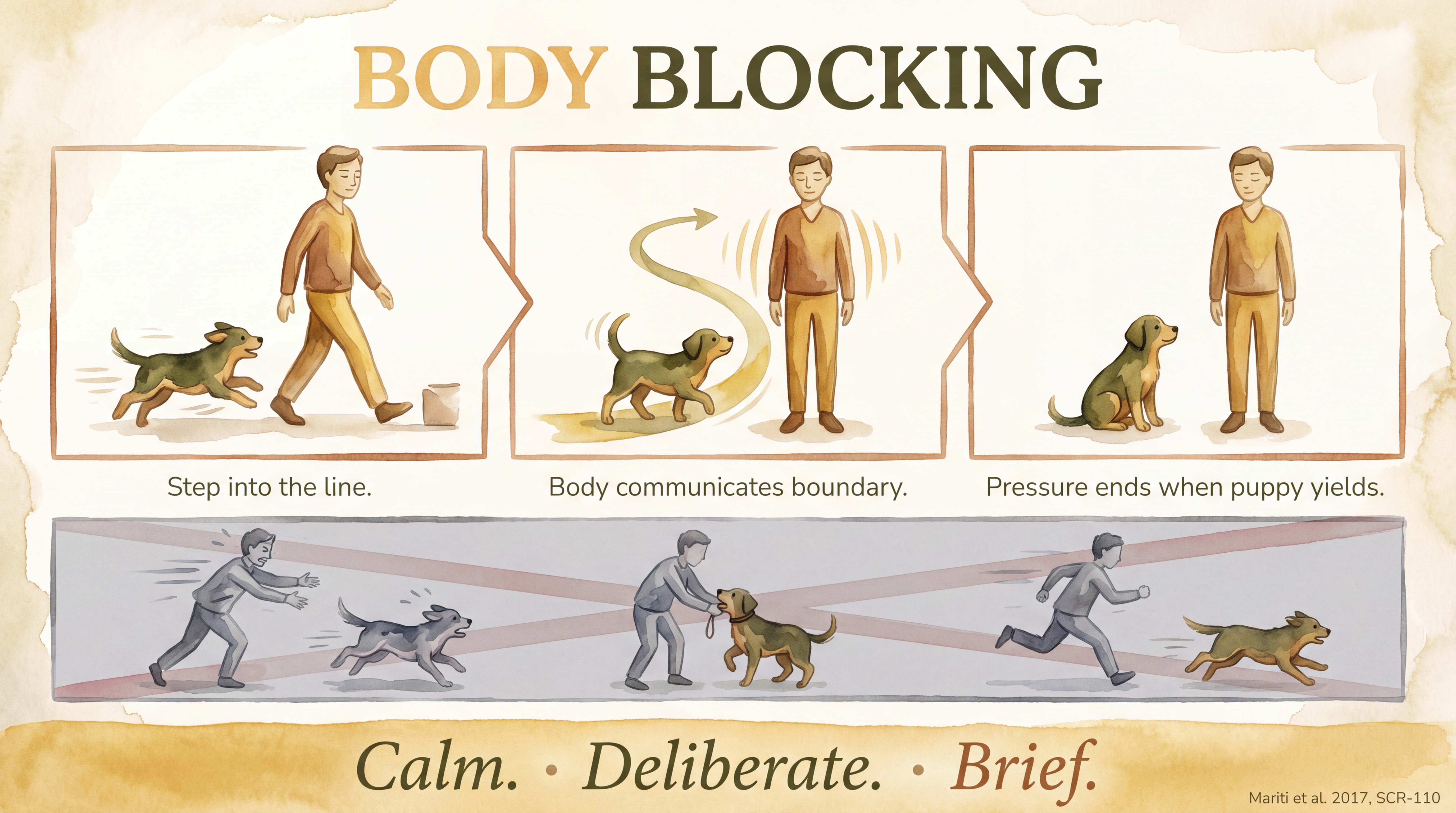
The body communicates the boundary - step into the line, let the puppy yield, pressure ends.
Key Takeaways
- Body blocking redirects access by changing the path, not by grabbing the dog.
- The strongest support is the documented role of spatial signaling in canine communication.
- The block should end as soon as the puppy yields.
- If the movement becomes looming, trapping, or emotional, it has crossed the JB line.
The Evidence
- Canine communication literature summarized in SCR-110domestic dogs
Dogs modulate approach angle, body orientation, and spatial positioning as intentional social signals, supporting body blocking as an ethologically legible medium. - Mariti, C. et al. (2017)domestic dogs
Pilot evidence supports de-escalatory social signaling in dog-dog interactions, reinforcing the idea that low-intensity social signals can organize behavior without overt force.
- Golden Retrievers in program practice
JB's specific guidance about how to step, where to place the body, and when to stop is observed practice rather than a directly tested protocol.
No published study directly tests the specific claims or protocols described in this entry within a controlled canine trial.
SCR References
Sources
- Mariti, C., et al. (2017). Analysis of the intraspecific visual communication in the domestic dog. Journal of Veterinary Behavior, 18, 49-57.
- Canine communication literature summarized in SCR-110. Supports canine spatial and social-signal communication as ethological background. The body-blocking technique-level claim remains [Observed/Heuristic] (anchor: SCR-110).