Environmental Management
Environmental Management is the physical side of Prevention. It is the part families can set up with gates, leashes, crates, thresholds, supervised access, and controlled routines before behavior has a chance to become a pattern. The operational framework is mostly heuristic, but it rests on documented ideas about repetition, predictability, and controllability. Heuristic
What It Means
Prevention is often described philosophically, but it is carried out architecturally.
If a puppy has unrestricted access to every room, every visitor, every exciting object, and every unstructured transition, then the family is not really running a prevention program. Heuristic They are hoping the puppy will self-organize under conditions that keep offering rehearsal opportunities.
Environmental management solves that problem before the puppy has to.
In JB terms, management is not imprisonment. It is structured access. The goal is to make the right behavior easier and the wrong behavior harder to rehearse while the puppy is still developmentally immature. Heuristic
That can look like:
- gates that prevent uninvited access
- leashes that slow chaotic movement indoors
- crates used as routine structure, not angry banishment
- supervised greetings instead of free-for-all visitor contact
- controlled exposure to novelty instead of unlimited stimulation
The point is not that physical tools teach the puppy everything. The point is that they shape which interactions are available for rehearsal.
This is also where Prevention and Structured Leadership overlap. Someone has to decide what access exists, when freedom expands, and what the household standards are. Management is not passive. It is leadership expressed through the environment.
JB also draws an important distinction between management and punishment. The same crate can be used in two completely different ways. As management, it is a calm, predictable part of structure. As punishment, it becomes a place the dog is sent because the human is frustrated. The object does not determine the meaning. The relational context does.
Why It Matters for Your Dog
Families often wait too long to manage. They leave the puppy free, the puppy rehearses unwanted behavior, and only then do they begin shutting doors, adding gates, or using tethers. Heuristic At that point management feels reactive because it is reactive.
JB wants the opposite sequence:
- structure first
- freedom later
- expansion earned through maturity and reliability
Environmental management is what Prevention looks like in physical form. It is how a family decides in advance which rehearsals the puppy will and will not get.
This approach also helps the puppy feel more controllable and less overwhelmed. Heuristic A predictable, structured environment gives the young dog clearer boundaries and fewer opportunities to spiral into overstimulation. The house becomes legible.
That is why good management often feels calmer, not stricter. It reduces the number of moments where the family must chase, nag, correct, or improvise. Heuristic
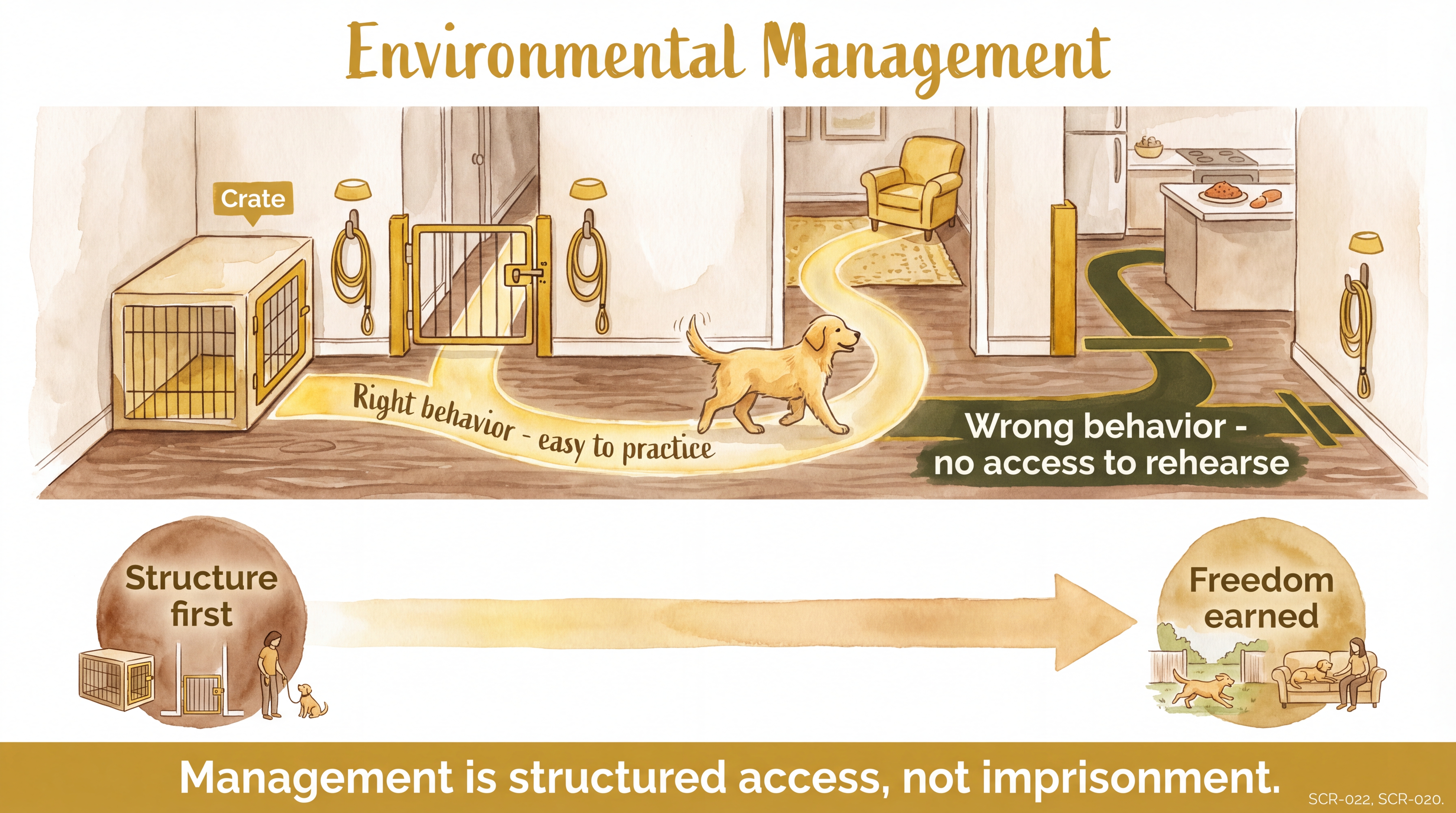
Management is structured access, not imprisonment - it determines which behaviors get rehearsed during developmental immaturity.
Key Takeaways
- Environmental management means using gates, leashes, crates, and controlled access to shape which behaviors the puppy can and cannot practice - not as punishment, but as architecture.
- Structure set up early prevents the puppy from rehearsing unwanted behaviors in the first place, which means fewer repetitions to later undo.
- Homes that are structured and predictable feel calmer to puppies and require far less correction because they have fewer opportunities to practice wrong behaviors.
The Evidence
- SCR-022 synthesisgeneral mammalian neuroscience
Repeated rehearsal strengthens behavioral pathways, which is the core reason environmental setup matters before problems are repeated into habit. - SCR-020 synthesisgeneral mammalian stress and learning science
Predictable environments support controllability and reduce helpless or chaotic responding, giving a scientific basis for structured setup rather than constant reactive correction.
The specific JB toolkit of gates, indoor leashes, supervised access, and routine-based crate use is a practical raising framework rather than a directly trial-tested package. Its logic is to reduce rehearsal opportunities and increase predictability during development.
No published study directly tests the specific claims or protocols described in this entry within a controlled canine trial.
SCR References
Sources
- SCR-022 synthesis. The underlying mechanism is documented in the cited literature. Page-level operational translation as a JB raising toolkit remains [Heuristic] (anchors: SCR-022, SCR-020).
- SCR-020 synthesis. The underlying mechanism is documented in the cited literature. Page-level operational translation as a JB raising toolkit remains [Heuristic] (anchors: SCR-022, SCR-020).