Command Dependency and Context Collapse
Compound evidence detail1 SCR / 2 parts
- Documentedthe cross-species context-dependent learning principle (Bouton 2002, 2004) demonstrating that learned responses do not transfer freely across contexts in rat models and broader learning science
- Documentedthe canine-direct demonstrations of context-specific behavioral transfer (Bray, MacLean and Hare 2014; Brucks 2017; Silver 2025; Range and Viranyi 2015; Gergely 2014)
Commands can teach useful skills, but they also organize behavior around cue, context, and human instruction. The Foundations concern is that a dog who behaves only when told has not necessarily learned how to live well in the environment - it may simply have learned which response belongs to which prompt in which setting. Mixed Evidence
What It Means
Context-dependent learning is one of the clearest findings in behavioral science. Animals do not learn in the abstract. They learn in a place, with a person, under a set of environmental conditions, with a particular cue history surrounding the behavior. Documented That is why a dog can sit beautifully in the kitchen and then stare blankly in the park. The dog is not being stubborn. It is showing you that the learning was narrower than you hoped.
The problem gets deeper when commands become the main structure of the relationship. A cue-centered system teaches the dog to wait for the cue. No cue, no behavior. The dog learns that action begins when the human activates it. That can be useful for sport routines or specific tasks. It is much less useful when the goal is a dog that settles, greets, waits, and moves through daily life appropriately without being micromanaged.
Theatre offers a useful analogy. An actor can perform a line perfectly when the stage direction, lighting, and cue are all in place. That does not mean the actor is speaking the line as a natural part of life. Commands often work like stage cues. They can produce correct performance inside the scene while leaving behavior fragile outside it. Documented
Hebbian logic reinforces the same point from a different angle. Rehearsed cue-response-context packages strengthen together. If the dog repeatedly performs "sit" only after a verbal cue in a narrow set of environments, that is the pathway being strengthened. Mixed Evidence The pathway is real. It is just narrower than the family often imagines.
Why It Matters for Your Dog
Families usually do not want a household full of stage directions. They want an ambient pattern: a dog who waits at doors, settles when people sit down, carries itself calmly through greeting moments, and does not require a cue for every ordinary act of good behavior. Documented That is a different learning target from a dog who performs on request.
This is why JB treats command dependency as a foundational concern rather than a small stylistic objection. When the household teaches through presence, rhythm, and consistent environmental consequence, the puppy can learn what the situation itself calls for. Mixed Evidence When the household teaches mainly through commands, the puppy may become fluent in responding while remaining weak in self-organized behavior.
Structured Leadership aims for a dog that reads the household and moves with it. That is harder to build when every meaningful choice is delayed until the human issues a cue.
None of this means verbal cues have no place. Names matter. Safety cues matter. Specific tasks can matter. The Foundations claim is narrower and more important: command-based systems do not automatically create general behavior, and families often mistake reliable response in one context for real maturity everywhere else.
That is why JB keeps returning to presence over instruction. It is trying to build behavior that survives the absence of the cue.
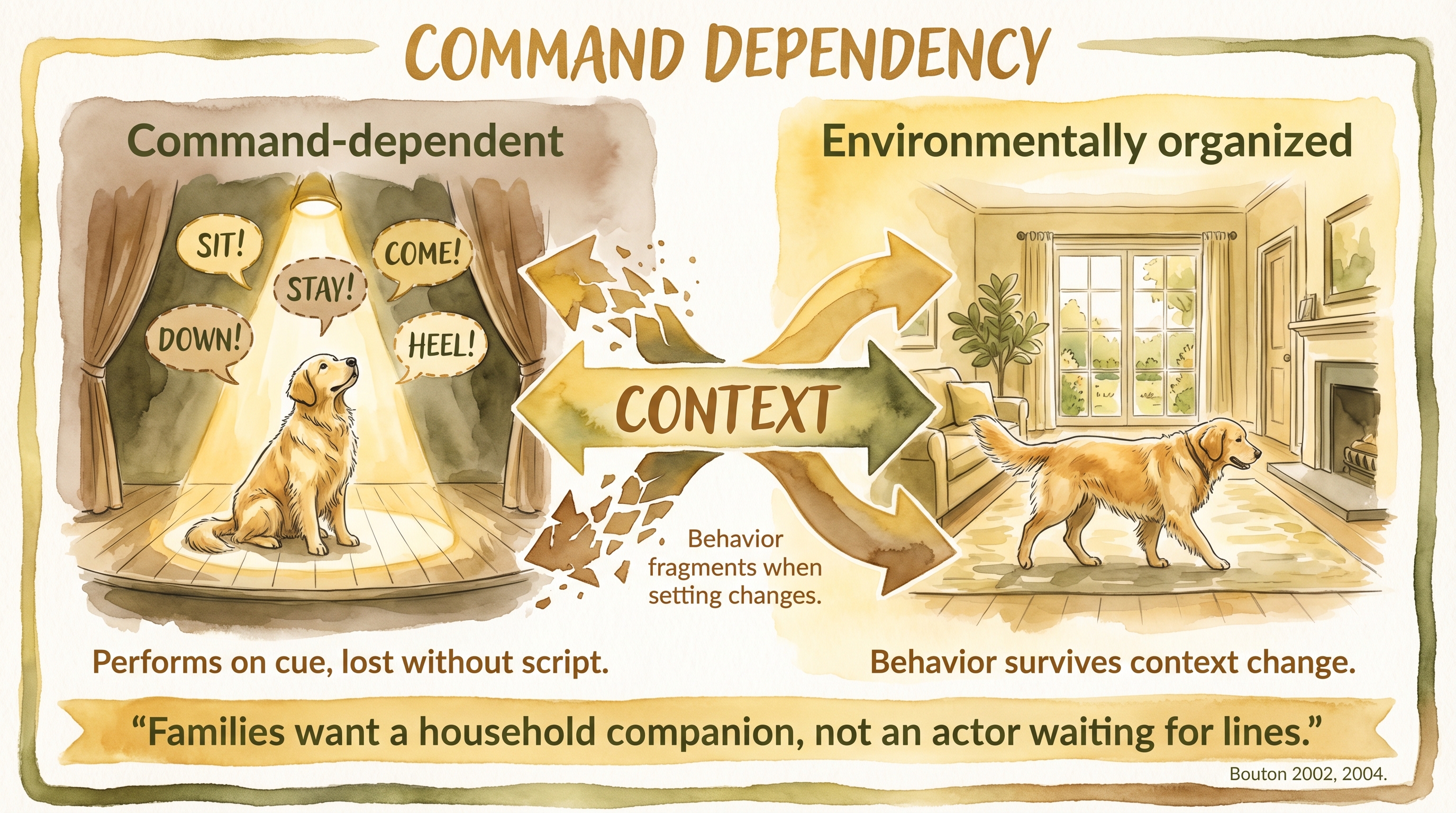
Command-dependent dogs perform on cue but fragment when the context changes - families want household companions, not actors waiting for lines.
Key Takeaways
- Context-dependent learning means dogs often learn a response in a specific setting rather than learning a behavior that transfers everywhere automatically.
- Command-heavy systems can create dependency by teaching the dog to wait for instruction before acting.
- Families usually want ambient good behavior, not constant performance on cue, which makes general life-pattern learning more important than many command systems provide.
- JB critiques commands mainly at the level of developmental organization: the cue can become the center of behavior instead of the environment and relationship becoming the center.
The Evidence
This entry uses mixed-evidence claim-level tags beyond the dedicated EvidenceBlocks below. These tags mark claims that combine documented findings with observed practice, heuristic application, or unresolved gaps.
- Bouton, M. E. (2002, 2004)multiple species
Established that context plays a central role in learning expression and extinction, helping explain why behavior can look stable in one setting and fragile in another. - Gazit, I., Goldblatt, A., & Terkel, J. (2005)domestic dogs
Showed context sensitivity in extinction of canine searching behavior, reinforcing that dogs do not automatically generalize learning across settings. - Hall, N. J. & Wynne, C. D. L. (2016)domestic dogs
Reviewed persistence and resistance to extinction in dogs, highlighting practical limits in transfer and unlearning.
- Hebbian-learning synthesis summarized in SCR-022multiple species
Repeatedly pairing a cue, context, and response strengthens that package, which helps explain why narrow performance can become reliable without becoming broadly general. - Context-transfer literature summarized in SCR-169domestic dogs
Trained behaviors often show poor transfer across location, handler, and distraction context unless generalization is built deliberately.
- JB command-dependency synthesisfamily-raised dogs
JB interprets the narrowness of cue-bound learning to mean that command-heavy systems often produce dependence on instruction rather than deeper household fluency.
No published family-dog trial has directly compared command-heavy raising and presence-heavy raising on generalized household behavior while holding breeder background and family consistency constant.
The literature documents context collapse in learned behavior, but it has not yet quantified how much verbal cue reliance is enough to impair ambient self-organized behavior in puppies.
SCR References
Sources
Bouton, M. E. (2002). Context, ambiguity, and unlearning: Sources of relapse after behavioral extinction. Biological Psychiatry, 52(10), 976-986.
Bouton, M. E. (2004). Context and behavioral processes in extinction. Learning & Behavior, 32(4), 485-494.
Gazit, I., Goldblatt, A., & Terkel, J. (2005). The role of context in extinction of searching behavior in dogs. Animal Cognition, 8(2), 91-99.
Hall, N. J., & Wynne, C. D. L. (2016). Persistence and resistance to extinction in the domestic dog: Basic research and applications to canine training. Behavioural Processes, 129, 67-72.