Maternal Influence on Temperament
Compound evidence detail2 SCRs / 4 parts
- DocumentedAwalt-supported canine evidence that early environment relates to NR3C1 and OXTR methylation patterns
- HeuristicJB-specific extension from maternal temperament framing to durable stress-regulation advantages in dogs
- DocumentedAwalt 2024 canine association between early-life history and NR3C1 or OXTR methylation patterns
- Heuristicinference that those methylation differences produce specific temperament or health consequences in dogs
The dam influences puppy temperament through at least three channels at once: genetics, prenatal environment, and postnatal care. That means "maternal influence" is not one variable. It is a cluster of overlapping pathways that begin before birth and continue through the first weeks of life. In dogs, that broad claim is well supported even though some mechanisms are documented more strongly than others. Documented
What It Means
The Three Pathways
The first pathway is obvious: the dam contributes half the genome.
The second is prenatal. Maternal stress, physiology, and endocrine state shape the developmental environment in utero. Documented
The third is postnatal. Nursing style, responsiveness, regulation, tolerance withdrawal, and broader caregiving pattern affect how the puppy experiences the world after birth. Documented
The mistake is to talk as though only one pathway matters. Temperament begins as all three at once.
The Postnatal-Care Evidence
SCR-037 is especially important because it moves this topic past vague sentiment. In guide-dog populations including Golden Retrievers, maternal investment style was associated with later resilience outcomes. More indulgent, less challenging nursing styles were linked to lower later resilience, while more effort-requiring maternal patterns predicted stronger outcomes. Documented
That finding matters because it blocks two easy myths that more maternal investment is always better; and that maternal care is irrelevant once genes are fixed. Documented
The Epigenetic Bridge
SCR-011 and SCR-094 supply the broader biological bridge. Maternal-care epigenetic calibration is foundationally documented in other mammals, and dogs now have direct early-life-associated methylation evidence in NR3C1 and OXTR.
The canine evidence is not yet a complete maternal-style map, but it is enough to say that the mother's environment and care are not neutral background conditions.
Why It Matters for Your Dog
Why Breeder Decisions Matter So Much
This page is one of the clearest places where breeder practice becomes developmental biology rather than branding.
Choosing a dam with sound temperament matters. Managing her prenatal stress matters. Documented Protecting the postnatal environment matters. Allowing the puppies to experience her real caregiving style matters.
None of those replace one another. A strong genetic line raised in a chaotic developmental environment is still compromised. Excellent early environment cannot erase every inherited vulnerability. The breeder's real job is to treat these pathways as cumulative.
The strongest science-backed version of the breeder claim is not that the dam determines everything. It is that the dam shapes development through several powerful channels that the breeder ignores at their peril.
The Key Boundary
The page should not be used to imply that every later behavioral detail can be traced cleanly back to the dam. Maternal influence is major, but it is still one part of a longer developmental sequence that includes litter, breeder environment, transition, and later family life.
The correct takeaway is "major leverage," not "total destiny."
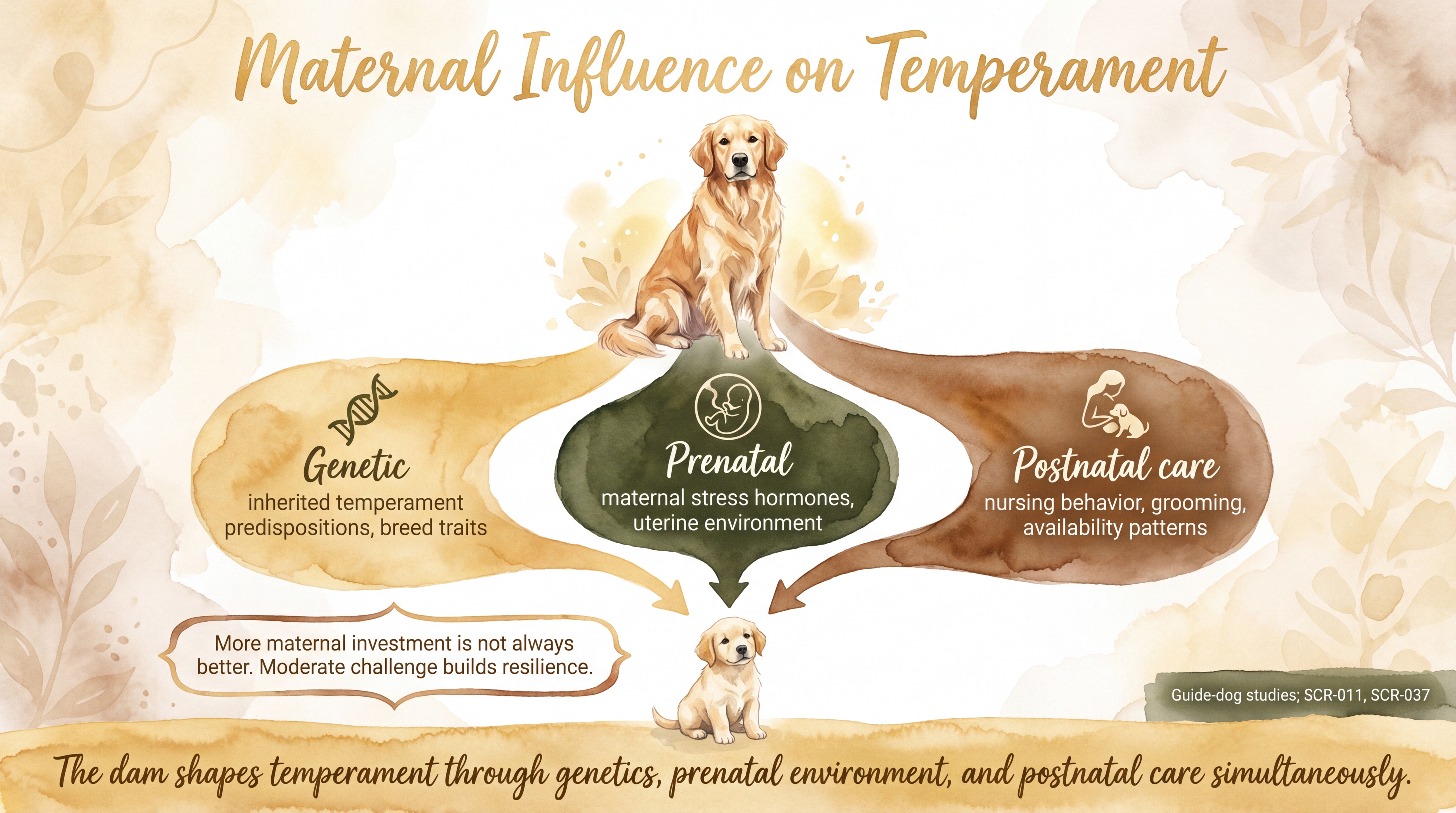
The dam shapes temperament through genetics, prenatal environment, and postnatal care simultaneously.
Key Takeaways
- Maternal influence on temperament works through genetics, prenatal biology, and postnatal care at the same time.
- Direct canine research shows that maternal style is associated with later offspring outcomes, including resilience.
- More maternal investment is not automatically better if it reduces developmental challenge too far.
- The dam has major leverage over early temperament without fully determining the dog's whole life outcome.
The Evidence
- Bray, E. E. et al. (2017)domestic dogs including Golden Retrievers
Maternal style, especially nursing posture and challenge level, predicted later resilience and guide-dog outcomes. - Guardini, G. et al. (2017)domestic dogs
Variation in maternal care was associated with differences in later offspring behavioral development.
- Weaver, I. C. G. et al. (2004)rats
Maternal care altered later stress physiology through epigenetic pathway changes. - Awalt, S. L. et al. (2024)domestic dogs
Direct canine evidence linked early-life history to methylation differences in stress- and bonding-related genes.
- domestic dogs
No published canine study fully disentangles genetic inheritance, prenatal effects, and postnatal maternal style in later temperament outcomes.
SCR References
Sources
- Awalt, S. L., Boghean, L., Klinkebiel, D., & Strasser, R. (2024). A dog's life: Early life histories influence methylation of glucocorticoid (NR3C1) and oxytocin (OXTR) receptor genes, cortisol levels, and attachment styles. Developmental Psychobiology, 66(3), e22482. DOI: 10.1002/dev.22482.
- Bray, E. E., Sammel, M. D., Cheney, D. L., Serpell, J. A., & Seyfarth, R. M. (2017). Effects of maternal investment, temperament, and cognition on guide dog success. Proceedings of the National Academy of Sciences, 114(34), 9128-9133. DOI: 10.1073/pnas.1704303114.
- Guardini, G., Bowen, J., Mariti, C., Fatjo, J., Sighieri, C., & Gazzano, A. (2017). Influence of maternal care on behavioural development of domestic dogs (Canis familiaris) living in a home environment. Animals, 7(12), 93. DOI: 10.3390/ani7120093.
- Weaver, I. C. G., Cervoni, N., Champagne, F. A., D'Alessio, A. C., Sharma, S., Seckl, J. R., Dymov, S., Szyf, M., & Meaney, M. J. (2004). Epigenetic programming by maternal behavior. Nature Neuroscience, 7(8), 847-854. DOI: 10.1038/nn1276.