The Dog and Household Change: Moves, Marriages, Babies
Most dogs do not spend adulthood in a perfectly unchanged household. Families move. Relationships form and end. Children arrive. Illness changes routines. Work schedules shift. New relatives move in. JB does not treat these as separate from raising just because the dog is no longer a puppy. They are still transitions, and the same basic principle still governs them: the dog adapts best when the household carries continuity through the change. Observed-JB
That is why adult-household change belongs in the Living category. Families often imagine the dog should simply absorb adult-life upheaval because it is older now. Sometimes it can absorb more than before. It still reads the environment exactly the way it always did: through rhythm, tone, access, rest, handling, and the emotional weather of the people around it.
What It Means
A Move Is a Mini-Transition
The cleanest way to think about moving house is to remember the first week home.
The dog does not need a theatrical reintroduction to life. The dog needs the new house to become readable quickly.
That usually means setting up the dog's rest space before arrival, preserving bed, bowls, crate, and familiar objects, keeping the first days smaller than the family is tempted to make them, walking the immediate environment calmly rather than overexposing at once, and protecting sleep while the household is still disorganized.
Families often assume the move is about space. For the dog it is mostly about pattern. If food, rest, door routine, and human tone remain legible, adaptation is often smoother than people fear.
Changes in Family Structure
Partnership, marriage, separation, divorce, relatives moving in, and children leaving home all change the social map the dog has been living inside. Observed-JB
The dog does not understand the human story in the abstract. It understands who is present, who is absent, how people are moving, whether the house is tense, and whether old patterns are still operating.
That is why family-structure change should be approached with more humility than families often bring to it. The dog may not need a major intervention, but it does need the adults to understand that household emotion and routine have become part of the dog's transition load.
When possible, JB favors maintaining the strongest anchors: consistent feeding, consistent walk timing, continuity of the primary bond, and protected rest away from conflict or crowding.
The dog does not need to be made into a counselor. It needs to be spared becoming collateral.
The Arrival of a Baby
Few changes alter a household more quickly than a new baby. Observed-JB The cultural temptation is to split into two equally unhelpful errors.
One error is under-preparing completely and assuming the dog will simply be sweet and intuitive.
The other is over-preparing so anxiously that the dog reads the coming change as alarm before the baby even arrives.
JB prefers a steadier path. In the weeks before the birth or arrival, the family can calmly adjust household patterns, rehearse quieter room boundaries, introduce baby-related sounds and gear without ceremony, and make sure the dog's ordinary rest spaces will still exist after the household expands.
Then, when the baby comes home, the arrival is handled like every other meaningful JB transition:
quietly, legibly, without making the dog or the baby the center of a social spectacle.
Why Overreaction Usually Backfires
When families sense change coming, they often want to compensate by doing more to the dog: more drills, more commands, more excitement, more pressure. Observed-JB Or the opposite: less structure, because everyone is too overwhelmed to hold it.
Neither usually helps. The dog is not best served by sudden training intensity or by total environmental collapse. It is best served by continuity with thoughtful adjustments.
The Soft Landing Never Stopped Applying
One of the deepest JB claims is that the soft landing was never only about week one. It named an orientation. Every meaningful household change asks the family the same question the first transition asked: Observed-JB
Can you carry enough familiar calm through this change that the dog does not have to start over?
The dog should not have to solve the family's upheaval by itself. Adult transitions go best when the household remembers the original lesson: make the new reality readable, keep the emotional tone low, and let continuity do more of the work than intensity ever could.
What This Is Not
This page is not promising that every dog will glide through every major life event. Some dogs are more sensitive. Some changes are larger than others. Some households are under serious strain in ways no philosophy can erase.
JB is not saying calmness makes stress vanish. It is saying calmness gives the dog a better chance of orienting inside change without losing itself.
Why It Matters for Your Dog
The dog that handled the original transition well has already learned something precious: humans can make a changing world feel coherent. That lesson becomes available again during adulthood. A move, a new baby, or a family reorganization does not erase the dog's earlier vocabulary. It activates it.
If the family remembers that, the dog often does far better than people expect. The household changes, but the dog's way of being held inside the household stays recognizable. That is what allows adaptation without crash.
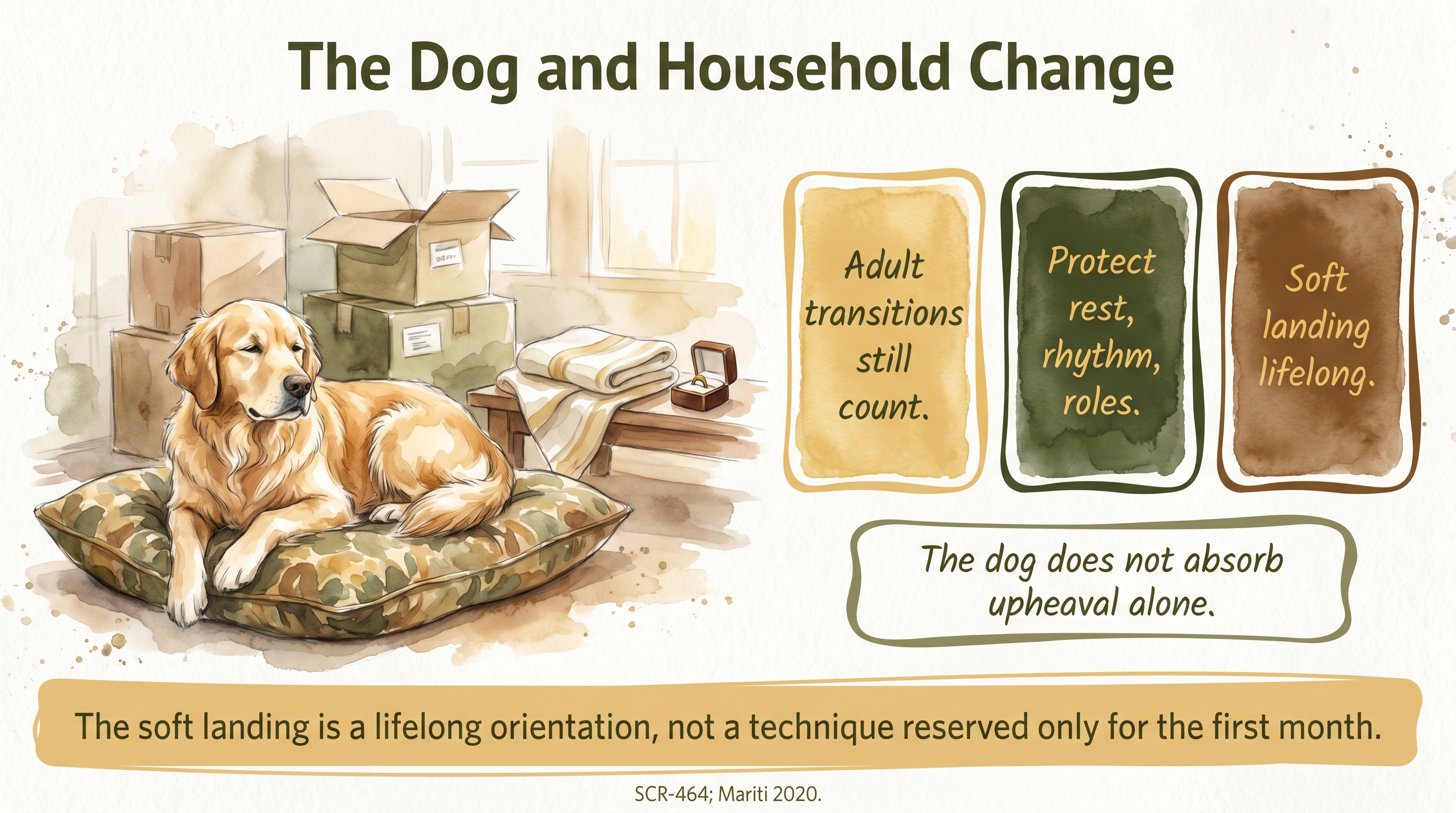
The soft landing is a lifelong orientation, not a technique reserved only for the first month.
Key Takeaways
- Adult household changes are still transitions, and dogs benefit from the same continuity principles that shaped the first month home.
- Moves, relationship changes, and babies are easier on dogs when rest, rhythm, and known spaces remain legible.
- The dog does not need to absorb family upheaval without help or become the emotional center of it.
- The soft landing is a lifelong orientation, not a puppy-only technique.
The Evidence
- owner-behavior literaturedomestic dogs
Dogs' behavioral outcomes are shaped not only by the physical environment but by the consistency, emotional tone, and handling patterns of the people around them. - environmental-change and stress literaturedomestic dogs
Changes in environment and routine can alter coping and arousal, particularly when predictability and recovery are reduced.
- JB breeder observationGolden Retrievers
Adult dogs usually handle moves, babies, and family-structure changes best when the household treats them as transitions requiring continuity rather than assuming maturity alone will carry the dog through. - JB family practicefamily dogs
Preserving a dog's known rest space, meal rhythm, and primary bond often does more to support adaptation than introducing new forms of management during the upheaval.
No published study directly tests the practical implications of the dog and household change: moves, marriages, babies for domestic dog raising programs. The application to household dog raising remains an interpretive synthesis rather than a directly tested intervention finding.
SCR References
Sources
- Sundman, A.-S., Van Poucke, E., Svensson Holm, A.-C., Faresjo, A., Theodorsson, E., Jensen, P., & Roth, L. S. V. (2019). Long-term stress levels are synchronized in dogs and their owners. Scientific Reports, 9, 7391. https://doi.org/10.1038/s41598-019-43851-x
- Moyer, B. J., Zulch, H., Ventura, B. A., & Burman, O. (2025). A qualitative exploration of owner experiences following dog adoption. Animal Welfare, 34, e9. https://doi.org/10.1017/awf.2025.4
- Schork, I. G., Manzo, I. A., De Oliveira, M. R. B., da Costa, F. V., Palme, R., Young, R. J., & de Azevedo, C. S. (2022). How environmental conditions affect sleep? An investigation in domestic dogs (Canis lupus familiaris). Behavioural Processes, 199, Article 104662. https://doi.org/10.1016/j.beproc.2022.104662
- Just Behaving program observation disclosure. (2026). Boundary: this internal observation is limited to JB-raised Golden Retrievers whose families continued the JB framework after placement; cohort size, time window, and counting rule are deferred in this revision. Treat as program observation supporting household-change adaptation patterns, not as published external evidence.