Dog Training Methods: An Overview
Compound evidence detail1 SCR / 2 parts
- Documentedthe documented absence of any RCT establishing single-method superiority across canine behavioral domains, paired with the on-record organizational position statements (AVSAB 2008 and 2021, APDT 2020 and 2023, CCPDT 2025, IACP 2025, plus Ziv 2017 and Todd 2018 reviews) which constitute institutional policy rather than scientific consensus
- Heuristicthe JB characterization of professional ideological fragmentation across force-free, balanced, and compulsion approaches, carrying the load-bearing firewall that absence of method-superiority RCT does not equalize methods on welfare grounds where SCR-026, SCR-028, and SCR-036 document harm from aversive methods independently of the outcome comparison gap
Dog training methods look simple from the outside because the labels sound tidy. Positive reinforcement, balanced training, clicker work, e-collars, force-free, relationship-based. A family hears the label and assumes it names one clear thing. In practice, each label bundles together mechanics, ethics, history, and marketing. It can describe what the trainer physically does in a moment, what philosophy the trainer holds about dogs in general, and what social tribe the trainer identifies with in the profession. That is why the landscape feels confusing even before a family has chosen a class, a private trainer, or a board-and-train. Documented
The scientific backbone of the landscape begins with operant conditioning. Trainers often sort methods using four quadrants: positive reinforcement, negative reinforcement, positive punishment, and negative punishment. That framework is useful because it names the immediate behavioral mechanics. Add food after a sit and the sit becomes more likely. Release leash pressure when the dog moves with you and the movement becomes more likely. Add an aversive after barking and the barking may decrease. Remove attention after jumping and the jumping may decrease. Those are real learning processes. They are not the whole culture around them.
The cultural part matters just as much. A force-free trainer may rely mostly on reinforcement, management, and negative punishment while also holding a strong moral objection to correction tools. A balanced trainer may use some of the same reinforcement tools while reserving certain corrections for specific cases. A relationship-oriented trainer may borrow techniques from both worlds but interpret the dog's behavior primarily through body language, arousal, attachment, and household structure rather than through quadrants. Two trainers can therefore use similar mechanics while disagreeing about what dogs are, what families need, and what counts as humane guidance.
JB's position starts earlier than the method debate. Ambiguous The Five Pillars are not a fifth school competing with the other schools. They are a raising framework built on mentorship, calmness, structured leadership, prevention, and indirect correction. That means JB does not deny that training methods work. It says methods enter the story after a prior question has already been answered poorly or well: how was the dog raised, and how much unnecessary behavior had to be cleaned up later because prevention was absent in the first place?
What It Means
Mechanics and Camps Are Not the Same Thing
One reason this category becomes muddy so quickly is that families are usually handed philosophy words instead of behavior words. A trainer says "I am force-free" or "I am balanced" and the family thinks it has learned what will happen in the room. Sometimes it has. Often it has not. The label may predict values better than it predicts exact technique.
The mechanics are more concrete. Operant conditioning describes what is happening functionally when a consequence changes the future likelihood of a behavior. Philosophical camps describe how a trainer organizes those mechanics, which tools they consider legitimate, how they speak about welfare, and how much of the dog-human relationship they think should be understood through learning theory alone. Those are related questions, not identical ones.
That distinction is essential in the current market because the camps are socially visible and the mechanics are often hidden. Clients see websites, logos, slogans, and social media clips long before they see a full lesson. A family may therefore choose a tribe before it understands a procedure.
The Four Quadrants Are a Map, Not a Moral System
The operant quadrants remain the most common technical map of training behavior. Observed-JB Positive reinforcement adds something the dog wants after a behavior. Negative reinforcement removes something the dog wants to escape. Positive punishment adds something the dog finds aversive. Negative punishment removes access to something the dog wants. Skinner's framework gave trainers a vocabulary that was cleaner than folk language about stubbornness, respect, and attitude.
That vocabulary is useful, but it does not answer the ethical question by itself. A behavior can be changed through several quadrants at once. A leash correction may include positive punishment and negative reinforcement in rapid sequence. A calm body block may be read by one trainer as spatial communication and by another as punishment. A time-out can be low drama and clarifying in one setting, or chaotic and distressing in another. The quadrant tells you something real. It does not tell you enough about magnitude, timing, developmental context, or relationship quality to settle the whole argument.
The evidence base reflects that limitation. Comparative studies are often asking whether broad method categories correlate with obedience, stress behavior, cortisol, cognitive bias, or owner-reported problem behavior. They are rarely able to isolate one mechanical variable cleanly. Definitions of "balanced," "mixed," or even "reward-based" vary across studies, which is one reason the evidence discussion later in this subcategory has to stay precise about what any paper actually measured.
That messiness shows up in the field's best-known landmarks. Skinner supplied the quadrant vocabulary, the CCPDT later codified LIMA in public policy, AVSAB's 2021 humane-training statement endorsed reward-centered first-line work, and studies such as Ziv 2017, Vieira de Castro 2020, and China 2020 keep the welfare dispute active without ending every downstream argument.
JB treats training methods as downstream technologies. The bigger question is how much of the dog's life had to become a behavior-modification project because the home did not build calmness, boundaries, and social maturity first.
Families Usually Buy a Story, Not a Procedure
In the real world, methods do not reach families as neutral scientific options. They arrive as stories. One story says good dogs are built through rewards and trust. Another says hard cases need accountability and consequence. Another says the dog is speaking a social language modern trainers have forgotten. Another says science has already settled the matter. These stories help owners decide who feels credible before any evidence sheet is opened.
That marketing layer matters because it changes what families expect methods to do. A puppy-class family may think positive reinforcement means no boundaries. A frustrated adolescent-dog owner may think balanced training means realism at last. A person drawn to ethological training may assume that technique barely matters if relationship is good. None of those shortcuts is fully accurate. Methods are narrower and messier than the stories sold around them.
The field's fragmentation reinforces the problem. There is no universal licensure floor, no single professional authority, and no head-to-head literature strong enough to end the debate across all use cases. Ambiguous That leaves families sorting among camps whose confidence often exceeds the evidence base.
Where JB Actually Sits
JB is easiest to misunderstand when people try to place it inside the method map itself. It shares real ground with reward-based training when a discrete skill genuinely needs to be taught. It shares real ground with relationship-based and ethological thinkers when they insist that dogs are social mammals, not blank behavior widgets. It parts company with both when either side acts as if training mechanics are the center of canine development.
That difference is practical, not merely philosophical. A method-centered framework asks, "How do we teach the dog not to jump?" JB asks first, "How did this dog's daily rhythm, arousal pattern, household traffic, and adult guidance make frantic greeting behavior so available?" Heuristic The training question may still matter. It simply enters later, and often at a lower volume.
So this overview should be read as orientation, not allegiance. Families need a map of the field because the field is real. They also need permission not to hand over the entire developmental story of their dog to whatever method currently sounds most confident.
Why It Matters for Your Dog
For a Golden Retriever family, the method debate can feel oddly distant until the puppy becomes loud, mouthy, over-social, or difficult to settle. Ambiguous Then it suddenly feels immediate. One person recommends more treats. Another recommends more boundaries. Another says the issue is lack of sleep and too much stimulation. Another says the dog is simply rehearsing what the family has allowed. All of those statements may contain some truth, but they belong to different maps of the problem.
That is why the overview matters. A family that does not know the maps can lurch from one framework to another every two weeks and accidentally create the very inconsistency that keeps the dog disorganized. The dog experiences none of those frameworks as theory. The dog experiences only changes in pattern, timing, pressure, and adult coherence.
A Golden example makes the point. Imagine a nine-month-old retriever who drags on leash, screams when visitors arrive, and turns wild in the evening. A purely skill-building trainer may prescribe leash drills, mat work, markers, and structured reinforcement. A balanced trainer may add consequence for screaming or leash forging. A relationship-focused trainer may zoom out to body language, transitions, and the emotional temperature of the household. The family does not need to become ideologues. It does need to understand what each frame is emphasizing and what each frame may miss.
This matters especially with Goldens because the breed can hide method mismatch for a while. Their sociability, food motivation, and forgiveness often let adults get away with sloppy thinking longer than they could with a sharper or more defensive dog. A Golden may tolerate inconsistency, excessive verbal chatter, poor timing, or theatrical correction without immediate fallout. That does not mean the method picture is sound. It may simply mean the breed is buying the family extra time before the cracks become obvious.
The overview is also useful because many family problems are hybrids. A dog may genuinely need a taught behavior and a changed environment at the same time. Recall can require formal teaching. Settling can require both patterning and lower household arousal. Leash walking can require mechanics, emotional neutrality, and changes in how exits from the house are handled. Families often suffer when they are told to choose one worldview for a problem that actually spans several levels.
Another important point is that methods do not carry equal welfare risk. The evidence base is incomplete, but it is not empty. Reward-based teaching has a lower documented welfare risk profile than aversive-heavy approaches. Review-level evidence and the strongest welfare studies tilt clearly in that direction, even if many comparative studies remain observational or methodologically constrained. Families should know that before they let anyone flatten the debate into "all tools are the same if the trainer is skilled."
Yet welfare is not the only question. Families also need durability, generalization, and a dog who can live inside ordinary life rather than only inside formal sessions. The transfer problem appears all over the literature: dogs learn in one context and fail in another, owners cannot maintain the protocol, or early progress decays because the household never actually changed. That is why JB keeps pointing back to raising. A method may teach a behavior. Raising determines the environment into which that behavior has to live.
For many households, the overview's most practical gift is emotional steadiness. Once the family sees that methods are real but partial, it becomes easier to stop hunting for a total solution in the next slogan. The home can use a tool without converting the entire relationship into a method identity.
That matters in the breeder-to-family transition too. A puppy leaving a calm, patterned breeder environment can become disorganized quickly if the family immediately experiments with several conflicting training frameworks. The softer landing is not the absence of teaching. It is a coherent home that knows when it is using a method and when it is simply living with the dog in a way that either stabilizes or destabilizes development.
One more practical point belongs here. Method switching itself can become part of the dog's confusion. A family who spends Monday luring with food, Wednesday correcting on leash, Friday experimenting with relationship language from social media, and Sunday buying a new protocol is not merely sampling ideas. It is changing contingencies, emotional tone, and criteria faster than the dog can form a stable picture. Goldens often absorb that chaos kindly for a while, which is exactly why families need the overview before the cracks widen.
What This Means for a JB Family
For a JB family, the right sequence is usually clearer than the right school. Build calmness first. Protect sleep, transitions, greetings, confinement routines, and the emotional tone of the home. Prevent what can still be prevented. Add training methods where a real skill genuinely needs to be taught. That order does not reject training. It just keeps training from becoming a substitute for stewardship.
This also means reading trainers with better questions. Not only, "What method do you use?" but "What do you think is causing the problem?" "How much of your plan is teaching a cue and how much is changing the dog's daily life?" "What do you do when owner follow-through is imperfect?" "What would make you refer out?" Those questions reveal far more than a website badge does.
JB families should also resist the urge to treat every disagreement between camps as evidence that one side is morally pure and the other side is fraudulent. The field is fragmented because dogs are complicated, owners are inconsistent, the evidence base is thinner than the rhetoric, and many trainers are solving different assignments. A patrol-dog trainer, a fearful-dog behavior consultant, a puppy-class instructor, and a breeder raising family Goldens are not all carrying the same task.
The deepest JB takeaway is that methods belong inside relationship, not above it. If a method strengthens clarity inside a calm, structured, mentoring household, it can be useful. If it becomes the household's whole theory of how dogs grow up, it is already being asked to do too much.
That perspective protects the family from two equal mistakes. One is giving up on skill teaching because relationship feels sufficient in principle. The other is flooding the home with technique because technique feels more concrete than patient raising. Mature guidance usually sits between those errors. It knows when a method is needed, what the method can actually do, and what must still be built through daily life.
In very practical terms, JB families should choose helpers by how they think, not only by the badge they wear. Ask whether the trainer can distinguish skill deficits from lifestyle-created disorder. Ask whether they can explain why the dog is struggling before they explain how they will intervene. A method label matters less once the family can hear the causal model beneath it. That is often the clearest sign of whether the help on offer will actually fit the dog in front of you.
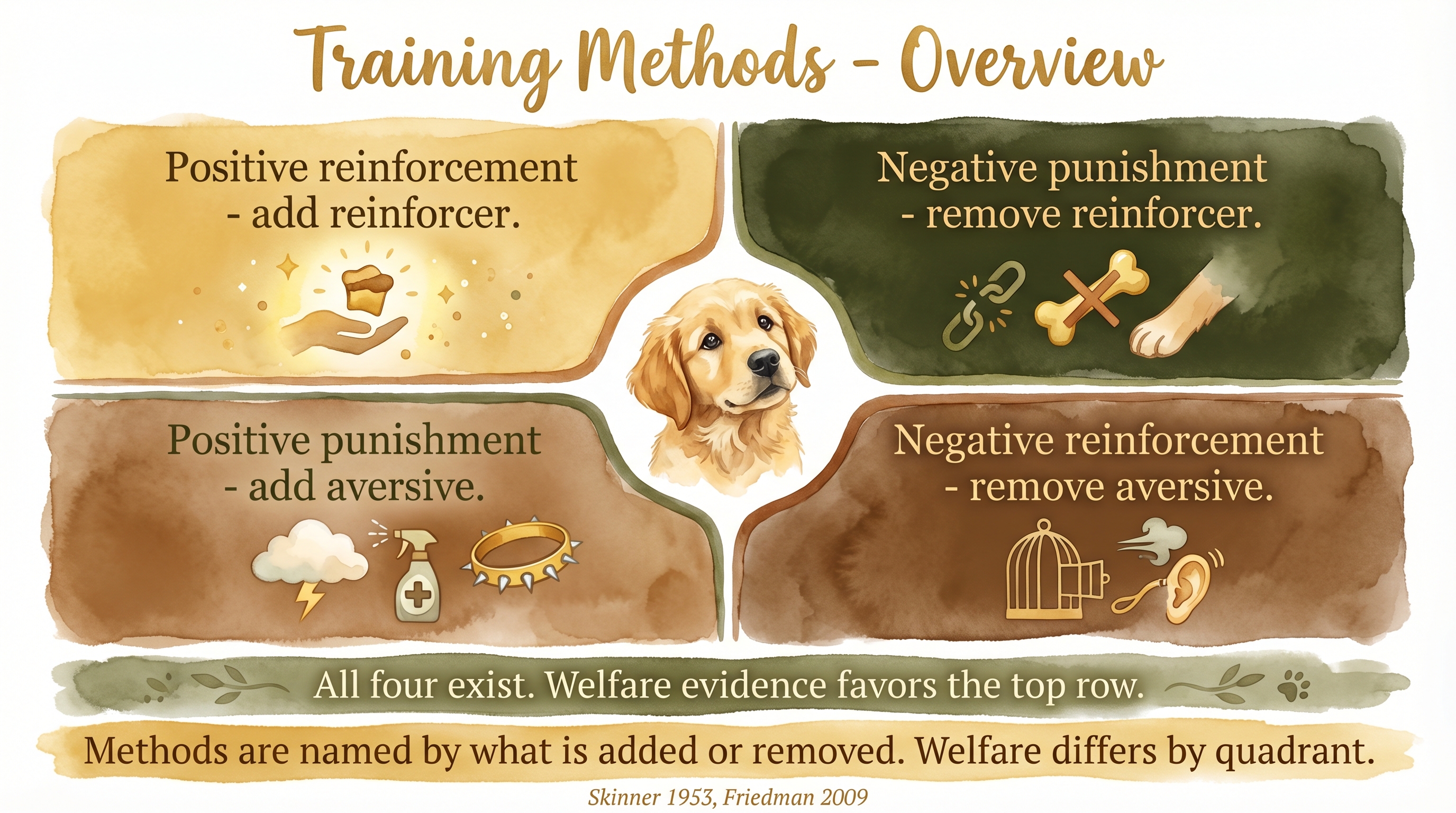
Methods are named by what is added or removed - welfare differs by quadrant.
Key Takeaways
- A dog-training method is both a mechanical procedure and a philosophical orientation, and families should not confuse those layers.
- The operant quadrants are useful descriptions of how behavior changes, but they do not by themselves settle the ethical or developmental question.
- The current profession is fragmented, which is why families hear sharply different advice from equally confident trainers.
- JB treats methods as downstream tools that matter most after the home has already either succeeded or failed at calm, preventive raising.
The Evidence
This entry uses observed claim-level tags beyond the dedicated EvidenceBlocks below. These tags mark JB program observation or practice-derived claims that need dedicated EvidenceBlock coverage in a later content pass.
This entry uses heuristic claim-level tags beyond the dedicated EvidenceBlocks below. These tags mark JB interpretive application rather than direct study findings.
This entry uses ambiguous claim-level tags beyond the dedicated EvidenceBlocks below. These tags mark claims where the literature remains unsettled or multiple interpretations coexist.
- companion dogs
Documents the comparative literature on reward-based, aversive, and mixed approaches, including the field's major methodological constraints. - companion dogs
Shows that class attendance, family adherence, transfer failure, and long-term measurement gaps all shape what methods achieve in real homes. - CCPDT LIMA Policy and public policiesprofessional dog training
Illustrate how one major credentialing body frames humane escalation, real-world pragmatism, and tool use inside a professional ethics structure. - AVSAB Humane Dog Training Position Statement (2021)companion dogs
Represents the mainstream veterinary-behavior position that humane, reward-centered methods should be first-line for most pet-dog training goals.
- domestic dogs
No single dataset directly resolves the full population picture for dog training methods: an overview without the usual survey, sampling, and threshold limitations.
SCR References
Sources
- American Veterinary Society of Animal Behavior. "Humane Dog Training Position Statement" (2021).
- Certification Council for Professional Dog Trainers. "LIMA Policy" (2021).