Positive Reinforcement Training
Positive reinforcement training became the modern default in pet-dog culture because it solved two problems at once. It gave trainers a clear, practical way to build behavior, and it offered families a more humane moral language than the correction-heavy traditions that dominated much of the twentieth century. In operant terms, the definition is straightforward: add something the dog wants after a behavior and that behavior becomes more likely in the future. In practical pet-dog life, the added consequence is usually food, play, access, praise, or movement into something enjoyable. Documented
The method rose to prominence through a specific historical line. Skinner formalized the consequence language in 1938 and 1953. Karen Pryor translated reward-centered training into a public idiom with Don't Shoot the Dog! in 1984 after her marine-mammal work. Ian Dunbar, Jean Donaldson, and later positive-reinforcement schools made the technique ordinary in puppy classes, shelter behavior work, and private coaching. Documented By the 2000s and 2010s, reward-based language had become the professional default across much of the credentialed companion-dog world.
Its strengths are real. Reward-based training is low risk relative to aversive-heavy methods, especially for teaching new behaviors. It encourages repetition, engagement, and a cleaner emotional tone between dog and handler. Documented Veterinary-behavior and force-free organizations have therefore treated it as first-line for most family-dog teaching tasks. That does not make it magic, and it does not make every implementation equally skilled. The method is only as clear as the timing, criteria, environment, and follow-through behind it.
JB accepts positive reinforcement as a legitimate training tool and often the best starting tool for teaching a skill. JB objects only when the tool is inflated into a full anthropology of the dog. A Golden Retriever can learn a sit, recall, station, hand target, or cooperative-care routine beautifully through reward. That same Golden still needs calmness, adult structure, non-initiation of chaos, and a home rhythm that does not keep the dog hovering above threshold all day. Reward builds behavior. It does not automatically build maturity.
What It Means
What the Quadrant Actually Describes
Positive reinforcement is one quadrant of operant conditioning, and the label means something more exact than "being nice." The handler adds a desirable consequence after a behavior, and the behavior increases. If a dog sits and receives food, and sitting becomes more frequent in that context, reinforcement has occurred. If the dog receives food but sitting does not become more frequent, the trainer may have delivered a treat without actually reinforcing anything.
That precision matters because families often blur reinforcement with affection, bribery, and permissiveness. Reinforcement is not just "the dog got something." It is a functional relation between a consequence and a changed future behavior. A trainer using the language carefully is describing a learning event, not a personality style.
How Reward-Based Training Usually Works in Practice
In everyday companion-dog work, positive reinforcement usually appears in a chain. Observed-JB The dog offers or is prompted into a behavior. The handler marks or confirms the moment. The dog receives the reward. The trainer repeats at a high enough rate that the dog can discover the pattern. Criteria are then raised gradually, rewards are thinned, and the behavior is practiced in broader environments.
That sounds simple because the sequence is simple. The difficulty lives in the details. Reward placement changes what the dog repeats next. Reinforcement rate changes frustration. Cue timing changes clarity. Environment changes success. A handler who is one second late, always shows the food first, or practices only in the kitchen may believe they are doing positive reinforcement while actually rehearsing confusion.
What Reward-Based Training Is Actually Good At
Positive reinforcement is especially strong for acquisition. It teaches new behaviors cleanly, supports frequent repetition, and tends to keep dogs willing to re-engage. This is one reason it dominates puppy classes, sports foundations, cooperative care, husbandry, and trick training. A dog can be taught to target a hand, settle on a mat, move into heel position, rest its chin for handling, enter a crate, or come through the yard without the training process itself becoming emotionally costly.
It also works well across a wide range of households because food and play are accessible to ordinary families. A family does not need advanced equipment or a dramatic emotional posture to use it. That accessibility matters in the real world, where many families are inconsistent, busy, inexperienced, or raising puppies around children and work schedules.
JB does not oppose reward. It opposes the idea that relationship can be replaced by reward. Positive reinforcement is often the best way to teach a skill once the adults have already created a home where the dog can learn without living in chronic chaos.
The Limits That Families Feel First
The honest limits are just as important. Positive reinforcement requires repetition, timing, and criteria management. It teaches most quickly in settings where the trainer can control distraction value. That is why families so often report the same complaint: "My dog does it perfectly at home, then forgets everything outside." The dog has not necessarily forgotten. The behavior was trained under one set of competing motivations and has not generalized well to another.
There is also a structural compliance problem in the literature. Owners struggle to maintain protocols, especially when the exercises are effortful, the dog is adolescent, or several family members handle the dog differently. Reward-based systems depend on good human delivery more than marketing usually admits. That does not make the method weak. It means the method is only as robust as the people carrying it.
JB's further criticism is philosophical. Reward-based training can teach beautifully while still leaving untouched the deeper developmental question of what kind of social life the dog is living in between sessions. Documented A Golden may perform beautifully for food and still be chronically over-aroused, under-rested, or emotionally unmanaged in daily life. A reinforcement system cannot compensate indefinitely for a household that keeps generating the very dysregulation it later tries to train away.
Why It Matters for Your Dog
For a Golden Retriever family, positive reinforcement is usually the safest and most useful method to know first. Goldens tend to be food-motivated, socially engaged, and willing to repeat behaviors with humans. That makes them excellent candidates for reward-based teaching. If a family wants to teach recall foundations, stationing, polite greetings, crate entry, grooming cooperation, or door manners, positive reinforcement gives them a humane and practical way to do it.
The method becomes especially helpful during puppyhood because puppies need high repetition and low emotional cost. A young Golden who is still learning how the human world works does not benefit from being made uncertain about the adult through heavy correction. Reward-based teaching lets the family give the puppy a clear picture of what works without turning the lesson itself into conflict.
At the same time, Goldens expose the method's limits in a very particular way. Because they are social and bouncy, families can accidentally create a dog that is fluent in drills and still wildly disorganized in ordinary life. A puppy may sit for treats, touch a hand target, and spin on cue while still charging guests, stealing socks, and melting down in the evening. Owners then wonder why "all the training" is not fixing the behavior problem.
The answer is often that the training and the problem are happening on different levels. The dog can learn a cue and still live in too much stimulation. The dog can be rewarded for calm and still spend the rest of the day rehearsing excitement. The dog can be brilliant in a five-minute session and impossible during a chaotic transition from school pickup to dinner guests. Positive reinforcement did not fail there. It was simply never the entire job.
A concrete example helps. Suppose a ten-month-old Golden knows "place" well in the kitchen. The family has practiced with treats and markers for weeks. Yet every time visitors arrive, the dog screams, launches forward, breaks the station, and spins into mouthy excitement. A narrow reading says the family needs better proofing. That may be partly true. A wider reading asks what the dog rehearses for the thirty minutes before the knock: pacing windows, hearing loud voices, getting amped up by the adults, missing a rest period, and entering the scene already over threshold. The cue then collapses under the emotional load around it.
This is why reward-based training works best for JB families when it is embedded in a broader social plan. The cue is taught with food or play, but the dog's day is also designed around calm transitions, clear limits, enough sleep, and adult pacing of stimulation. Then the cue lands in a body and household that can actually use it.
Positive reinforcement also matters because it shapes how children learn to interact with the dog. It teaches the family to notice desired behavior rather than only exploding at undesired behavior. That attentional shift is healthy. It creates a home where adults and children look for small wins, not just rule violations. For a family dog, that emotional tone is often as important as the mechanics of the cue itself.
Still, reward can drift into bribery if the adults never fade the visible food, never raise criteria thoughtfully, or never ask whether the environment is too hard. Then the family starts saying the classic line: "He only listens if I have treats." That line is often partly about mechanics and partly about honesty. The dog may listen in one context because reinforcement history is strong there, and fail in another because the family's daily life is asking more of the dog than the training history supports.
For a Golden, that mismatch matters because the breed often stays generous through the confusion. A more brittle dog may shut down, avoid, or become sharp. A Golden may just get louder and sillier. Families sometimes mistake that for proof that their method is fine. Really it may be proof that the dog is absorbing the mismatch in a breed-typical way.
Outdoors is where this becomes painfully obvious for many families. A reward history built in the kitchen may feel impressive until the retriever smells geese, sees a jogger, or hears children in the next yard. Families sometimes interpret that collapse as evidence that rewards are weak. More often it is evidence that the dog was trained under easier competing motivations and the adults skipped the long middle stretch between no distraction and real life. Positive reinforcement remains useful there, but only if the family respects how much staged practice real-world fluency usually requires.
What This Means for a JB Family
For a JB family, positive reinforcement is not controversial. It is often the right tool for teaching a specific skill cleanly and humanely. If the family wants a recall cue, a cooperative nail-trim routine, calm crate entry, or a usable station behavior, reward-based teaching makes good sense. Documented
The caution is about scope. Do not ask positive reinforcement to do the work of calm household architecture. Do not assume a dog is well raised because the dog can perform for food. Do not mistake a successful session for a successful developmental plan. Rewards teach. The home still raises.
That difference changes how the family uses the method. Rather than chasing cue after cue in response to every problem, the adults first reduce unnecessary arousal, simplify routines, and stop rehearsing the chaos they later try to counteract with treats. Then the reward-based lesson becomes cleaner, easier to generalize, and less likely to feel like a frantic patch.
JB therefore treats positive reinforcement as a valuable instrument, not a total worldview. It belongs inside Mentorship and Prevention, not instead of them. The dog should not have to earn every piece of orderly family life through contingent food delivery. Much of that order should already exist in the structure of the day.
Used that way, positive reinforcement becomes exactly what it does best: a low-risk, high-clarity method for building skills in a dog who is already being raised in a way that supports learning. That is a strong role. It is simply not the whole relationship.
The family should also get comfortable with fading visible food without fading generosity. Reinforcement can stay rich even after the treat is no longer held in front of the dog's nose. Food comes from the pocket, the counter, the treat station, or a later jackpot. Daily life keeps plenty of quiet affection, access, and orientation that are not turned into constant bargaining. That balance helps the dog stop reading the adults as vending machines while still learning that good choices reliably pay.
That is why the best JB use of positive reinforcement feels calm rather than frantic. The adults are not throwing food at a problem the household keeps recreating. They are teaching a skill deliberately inside a life that is already becoming more orderly. Once that sequence is clear, reward-based work stops feeling like bribery and starts feeling like competent instruction.
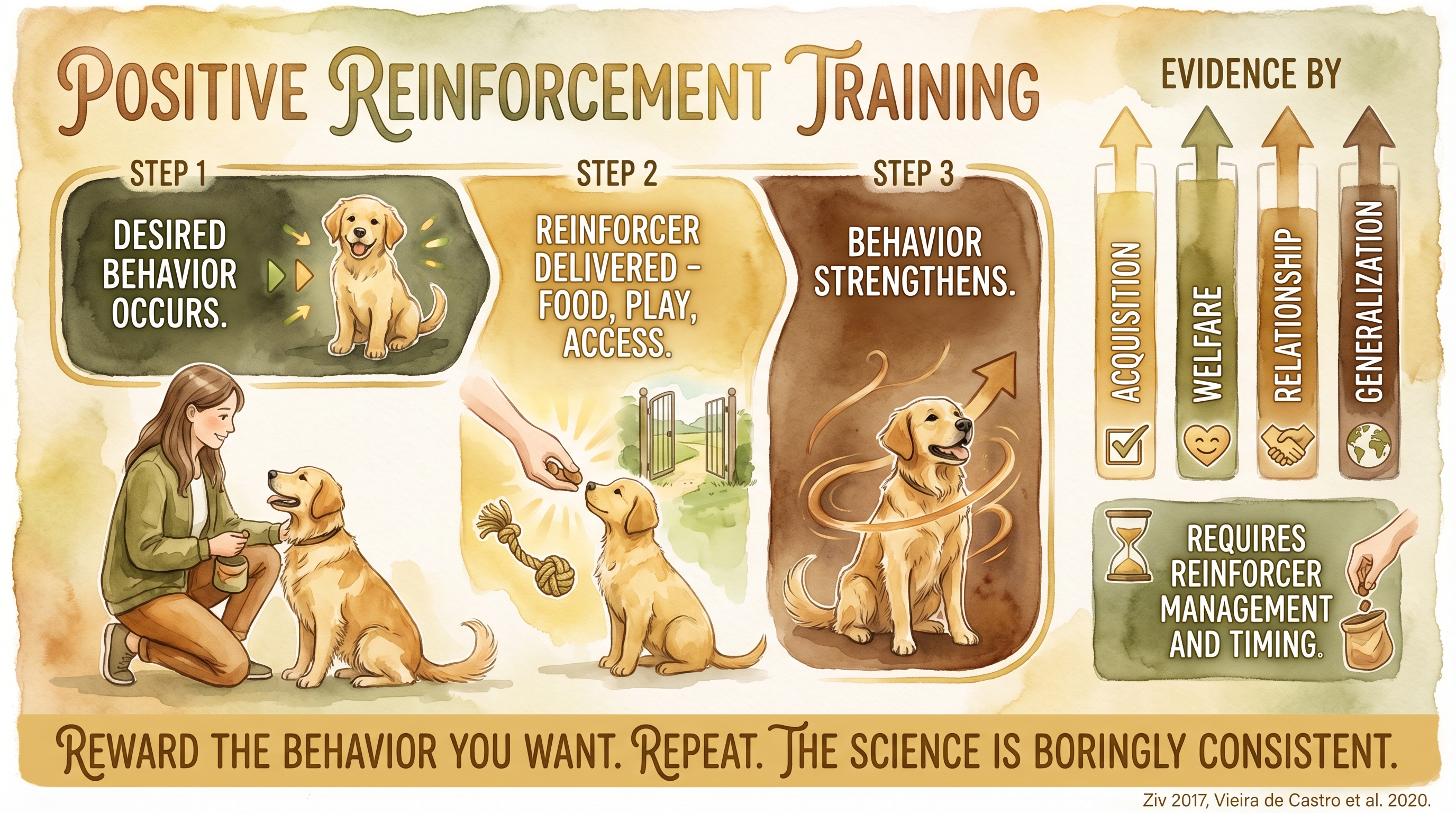
Reward the behavior you want - repeat - the science is boringly consistent.
Key Takeaways
- Positive reinforcement is a real operant learning process, not just a synonym for kindness.
- It is especially strong for teaching new skills with comparatively low welfare risk.
- Its common failure modes are usually human ones: weak timing, poor fading, inconsistent follow-through, and training in the wrong environment.
- JB treats reward-based training as a useful teaching tool, but not as a substitute for calm, preventive raising.
The Evidence
This entry uses observed claim-level tags beyond the dedicated EvidenceBlocks below. These tags mark JB program observation or practice-derived claims that need dedicated EvidenceBlock coverage in a later content pass.
- companion dogs
Summarizes the comparative literature showing welfare advantages for reward-based approaches relative to aversive-heavy methods. - AVSAB Humane Dog Training Position Statement (2021)companion dogs
Supports the veterinary-behavior consensus that humane, reward-centered methods should be first-line for most pet-dog teaching goals. - Rooney & Cowan (2011)companion dogs
Found stronger owner-directed play and interaction in dogs whose handlers used more reward-based approaches. - companion dogs
Documents the compliance and generalization limits that affect real-world success for any training protocol, including reward-based ones.
- domestic dogs
No published long-term study directly compares positive reinforcement training against structured relational raising and no-intervention controls across ordinary companion-dog homes.
SCR References
Sources
- American Veterinary Society of Animal Behavior. "Humane Dog Training Position Statement" (2021).
- Rooney, N. J., & Cowan, S. (2011). Applied Animal Behaviour Science.
- Pryor, K. (1984). Don't Shoot the Dog!