Relationship-Based and Ethological Training
Compound evidence detail3 SCRs / 6 parts
- Documentedthe commensal pathway model of canine domestication established as the dominant framework in evolutionary biology, supported by Bergstrom 2020 genomics, Thalmann 2013 mtDNA, Larson and Bradley 2014, and Freedman 2014
- Heuristicthe JB interpretive bridge mapping the Five Pillars onto the selection pressures inferred to have operated during commensal domestication, a synthesis without direct genomic or archaeological support
- Documentedhuman attachment evidence base together with canine-direct secure-base findings (Topal 1998, Horn 2013) and Schoberl-documented physiological effects of secure caregiving in dogs
- Heuristicfull attachment-theory apparatus transfer to canine relationships, including internal working models and attachment-classification systems
- Documentedcanine welfare evidence on aversive training methods (Vieira de Castro 2020, Ziv 2017, Hiby 2004) and attachment-mediated stress modulation evidence (Schoberl 2015, Asher 2020, Brubaker and Udell 2023)
- HeuristicJB claim that secure attachment context measurably alters how dogs experience mechanically operant-identical correction procedures, RF-flagged in the SCR and formally untested in controlled canine studies
Relationship-based and ethological training refers to a loose family of approaches that begin with a different assumption from classic dog training. Instead of asking first how to shape or reinforce a target behavior, they ask what kind of social animal the dog is, what signals the dog is already using, and how human handling fits into that species-typical communication system. The dog is approached less as a learner of cued tasks and more as a social mammal living inside a human group. Mixed Evidence
This camp is intellectually broad. Turid Rugaas popularized the language of calming signals through On Talking Terms with Dogs. Suzanne Clothier's 2002 book Bones Would Rain from the Sky placed relationship at the center of good handling. Kim Brophey's more recent Family Dog Mediation and Meet Your Dog framework integrates genetics, function, health, and behavior through an applied-ethology lens. Documented Alongside those practitioner voices sits a more academic current: John Bradshaw, Adam Miklosi, Jozsef Topal, Brian Hare, Patricia McConnell, and the Family Dog Project all contributed research or critique that pulled attention toward canine social cognition and communication rather than pure operant control.
The evidence base here is mixed because the camp contains both well-supported findings and looser interpretive claims. Heuristic It is well documented that dogs are highly sensitive to human ostensive cues, show attachment-like patterns to caregivers, read gestures and gaze, learn socially in some settings, and possess cooperative-communicative skills that emerge early. Topal's 1998 Strange Situation work, Hare's 2002 domestication-of-social-cognition paper, Miklosi's 2003 look-back finding, and Fugazza and Miklosi's 2015 social-learning work all point in that direction. It is less well documented that these findings settle the practical argument that formal training should be displaced by relational raising in everyday family life. That stronger conclusion remains partly philosophical.
JB stands very close to this tradition and still keeps a line of caution. JB agrees that the relational frame is the right starting point. JB also agrees with the notebooks for this dispatch that some ethological rhetoric outruns the evidence when it turns every observational insight into a law. Dogs are social mammals with native communicative skill. That is documented. The stronger claim that relational frameworks are sufficient on their own for every family-dog problem is not. JB's own position therefore belongs here, but it belongs here with its evidence tags left on.
What It Means
The Camp Begins With Social Meaning, Not With Quadrants
Relationship-based and ethological trainers ask a different first question from operant trainers. They are less likely to begin with "How do I reinforce or punish this?" and more likely to begin with "What is the dog communicating, rehearsing, or needing in this social context?" That shift sounds subtle, but it changes everything about observation. The handler watches body language, orientation, distance-increasing signals, environmental load, frustration, attachment behavior, and household rhythm before selecting any technique.
This is why the camp feels intuitively different to many families. The dog is not only a performer of behaviors. The dog is a participant in a relationship. That does not make learning theory false. It changes the scale at which the dog is being understood.
The Practitioner Lineage
Turid Rugaas made one major contribution to popular dog culture by naming and systematizing "calming signals," the small appeasement and de-escalation behaviors she observed in dogs communicating with one another and with humans. Suzanne Clothier, especially through Bones Would Rain from the Sky in 2002, argued that relationship quality and observation should lead training choices rather than the other way around. Kim Brophey's recent work at The Dog Door and in Meet Your Dog pushes a similar intuition through an applied-ethology framework that emphasizes breed function, individual variation, and environment.
These practitioner systems are not all identical, and they should not be flattened into a single doctrine. Some lean more observational, some more counseling-oriented, and some more philosophical. Their common move is to treat the dog as a species with communicative patterns and inherited tendencies that matter before formal technique enters the room.
The Academic Evidence That Gives the Camp Weight
The strongest support comes from canine cognition and attachment research rather than from direct trials of relationship-based training programs. Documented Topal et al. in 1998 adapted Ainsworth's Strange Situation and showed secure-base and separation-distress patterns in dogs with their caregivers. Hare, Brown, Williamson, and Tomasello in 2002 showed dogs outperforming wolves and chimpanzees in reading human social cues. Miklosi and colleagues in 2003 showed dogs looking back to humans during problem solving in ways wolves did not. Topal et al. in 2009 argued that dogs are sensitive to human ostensive communication in ways reminiscent of human infants. Fugazza and Miklosi in 2015 showed dogs can learn socially through "Do As I Do" protocols, with implications for generalization and memory.
Those are major findings. They do not prove every relational trainer is right about every practical claim, but they do undermine the idea that dogs are best understood only as organisms waiting for reinforcement contingencies. The notebooks for this dispatch are right to say that the social-cognition layer is robust even where the broader philosophical applications remain partly heuristic.
JB locates itself here because dogs do not come to human life as blank operant learners. They arrive already equipped to read social orientation, spatial pressure, communicative intent, and subtle changes in relationship tone.
Where the Evidence Stops
This is where the camp needs honesty. Rugaas's calming-signal framework is observational and influential, but not every strong claim made in its orbit has been directly formalized in peer-reviewed experiments. Bradshaw and Miklosi offer real critique of reductive training frames, but their most philosophical conclusions remain exactly that, philosophical conclusions. Even the strongest social-cognition evidence does not by itself prove that a household can replace all training with relationship and still solve every modern pet-dog demand.
JB accepts those limits. The relational frame is probably the correct starting point for family dogs. That is a defensible reading of the evidence plus the species' evolutionary history. It is not yet a closed comparative proof. The difference matters because this entry belongs to the area of the field where it is easiest to slide from well-supported observation into totalizing worldview language.
Why It Matters for Your Dog
For a Golden Retriever family, this subject matters because Goldens are among the breeds most obviously built for social reading. They watch faces, movement, tone, pace, and group structure constantly. Families often see that sensitivity in ordinary life before they know any theory. The dog settles when the adults settle. The puppy follows the older dog through routine. A small shift in body posture changes whether the retriever barrels through a doorway or pauses. Those are relational facts before they are training facts.
That matters because many common family frustrations are not failures of reward timing so much as failures of social coherence. A Golden who keeps jumping on guests may understand plenty of cues and still be swimming in too much social intensity. A dog who drags on leash may not need a more elegant reinforcer so much as an adult who changes the whole pace of departures. A puppy who mouths harder when talked to is often responding to the energy of the interaction, not merely ignoring the formal consequence structure.
A concrete example helps. Imagine a six-month-old Golden who becomes wild every evening when the family gathers in the kitchen. A purely operant approach might ask which calm behaviors to mark, which incompatible response to cue, and how to structure reinforcement schedules. Those are reasonable questions. A relationship-based reading asks different questions first. What social energy is filling the room? Is everyone talking over each other? Is the puppy tired, crowded, and repeatedly invited into excitement? Has the household accidentally taught the dog that this hour is a flood of attention, movement, and food smells? Once those questions are asked, the behavior problem starts to look less like stubbornness and more like an honest response to social conditions.
Goldens also show why the camp's cautions about signal mismatch matter. Patricia McConnell's point about humans flooding dogs with contradictory language is immediately recognizable in family life. Adults say "off" while leaning in, "come" while sounding angry, and "settle" while the whole room is buzzing. A relationship-based lens helps owners notice that dogs are often not failing to obey. Observed-JB They are trying to sort conflicting social information.
The attachment findings matter too. A dog who treats the caregiver as a secure base is not only a dog that can be rewarded. It is a dog whose confidence, exploration, and regulation are tied to relationship quality. Families raising Goldens often see this when a puppy behaves differently with the calm parent than with the frantic one, even when both use the same treats. That difference is not noise. It is part of the mechanism.
At the same time, this camp can be romanticized. Some owners hear "relationship" and conclude that explicit teaching, management, or technical skill are unnecessary. That is not the JB reading. A family dog still has to live in doorways, cars, neighborhoods, children's routines, grooming appointments, and travel contexts. Relationship is the foundation, not an excuse to abandon competence. The best relational handling still notices timing, repetition, environment, and clear adult boundaries.
This is where JB differs from some softer versions of the camp. JB does not want a sentimental relationship. It wants an ordered one. Goldens flourish when the relationship is warm and asymmetrical, affectionate and governed, observant and decisive. Ethology without structure can drift into overinterpretation. Structure without ethology drifts into mechanical training. The sweet spot is the combination.
Children often make the point plain. A Golden may respond very differently to a still adult, a squealing child, and a visiting friend not because the dog forgot its training, but because the social meaning of the scene changed. A relationship-based lens helps the family see that behavior is being organized by who is present, how they are moving, and what the dog expects from them. That is precisely why the household cannot outsource everything to cue fluency alone.
The same point shows up in transitions that no one formally trains. A puppy watches how adults move toward the door, how tension rises before guests arrive, how the older dog settles after a burst of activity, and how much speech actually carries information. Those are ethological facts of household life. Families do not have to choose between noticing them and teaching skills. They simply need to stop pretending the untrained social world is neutral.
That shift in attention is often where the practical value of the camp begins.
It gives ordinary life diagnostic value.
That is useful in every home.
Especially busy family homes.
What This Means for a JB Family
The practical takeaway is to start by reading the dog as a social mammal, not as a cue machine. Watch posture, tempo, orientation, distance, arousal, and imitation before assuming the answer lives only in better rewards or better corrections. Goldens usually tell families a great deal through those channels if the adults slow down enough to notice.
The second takeaway is that relationship is not the opposite of structure. It is the medium through which structure becomes intelligible. A calm doorway pause, a quiet body block, a slowed transition, a settled adult dog, and a household that does not narrate everything all teach the Golden how group life works. Those are relational acts with real training consequences.
JB families should still stay honest about the evidence ceiling. Social cognition, attachment, and imitation research strongly support the idea that dogs are built for relationship-rich learning. The further claim that relational raising can replace most formal training in family life is a broader JB position and remains partly heuristic because the direct comparison studies do not exist. There is no need to hide that. It is enough to say that the evidence points JB in this direction and that daily life with well-raised dogs often reinforces the same reading.
Used properly, this camp gives families a saner starting point. Instead of asking how to get behavior out of the dog, it asks what kind of life is teaching the dog already. Documented For a Golden Retriever, that is a powerful shift because so much of the breed's goodness emerges when the social world around it is calm, coherent, and worth following.
That is why JB belongs here. Not because every ethological claim in the industry has been proven, and not because formal teaching is never needed, but because the right first language for a family dog is relationship, communication, and development before it is technique.
The practical benefit is that families stop feeling forced to choose between softness and competence. They can read signals carefully, honor social reality, and still be clear leaders. They can use formal teaching when needed without pretending the dog starts each day as an operant blank slate. That is a much richer, and often much calmer, way to live with a Golden.
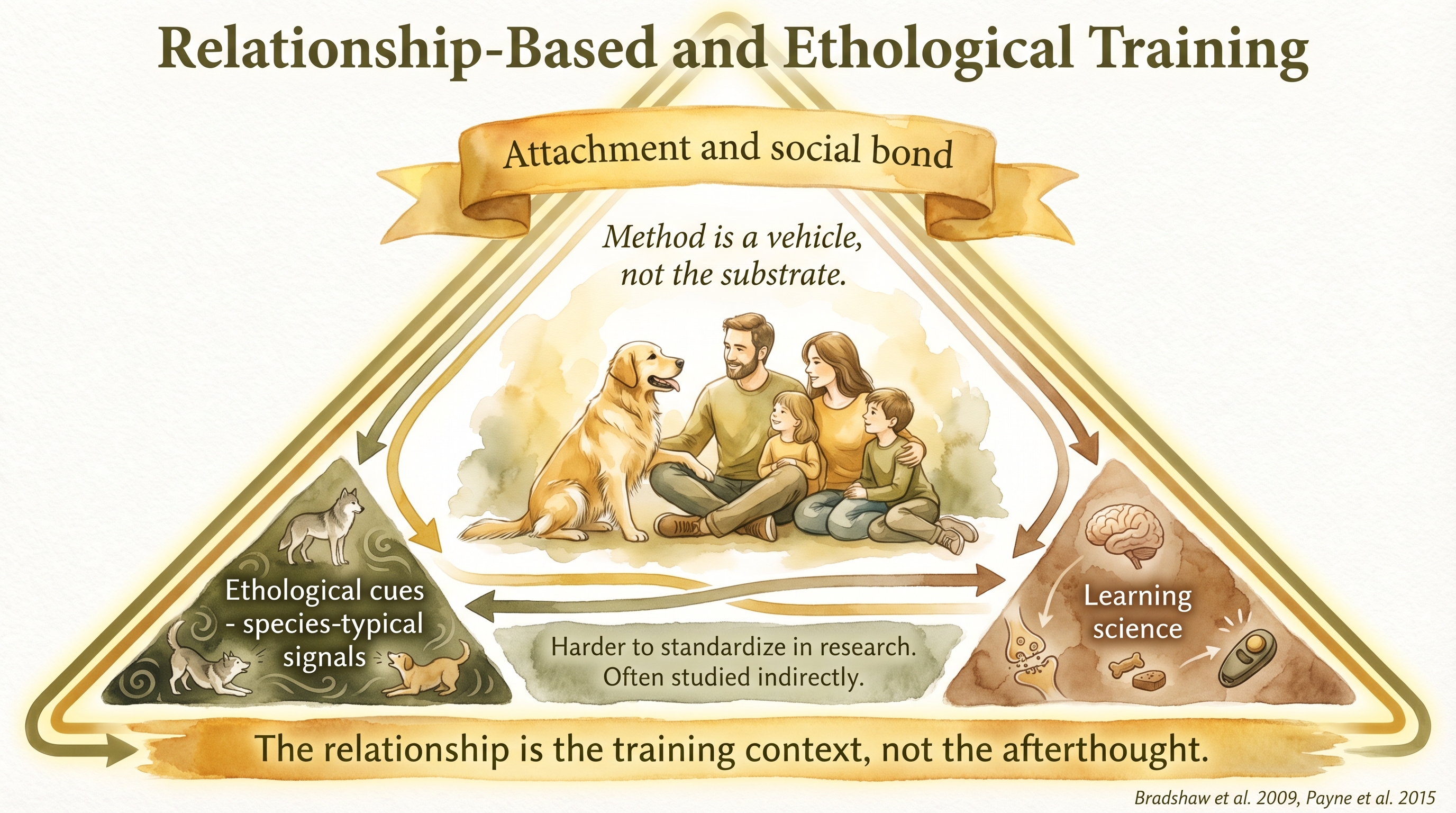
The relationship is the training context, not the afterthought.
Key Takeaways
- Relationship-based and ethological approaches start with communication, attachment, and species-typical behavior rather than with training quadrants.
- The social-cognition evidence supporting this orientation is strong, especially around gesture reading, attachment, and imitation.
- The bigger practical claim that relational frameworks can replace most formal training is more interpretive than the core cognitive findings themselves.
- JB aligns strongly with this camp while still keeping its strongest downstream claims properly hedged.
The Evidence
This entry uses documented claim-level tags beyond the dedicated EvidenceBlocks below. These claims should remain tied to the entry Sources and SCR references during the next evidence-chain authoring pass.
This entry uses observed claim-level tags beyond the dedicated EvidenceBlocks below. These tags mark JB program observation or practice-derived claims that need dedicated EvidenceBlock coverage in a later content pass.
This entry uses heuristic claim-level tags beyond the dedicated EvidenceBlocks below. These tags mark JB interpretive application rather than direct study findings.
- Topal et al. (1998)companion dogs
Demonstrated secure-base and separation-distress patterns in dogs toward caregivers using a Strange Situation adaptation. - Hare et al. (2002) and Miklosi et al. (2003)dogs and wolves
Show dogs' evolved sensitivity to human social cues and human-oriented problem solving. - Topal et al. (2009)dogs and wolves
Supports the idea that dogs are tuned to human ostensive communication in ways that differ from wolves. - Fugazza & Miklosi (2015)companion dogs
Demonstrates social learning through 'Do As I Do' protocols, challenging the idea that operant teaching is the only serious learning channel.
- domestic dogs
No published long-term study directly compares relationship-based and ethological training against structured relational raising and no-intervention controls across ordinary companion-dog homes.
SCR References
Sources
- Topal, J., Miklosi, A., Csanyi, V., & Doka, A. (1998). Journal of Comparative Psychology.
- Hare, B., Brown, M., Williamson, C., & Tomasello, M. (2002). Science.
- Miklosi, A., Kubinyi, E., Topal, J., Gacsi, M., Viranyi, Z., & Csanyi, V. (2003). Current Biology.
- Topal, J., Gergely, G., Erdohegyi, A., Csibra, G., & Miklosi, A. (2009). Science.
- Fugazza, C., & Miklosi, A. (2015). Applied Animal Behaviour Science.
- Dogwise. On Talking Terms with Dogs: Calming Signals by Turid Rugaas.
- Suzanne Clothier official site. Bones Would Rain from the Sky.
- The Dog Door official site. Kim Brophey and Meet Your Dog.