Evidence and Outcomes in Dog Training: An Overview
Compound evidence detail1 SCR / 2 parts
- Documentedthe structural absence of an industry-wide standardized canine behavioral outcome measurement and reporting system, supported by Hsu and Serpell 2003 (C-BARQ instrument), Lamb 2018 (LAIR clinician-overestimate finding), Mills 2020 (LCAS validation), Wright 2012 (DIAS validation), Daniels 2022 (UK client-rated equivalence regardless of method), and the IAABC Foundation Journal 2023 review of informal-assessment dependence
- Heuristicthe JB framing comparing the dog-training industry's outcome-measurement vacuum to adjacent helping professions (veterinary medicine, human psychology, education) where outcome measurement is regulatorily mandated or conventionally standardized, with the qualifier that the structural claim concerns industry-scale practice and does not deny that individual trainers measure outcomes in their own work
The evidence landscape for dog training is real, but it is much thinner and messier than the culture around dog training often implies. Families regularly hear phrases such as "science based," "evidence backed," or "what the research proves," yet the underlying literature is a patchwork of small trials, cross-sectional owner surveys, school comparisons, retrospective questionnaires, and a relatively small number of stronger experimental studies. Compared with human medicine or even mainstream clinical psychology, the field is young, underpowered, and methodologically fragile. Documented
That does not mean the field knows nothing. Several findings recur often enough to matter. Ziv's 2017 review concluded that aversive methods are associated with increased stress, fear, and aggression risk. Vieira de Castro and colleagues in 2020 found more stress behavior, higher cortisol, and more pessimistic cognitive-bias responses in dogs from aversive schools than in reward-based schools. Cooper in 2014 and China in 2020 found no clear performance advantage for remote-collar groups over reward-based groups while again showing more stress indicators. Owner-survey work from Hiby 2004, Blackwell 2008, Arhant 2010, and Casey 2014 repeatedly links punishment-heavy handling with more problem behavior or aggression risk.
The same literature also carries structural weaknesses that cannot be ignored. Owners self-select into methods. Trainers define categories inconsistently. Dogs are studied over weeks or months rather than years. Many outcomes are owner-reported rather than independently measured. A dog can look improved to an owner while still carrying stress, losing flexibility, or becoming dependent on the exact equipment or handler context that produced the result. These are not footnotes. They are central to how the evidence must be read.
JB therefore reads the literature with two commitments at once. First, the welfare case favoring reward-based over aversive-heavy training is meaningful and should not be minimized. Second, the whole field measures less than most consumers imagine. It is better at measuring whether a dog performed a task than at measuring whether a dog became a calmer, more secure, more mature family companion over time. That gap matters because JB's deepest disagreement with the industry lives there.
What It Means
What Counts as Evidence in This Field
Dog-training evidence comes in layers. Systematic reviews and meta-analyses sit highest because they synthesize multiple studies. Below that are randomized or controlled trials, which are uncommon and often small. Below those are cohort studies, observational school comparisons, and cross-sectional owner surveys. Lowest are case reports, trainer anecdotes, before-and-after videos, and testimonials, even though those are the forms most consumers see first.
The notebooks for this dispatch make an important methodological point: the field leans heavily on retrospective and cross-sectional designs because true randomized comparisons are difficult and sometimes ethically constrained. If a study intentionally exposes companion dogs to aversive handling, ethics tighten immediately. Documented As a result, much of the literature compares naturally occurring training populations rather than randomly assigning families to fundamentally different methods.
What the Strongest Findings Actually Support
The strongest support in the literature concerns welfare cost in aversive-heavy training conditions. Ziv's 2017 review synthesized seventeen studies and recommended reward-based methods as first-line. Deldalle and Gaunet in 2014 found more stress behavior and weaker attention to handlers in a correction-oriented school than in a reward-based school. Vieira de Castro in 2020 combined behavioral coding, salivary cortisol, and cognitive-bias testing in ninety-two dogs from seven Portuguese schools and found a negatively shifted picture for aversive-trained dogs that extended beyond the training session.
Remote-collar research makes the same point in a narrower form. Documented Cooper et al. 2014 and China et al. 2020 did not show clear superiority for remote collars over reward-based alternatives while still documenting more stress-related behavior in the remote-collar groups. Schalke 2007 and Schilder and van der Borg 2004 further support the claim that electric aversives can create measurable stress and conditioned fear associations. The field therefore has more evidence that aversives cost something than evidence that they buy something uniquely valuable.
What the Literature Keeps Missing
The outcome literature is much weaker on the questions families often care about most. Very few studies follow dogs for years. Almost none measure whether a method changes long-term arousal baseline, relationship security, or resilience across life stages. Many do not separate immediate compliance from durable maturity. Some do not even distinguish clearly between a dog performing in the trainer's setup and a dog functioning well in the owner's real home.
The notebooks also emphasize the handler variable. Powell et al. 2021 showed that owner personality and attachment predict treatment outcome independently of the prescribed protocol. Documented Takeuchi, Houpt, and Scarlett 2000 documented weak adherence to complex behavior plans. Lamb et al. 2018 showed that clinicians can overestimate success relative to validated measures. These findings mean the literature is not simply comparing methods. It is also comparing humans, commitment levels, and reporting styles.
The mainstream research field mostly measures whether a dog learned the target behavior. JB keeps asking a different question: what kind of upbringing produces fewer target problems to begin with, and where is that comparison actually measured?
The Honest Overall Reading
The honest reading is neither "the science is settled" nor "there is no evidence." Reward-based training has the better welfare profile in the published literature. Correction-heavy and aversive methods carry repeated signals of risk. At the same time, the field has not produced the kind of long-term, developmentally rich, socially sensitive evidence that would let anyone claim to have solved the family-dog problem scientifically.
That is why the dispatch notebooks keep stressing the difference between evidence strength and rhetorical temperature. Force-free advocacy is often directionally right about welfare and still overstates the completeness of the literature. Balanced advocacy is often right that the field has gaps and still understates the significance of the welfare findings we do have. The evidence supports some positions strongly, others moderately, and many only as open questions.
Why It Matters for Your Dog
For a Golden Retriever family, this entry matters because trainer claims land in your house long before research papers do. Families hear "best method," "proven system," "reliable recall," "science-based corrections," or "fear-free results" without being told what kind of evidence sits underneath those phrases. Once you understand the evidence landscape, those labels become easier to read with some discipline.
Start with the most practical point. A study showing that dogs in one school displayed fewer lip licks or lower cortisol after a training session is useful, but it is not the same thing as proving which method will produce the best adult family dog in your particular home. Documented A survey showing more owner-reported aggression in dogs exposed to punishment is important, but it does not automatically tell you what caused what in every case. A recall trial showing remote collars did not outperform rewards is highly relevant, but it still studied a limited sample over a limited time horizon. Good evidence narrows the field. It does not eliminate judgment.
That matters when your Golden is not a study participant but a real dog in a noisy household. Suppose your adolescent retriever listens beautifully in the kitchen and falls apart when the neighborhood comes alive. One trainer says more proofing and better treats. Another says the dog needs real consequences. A third says the issue is relationship and household arousal. The evidence can tell you some things. It tells you aversive-heavy options carry more welfare concern. It tells you reward-based teaching is a safer first-line route. It tells you owner consistency and household follow-through will matter enormously whichever plan you choose. It does not tell you that a single branded method will override your daily life.
The evidence landscape also helps families avoid false confidence from short-term wins. A dog may perform dramatically better during a two-week protocol and still regress at home. A dog may stop one behavior because the consequence was strong enough while becoming more cautious, frustrated, or equipment-dependent elsewhere. Without understanding what the field usually measures, owners can mistake task success for whole-dog success.
That is especially relevant for Goldens because they are often pleasant enough to mask method flaws. A softer dog may comply while internal state and maturity lag behind. Families then conclude that the method is perfect because the dog is still friendly and the visible problem shrank. The literature warns against that shortcut by repeatedly showing that welfare and performance are related but not identical outcomes.
There is also a budgeting question hidden here. Families spend money based on confidence signals. If the field mostly offers modest evidence, then strong guarantees deserve skepticism. A six-week board-and-train, an e-collar recall package, or a trainer promising permanent calm should not be weighed only by marketing charisma. It should be weighed against what the evidence can actually support and what the household will have to maintain afterward.
Most importantly, this overview protects families from two opposite mistakes. One mistake is cynicism, deciding that because the literature is limited nothing matters and all methods are opinion. The other is overcredulity, deciding that because a trainer uses scientific vocabulary the solution must be proven. The better stance is firmer and calmer: use the evidence we have, respect its limits, and choose approaches that do the least welfare harm while matching the realities of your dog's life.
That is very close to the JB stance. JB is not anti-evidence. JB is anti-false certainty. The literature is strong enough to shape first choices and ethical boundaries. It is not yet complete enough to settle every deeper developmental question the way the industry often pretends it can.
This changes how families should hear confident comparative language. If a trainer says one approach is scientifically superior, the next question is superior on what outcome and over what time period. Superior for immediate recall in a controlled session is different from superior for household calm six months later. Superior for visible obedience is different from superior for welfare. The overview helps families keep those layers separate so they do not accidentally buy one kind of success while imagining they purchased all of them.
That distinction also helps families resist panic shopping when a dog hits a rough stage. A short-term spike in pulling, mouthing, barking, or adolescent selective hearing does not automatically mean the humane option has failed and the harsher option has been vindicated. It may mean the family is confronting a developmental phase, an environment problem, or an adherence problem that no paper can solve for them automatically. Evidence literacy keeps a temporary struggle from being misread as proof that only a stronger method is serious.
What This Means for a JB Family
The JB takeaway is to become literate in evidence categories before becoming loyal to training brands. Ask what kind of study supports the claim. Ask whether outcomes were measured directly or reported by owners. Ask how long dogs were followed. Ask whether the method category was actually defined clearly. Ask whether the study measured immediate task performance, stress, relationship quality, or only one of those.
That habit changes family decision-making. Reward-based skill teaching rises as a sensible first-line option not because it is fashionable, but because its welfare profile is better supported. Heavy claims about corrections, miracle recalls, or guaranteed transformation become less persuasive because the literature rarely supports those promises at the level the marketing suggests.
It also creates a healthier relationship to JB's own claims. The same standard should be applied here. When JB says prevention and relational raising likely produce better family-dog outcomes, that claim should remain tagged where direct comparative evidence is missing. The field has not yet done the decisive raised-versus-trained-versus-control study. JB should not act as if it has.
Practically, that means a JB family chooses methods and helpers with humility. Use the evidence to set boundaries. Prefer lower-welfare-cost options. Notice the handler variable. Build the home so fewer crises demand technical rescue. Then keep your standards high for everyone, including JB, about what is documented and what is still reasoned interpretation.
That is the right altitude. Strong enough to rule out bad overclaiming, modest enough to leave room for what the field still has not measured.
That practical humility often feels better in family life than false certainty does. It gives parents permission to ask better questions, slow purchases down, and prefer trainers who can explain tradeoffs without turning every recommendation into a referendum on their own camp. In a fragmented field, that steadiness is one of the best outcomes evidence literacy can deliver before any dog-specific intervention even begins.
It also changes what counts as a green flag in professional help. A good trainer will usually sound precise about what research can support, honest about where owner follow-through will do most of the work, and careful not to sell a narrow skill result as if it were the whole dog. Observed-JB A family that learns to hear those signals becomes much harder to pressure with urgency, equipment mystique, or branded certainty.
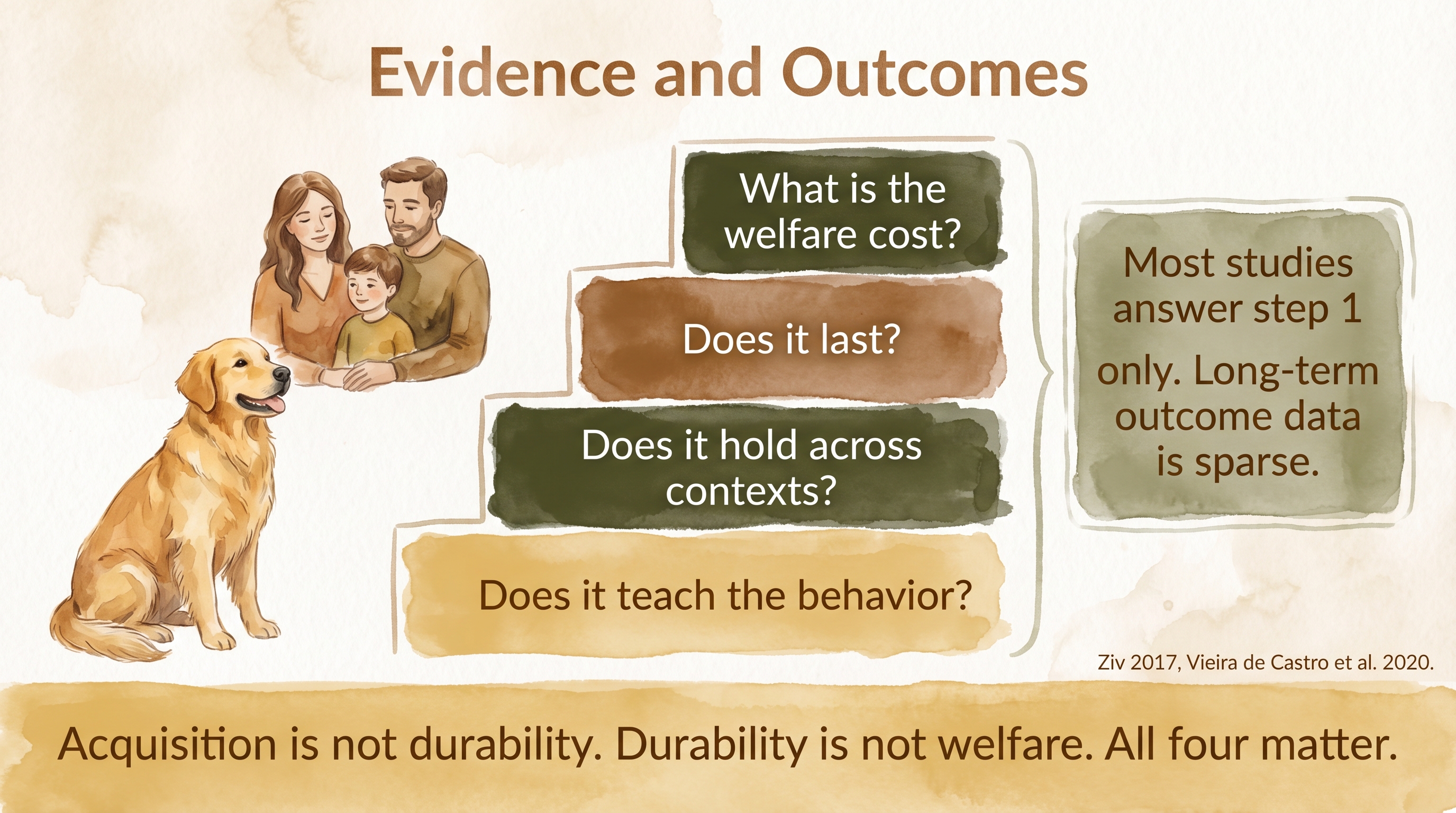
Acquisition is not durability - durability is not welfare - all four matter.
Key Takeaways
- Dog-training research exists, but much of it relies on small samples, surveys, or short follow-up periods rather than strong long-term trials.
- The best-supported finding is that aversive-heavy approaches carry more welfare concern than reward-based approaches.
- The field is much weaker at measuring long-term maturity, relationship quality, and durable family-life outcomes than at measuring task compliance.
- Families should use the literature to guide first choices and ethical boundaries, not to surrender judgment to marketing slogans.
The Evidence
This entry uses observed claim-level tags beyond the dedicated EvidenceBlocks below. These tags mark JB program observation or practice-derived claims that need dedicated EvidenceBlock coverage in a later content pass.
- Ziv (2017)companion dogs
Review found aversive methods associated with stress, fear, and aggression risk and supported reward-based approaches as first-line. - Vieira de Castro et al. (2020)companion dogs
Combines behavior, cortisol, and cognitive-bias measures to show stronger welfare costs in aversive-school dogs. - Powell et al. (2021) and Takeuchi et al. (2000)companion dogs
Show that owner traits and adherence influence outcomes, complicating simple method comparisons. - companion dogs
Highlights the direction-of-effect problem, inconsistent category definitions, and the near-absence of long-term developmental measures.
- domestic dogs
No single dataset directly resolves the full population picture for evidence and outcomes in dog training: an overview without the usual survey, sampling, and threshold limitations.
SCR References
Sources
- Ziv, G. (2017). Journal of Veterinary Behavior.
- Vieira de Castro, A. C., et al. (2020). PLOS ONE.
- Cooper, J. J., et al. (2014). PLOS ONE.
- China, L., Mills, D. S., & de Souza Machado, D. (2020). Animals.
- Powell, L