Balanced Training: The Modern Position
Balanced training is not a single technique. It is a camp identity built around one permission: both reinforcement and correction are legitimate tools, and the trainer should choose among them according to the dog, the handler, and the stakes of the situation. In modern pet-dog culture, that identity emerged partly as a reaction against positive-only orthodoxy and partly as a continuation of older working-dog traditions that never accepted reinforcement as sufficient on its own. The result is less a clean method than a practical coalition. Documented
The modern balanced position usually includes several claims at once. Reward should be used generously for teaching new behavior. Corrections are sometimes needed for stopping dangerous, compulsive, or well-rehearsed unwanted behavior. Serious cases may require tools or consequences that force-free trainers refuse to use. A dog should not be left in endless management because ideology has ruled out all aversive options. Those claims are associated publicly with trainers such as Larry Krohn, Tyler Muto, and Ivan Balabanov, but the camp is broader than any one figure.
The evidence around balanced training is frustrating because the research literature does not define the category cleanly. Documented The notebooks for this dispatch flag this as a central limitation: studies use "mixed" or "balanced" inconsistently, making it impossible to know the actual ratio of reinforcement to punishment. That matters because a low-level reward-first trainer who occasionally uses a correction and a punishment-heavy trainer who tosses food sometimes may both get counted in the same bucket. Comparative papers such as Ziv 2017, Vieira de Castro 2020, and the survey literature give real reason for concern about aversive-heavy practice, but they do not resolve every version of the balanced self-description.
JB therefore treats the balanced-versus-force-free dispute as a genuine ethical argument rather than an already settled slogan war. JB also refuses to let that dispute become the main horizon. The larger JB claim is that both camps are often arguing downstream, after prevention has already failed and the dog has already become a case. From that angle, balanced training is not the final answer to positive-only weakness. It is one branch of the same training enterprise trying to solve the damage later and under worse conditions.
What It Means
What Balanced Trainers Are Actually Claiming
Balanced trainers are usually not claiming that punishment is fun, dominant, or automatically superior. Their core claim is that training should not be restricted to one moralized subset of operant consequences. They want access to positive reinforcement for teaching, negative punishment for boundary setting, negative reinforcement for some pressure-release work, and positive punishment or corrective tools when a dog's behavior is dangerous, obsessive, or resistant to softer methods. Documented
This position attracts many families because it sounds like common sense rather than ideology. A puppy can earn food for a sit. A dog that chases livestock, drags someone into traffic, or bites through a board-and-train's routine may need more than cookies and management. That is the balanced pitch in its strongest form.
Why Positive-Only Critics Trigger the Balanced Response
Balanced training gained cultural force because some force-free messaging really did overstate the literature and understate hard cases. Trainers with severe aggression, predation, or high-conflict household dogs sometimes watched owners cycle through rewards, management, and endless protocol while remaining terrified of imposing any meaningful boundary. Balanced trainers built their critique there. They argued that the positive-only movement sometimes leaves families with dogs that are safer only inside carefully managed setups and that it can stigmatize any clear correction as abuse.
The critique has some practical bite because the training-outcomes literature documents compliance decay, transfer problems, and the fact that owners often fail to sustain technically demanding reinforcement plans. Observed-JB Powell et al. 2021 showed that owner personality and attachment are associated with behavior-treatment outcomes in veterinary behavior cases. Takeuchi, Houpt, and Scarlett in 2000 found low adherence to higher-effort behavior plans. Those findings do not prove balanced training is correct. They do help explain why purely reinforcement-based plans can collapse in ordinary homes.
What the Force-Free Side Is Right About
The force-free reply is not empty ideology either. Ziv's 2017 review, Deldalle and Gaunet 2014, Vieira de Castro 2020, Casey 2014, and related studies repeatedly connect aversive-heavy or punitive handling with stress, fear, aggression risk, or negatively valenced affect. Documented The strongest empirical ground in the entire training-method literature remains the welfare cost of aversive exposure. That means the burden of proof does sit on the side that wants to preserve corrections as a routine option.
Research also exposes a classification problem that hurts balanced claims. The notebooks for this dispatch explicitly note that definitions of "balanced" and "mixed" are inconsistent across studies. Because the category is so elastic, trainers can always say a bad result does not describe their version of balance. That may sometimes be true. It also protects the camp from falsification in a way families should notice.
JB reads the balanced-versus-force-free fight as a dispute inside the method world. Both camps are mostly asking how humans should intervene once the dog has already become a training project. JB keeps asking why the relationship needed to become a training project so early and so often.
Why JB Stands Upstream of the Debate
JB agrees that the debate is real and ethically important. Dogs can be harmed by bad positive-only advice and by bad balanced advice in different ways. But JB does not think the deepest mistake is choosing the wrong camp after the dog is already dysregulated, rehearsal-rich, and emotionally disorganized. Heuristic The deepest mistake is raising too little and training too late, then expecting method choice alone to compensate.
That is why JB refuses easy hero-villain stories. Balanced trainers are not universally wrong, and force-free trainers are not universally safe or complete. The evidence is incomplete. The family context matters. Handler consistency matters. Dog temperament matters. Yet the population-level pattern in the notebooks still looks poor across the enterprise: many dogs never get formal training, many families do not adhere well, and long-term outcomes remain thinly measured. Balanced training may solve some cases better than positive-only training. It has not solved the larger problem that most companion dogs are becoming difficult in the first place.
Why It Matters for Your Dog
For a Golden Retriever family, balanced training matters because it often arrives at the exact moment the family feels disillusioned with reward-based promises. The puppy who once learned every cue for treats is now an adolescent dragging on leash, blowing off recall, mugging visitors, and stealing every object in sight. A trainer then says what the parents are secretly ready to hear: the dog needs boundaries, consequences, and clarity, not more bribery.
Sometimes that diagnosis contains a real insight. Goldens do need boundaries. They do need adults who can say no cleanly. They do become exhausting when the home has mistaken friendliness for structure. A family that has spent months negotiating with food in a high-arousal dog may feel immediate relief when someone finally speaks in a firmer register and changes the consequences.
The danger is that the relief can blur several different problems together. The family may have discovered the value of clearer adult structure, but the trainer may package that discovery inside equipment or correction systems the dog did not actually need. In other words, the household may be hungry for leadership while being sold balance. Those are not identical things.
A concrete Golden example helps. Imagine an eleven-month-old retriever who is wonderful at home drills but loses all sense when guests arrive, geese appear, or children start moving fast. The force-free plan has become more management, more treats, and more distance. The parents are frustrated because daily life still feels chaotic. A balanced trainer steps in, fits a tool, interrupts the lunging sharply, and the dog looks more manageable within a week. The parents are not irrational to feel grateful. But what exactly improved? Did the dog develop mature regulation, or did the household finally experience consequences strong enough to suppress visible chaos in loaded moments? Both can look like progress in the short run.
This is why the evidence matters. The literature supports caution about aversive cost and does not show that correction-heavy methods outperform reward-based ones enough to justify routine use. The compliance literature also reminds us that hard methods do not magically erase the handler variable. Inconsistent adults still create inconsistent dogs. A Golden living in a noisy, overexcited, under-rested home may look sharper under a balanced program while still carrying the same developmental disorder underneath.
Families also need to understand how marketing works here. Balanced training is often sold as realism, adulthood, and courage, while positive-only is caricatured as naivete. Those cultural identities are powerful. Parents who feel embarrassed by an unruly dog are vulnerable to any philosophy that promises fast competence. The risk is not only welfare harm. It is narrowing the family's imagination. They stop asking how to slow the whole emotional economy of the home down and start asking only which tools can win the moment.
Goldens deserve better than that reduction because so many of their behavior problems are relational and arousal-based long before they become obedience problems. Documented A dog who cannot greet calmly, settle after activity, handle transitions, or accept delayed access is not only missing correction. The dog is often missing a home organized around adult pace and emotional coherence. Balanced programs may sometimes patch those deficits better than pure treat work, but they still arrive after the damage.
The JB stance is not that the balanced camp is imaginary. It is that its strongest selling points expose a failure earlier in the pipeline. The more compelling balanced training sounds, the more closely a family should inspect the developmental picture that made it sound necessary.
There is a family-politics issue here too. Balanced programs can feel emotionally reassuring because they promise to make the adults decisive again. In households that have become split between the person with treats and the person with frustration, that promise can be powerful. Sometimes the real repair is not allegiance to the balanced camp but a calmer, unified adult front that stops swinging between appeasement and exasperation.
That is why balanced marketing can feel more convincing than its underlying method category deserves. It is often selling relief from human confusion as much as it is selling any particular training technology. Families are not wrong to want that relief. They just need to make sure they are buying adulthood rather than only a stronger toolbox.
That distinction is one of the most useful filters a JB family can keep.
It helps separate steadiness from branding.
That is not a small distinction.
What This Means for a JB Family
The first JB takeaway is to hear the balanced critique without becoming captured by the balanced solution. Yes, a dog can need more than rewards. Yes, adults must be able to interrupt behavior. Yes, some force-free rhetoric hides from hard cases. Those points can all be true. They still do not mean a family should hand the relationship over to a correction-centered framework by default.
The second takeaway is to separate structure from tool identity. A Golden needs calm leadership, threshold control, rest, prevention, and socially coherent adults. Documented Those are not the exclusive property of the balanced camp. In fact, JB would argue that the thing many families most admire in competent balanced trainers is often not the correction itself but the adult steadiness around it.
Practical families should therefore ask different questions from the ones the camps encourage. Not "Are you force-free or balanced?" but "How do you prevent rehearsal?" "How do you measure fallout?" "What happens when the dog only behaves in equipment?" "How do you know the dog is maturing rather than merely complying?" Those questions pull the discussion back toward outcome quality rather than camp loyalty.
JB families usually do best by stealing the good criticism and refusing the false dilemma. Keep the insistence on adult clarity. Keep the refusal to let a dog spiral forever in the name of purity. Keep the skepticism about treat-based performative training that never reaches daily life. Then pair those insights with Prevention, Calmness, and Structured Leadership so the family does not need the full balanced apparatus in the first place.
That is the upstream move. Instead of asking which camp should repair the chaos, raise the dog so much less repair is needed. The ethical debate about correction remains real. JB simply refuses to let that debate define the whole project.
In that sense the most useful part of balanced training for JB families may be diagnostic rather than prescriptive. If the family's ears perk up at balanced rhetoric, it often means they are starving for clearer adulthood in the home. JB wants to answer that hunger with steadier structure and earlier prevention before it answers it with a new correction identity.
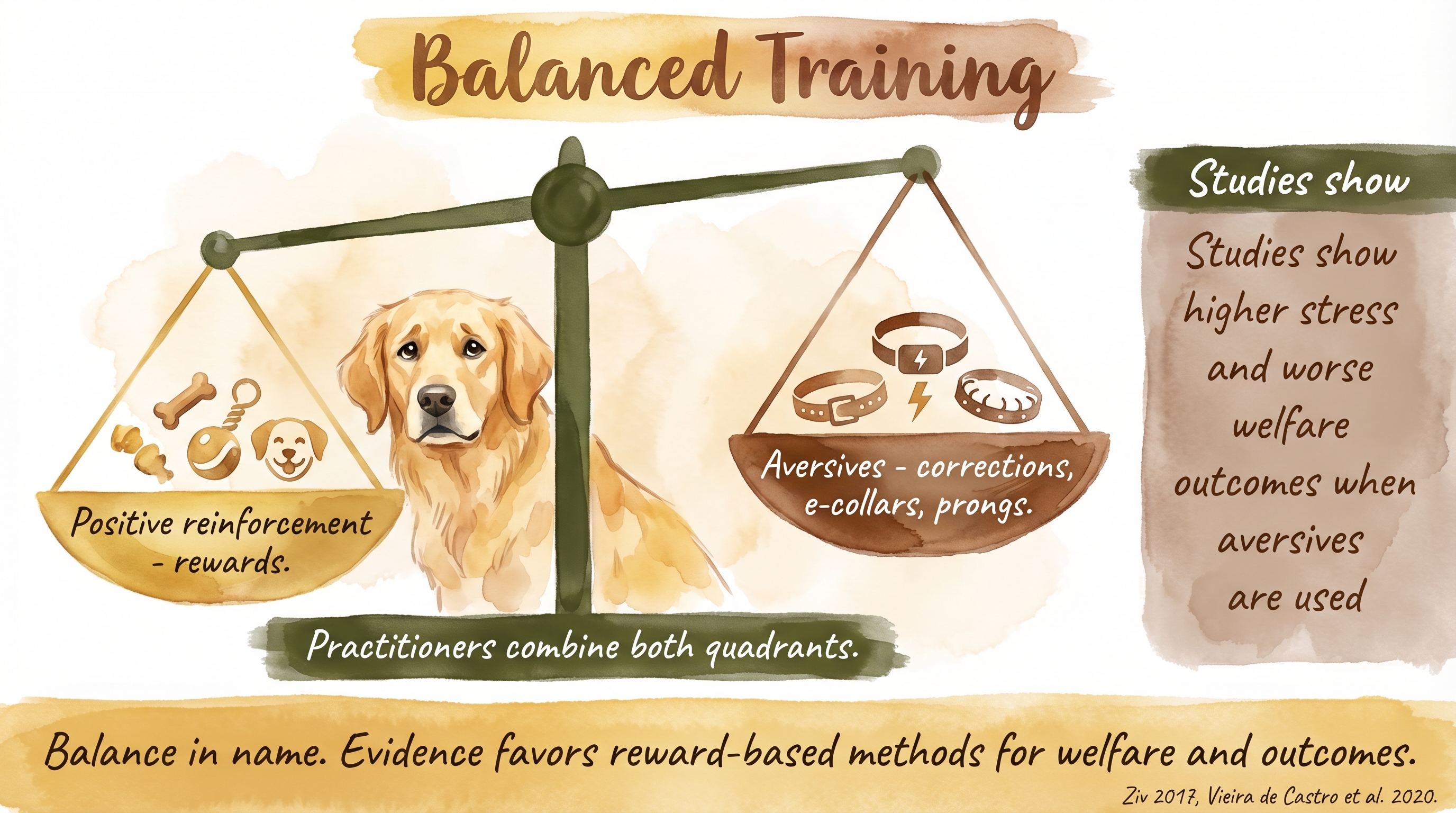
Balance in name - the evidence favors reward-based methods on welfare and outcomes.
Key Takeaways
- Balanced training is a camp identity built around permission to use both rewards and corrections, not a single standardized method.
- Its critique of positive-only training has some practical force, especially around hard cases and real-world family adherence.
- The literature still gives stronger support to aversive-welfare concern than to routine correction as a justified default.
- JB treats the entire debate as downstream of a bigger developmental failure: too little prevention before the dog becomes a case.
The Evidence
This entry uses observed claim-level tags beyond the dedicated EvidenceBlocks below. These tags mark JB program observation or practice-derived claims that need dedicated EvidenceBlock coverage in a later content pass.
This entry uses heuristic claim-level tags beyond the dedicated EvidenceBlocks below. These tags mark JB interpretive application rather than direct study findings.
- companion dogs
Identifies inconsistent definitions of balanced or mixed training as a major methodological limitation across studies. - Ziv (2017) and Vieira de Castro et al. (2020)companion dogs
Support welfare concerns about aversive-heavy training environments without resolving every low-level or mixed-use protocol. - Powell et al. (2021)companion dogs
Shows that owner personality and attachment are associated with treatment outcome, underscoring the handler variable that all camps must face. - Takeuchi, Houpt, & Scarlett (2000)companion dogs
Documents adherence decay in behavior-treatment plans, which helps explain why purely technical reinforcement protocols may fail in home conditions.
- domestic dogs
No published long-term study directly compares balanced training: the modern position against structured relational raising and no-intervention controls across ordinary companion-dog homes.
SCR References
Sources
- Ziv, G. (2017). Journal of Veterinary Behavior.
- Vieira de Castro, A. C., et al. (2020). PLOS ONE.
- Powell, L., Stefanovski, D., Siracusa, C., & Serpell, J. A. (2021). Frontiers in Veterinary Science, 7, 630931. https://doi.org/10.3389/fvets.2020.630931
- Takeuchi, Y., Houpt, K. A., & Scarlett, J. M. (2000). Journal of the American Veterinary Medical Association.