Talking to Your Veterinarian About Diet
Compound evidence detail2 SCRs / 5 parts
- Observed-JBthe clinical-management pattern in growing dogs with renal dysplasia, where growth requirements for minerals and protein conflict with phosphorus restriction for impaired kidneys
- Heuristicthe Golden-Retriever-specific maturity timing and practical diet-transition guidance that should remain veterinary-nutritionist-directed rather than treated as a standard formula
- Documentedthe AAFCO veterinary-exclusionary-statement pathway, the not-a-drug legal position of therapeutic diets, veterinary oversight boundary, and board-certified nutrition specialty framework
- Observed-JBcondition-category evidence where therapeutic diets have measurable support in areas such as renal disease, pancreatitis management, hepatic, urinary, or chronic-enteropathy care
- Heuristicthe category-wide efficacy boundary requiring condition-specific SCRs rather than universal claims across all therapeutic diet products
The diet conversation goes badly in families for predictable reasons. Families often arrive scared, overconfident, embarrassed, or already committed to an online conclusion. Veterinarians often have limited time and know that nutrition questions can turn into ideology faster than almost any other routine topic. Breeders sometimes feel defensive because feeding choices are part of how families judge them. None of those dynamics are unusual. They are exactly why a better framework matters. The strongest family-vet-breeder triangle is not built by pretending everyone always agrees. It is built by giving the conversation enough structure that evidence can actually be used. Heuristic
What It Means
Talking to your veterinarian about diet does not mean showing up and asking, "what food do you like?" The useful version is much more concrete. It means bringing the actual food name, formula, and if possible lot or batch information. It means knowing how much the dog eats in grams or measured cups, what treats and toppers are being used, whether the dog gets table food, what the body condition trend has been, and what exact concern is driving the appointment.
That concern might be normal growth, obesity, stool quality, itching, pancreatitis, kidney disease, suspected grain-free DCM risk, or just confusion after seeing contradictory advice online. Heuristic The more specific the concern, the more useful the veterinary answer can become.
What to Bring to the Conversation
The best nutrition appointment usually starts with a short factual inventory. What is the dog eating now. How much. How often. What else enters the mouth each day. Has body condition changed. Are there GI signs, skin signs, or activity changes. Are there any recent laboratory findings. Has the dog already failed other diets. Is the family looking for ordinary maintenance guidance or disease-state feeding guidance.
This sounds basic, but it changes everything. Many diet conversations fail because the family says "he eats a high-quality food" and the veterinarian still has no useful data. Documented Premium language is not nutritional information. Exact food identity and exact intake are.
The General Practice Reality
It is also worth saying something many families only hear as rumor: most small-animal general practice veterinarians are not full-time nutrition specialists. In most veterinary schools, nutrition is part of the curriculum but not the entire curriculum. That does not make general practice advice worthless. It means general practitioners are strongest at matching common cases to evidence-based mainstream choices, identifying medical red flags, and knowing when a case needs referral.
This is actually reassuring if families understand it properly. The family does not need every veterinarian to be a boarded nutrition specialist. They need the veterinarian to be able to guide ordinary feeding decisions responsibly and to escalate appropriately when the case becomes complex.
When a Nutrition Referral Makes Sense
A board-certified veterinary nutritionist becomes especially valuable when the dog has multiple concurrent diseases, needs a home-cooked diet formulated properly, has failed standard diet trials, or requires a tightly balanced plan that ordinary retail logic cannot safely solve. Kidney disease plus pancreatitis, chronic enteropathy plus severe food allergy, puppy growth plus congenital disease, and home-cooked plans for dogs with meaningful medical burdens all fit that higher-complexity category.
This is the point at which families should stop seeing referral as escalation born of failure. It is often the most efficient and safest path once the case exceeds ordinary clinical nutrition.
Useful Services and Better Questions
Families sometimes need practical support tools in addition to a veterinarian's in-clinic advice. Professionally formulated recipe platforms and consultation services can help when a home-cooked plan is medically necessary. The examples most commonly cited in the source layer include services such as BalanceIT, PetDiets, and academic resources like Tufts Cummings and the Petfoodology education layer. The point of naming these is not to create a mandatory shopping list. It is to show families what kind of resource category is actually useful: evidence-driven, formulation-aware, and connected to professional nutrition standards.
The better questions in the exam room are usually also less ideological. Instead of asking, "is kibble bad," it is more productive to ask, "given my dog's condition, what problem are we solving nutritionally?" Instead of "I heard grain-free is toxic," ask, "does my dog's diet history make you want to change course?" Heuristic Instead of "can I cook for my dog," ask, "under what conditions is a home-cooked plan appropriate, and who should formulate it?"
Why It Matters for Your Dog
This page matters because dogs are often harmed less by one wrong idea than by a string of half-finished plans. A veterinarian recommends a diet trial, the family follows it for ten days, social media says something else, the breeder says hold steady, the dog gets random treats anyway, and nobody really knows what happened. The result is not just confusion. It is loss of diagnostic clarity.
For your dog, the most valuable outcome of a good diet conversation is not emotional reassurance. It is shared specificity. Everyone should know what problem is being addressed, what food or plan is being used, how success will be measured, how long the trial lasts, and what would trigger the next step.
Diet conversations work best when the adults in the dog's life act like a coordinated care team. The dog should not be asked to live inside a rotating argument between internet advice, breeder preference, and incomplete veterinary follow-through.
This page also matters because it reduces one of the most common family errors: arriving with a fixed conclusion and treating the veterinarian as a stamp of approval rather than as a clinical partner. That posture narrows the conversation before it begins. It is far more useful to arrive with a clear question than with a verdict.
The same warning applies in the other direction. Veterinarians can miss useful nuance if the family does not explain what matters to them. Is the family considering home-cooked food for ethical reasons, GI reasons, or because the dog refuses everything else. Is the concern obesity, stool quality, allergy, or a fear created by a viral nutrition debate. Clarity helps both sides.
Another reason this page matters is that disease-state nutrition often conflicts with ordinary ideas about what a "good food" is supposed to look like. A kidney dog may need a food an owner would otherwise reject as too moderate in protein. A pancreatitis dog may need a formula that seems less romantic than a fresh-food subscription. A hydrolyzed diet may look unappealing on paper and still be exactly the right diagnostic tool. Families need a framework that lets medical goals outrank aesthetic food identity when the case requires it.
It also helps to know which questions usually move a diet appointment forward. A family can ask: what exact nutritional problem are we solving, what evidence-based diet categories fit that problem, how long should we stay on this plan before judging it, what signs count as success, what signs count as failure, and what would make you escalate to a specialist. Those questions give the veterinarian something clinically usable to answer. They are much more productive than asking for a brand favorite with no clear problem definition.
The veterinarian may also need the family to answer difficult questions honestly. Is the dog actually receiving only the stated food. Are multiple people feeding extras. Is the household likely to comply with a strict eight-week elimination trial. Is the family truly willing to weigh food, or are they hoping for a plan that still allows a lot of informal treating. These are not side questions. They often determine whether the plan will work more than the ingredient list itself.
Breeder input has a real place in this conversation too, especially in a program like JB where developmental context matters and where the transition from breeder home to family home is intentionally structured. But breeder input should work best as context, not as a replacement for medical care. The most useful breeder contribution is often information about what the puppy was eating, how it grew, how it tolerated transitions, and what philosophy guided early feeding. Once disease, allergy, chronic GI instability, kidney disease, or cardiac concern enters the picture, the veterinarian has to carry the medical nutrition lead.
The referral threshold also becomes clearer when families stop asking whether specialist input is "necessary" and start asking whether the case has become more complex than ordinary maintenance feeding. Home-cooked disease management, severe recurrent GI disease, multiple simultaneous restrictions, renal disease in a picky eater, pancreatitis with concurrent obesity, or a puppy with both growth and medical constraints all fit that higher-complexity lane. Heuristic That is when a board-certified veterinary nutritionist stops being optional polish and starts becoming the safest path.
There is also a follow-through lesson hidden inside every good nutrition appointment. A diet trial that is never completed, a weight plan that is never measured, or a renal diet that the dog never actually eats will not become effective through good intentions. Families should leave the appointment knowing exactly what to do in the first week, what to avoid, and when they are checking back in. The clearer the plan, the less likely the case is to dissolve into contradictory internet advice halfway through.
It is also useful for families to bring humility without bringing passivity. A good appointment is not the family surrendering all thought and it is not the family cross-examining the veterinarian with internet talking points. It is a working conversation. The family brings observations, routines, and constraints. The veterinarian brings clinical pattern recognition and medical prioritization. The best diet plans usually emerge when both sides stay specific enough to be useful and open enough to adjust.
Manufacturers can enter this conversation too, but only in the right order. It can be helpful to ask a veterinarian whether they care about feeding trials, large-breed growth formulation, phosphorus restriction, low-fat targets, hydrolysis, or company transparency in a given case. Heuristic It is less helpful to arrive with only front-of-bag marketing claims. In other words, the family should use manufacturer questions to clarify the medical plan, not to replace it.
This is also why documented follow-up is so powerful. When families write down what food was chosen, what exact amount is being fed, what non-food items are allowed, what signs are being tracked, and when the recheck occurs, the plan becomes much harder to derail. A vague intention invites drift. A written plan invites actual care.
That written-plan mindset is also what turns a stressful appointment into a usable one. Families who leave with specific instructions, a timeline, and a defined follow-up question usually feel calmer because the problem is no longer just "diet." It is a sequence of next steps. That is often the difference between a plan the household can actually honor and one that dissolves into second-guessing.
Clarity lowers anxiety, and lower anxiety usually improves follow-through.
That alone makes many nutrition conversations more effective than they first appear.
It gives the dog a real plan instead of a revolving debate.
When to Ask for More Help
Ask for more veterinary help sooner if the dog is losing weight, refusing food, vomiting repeatedly, has chronic diarrhea, is severely itchy, has a diagnosed medical condition that now affects feeding, or has failed a previous diet trial. Those are the moments when casual retail experimentation becomes expensive and uninformative.
Ask for referral help if the dog has multiple diseases, if a veterinarian recommends a home-cooked plan but not a formal formulation pathway, if the family is trying to balance competing restrictions, or if the case has become emotionally and clinically stuck. Referral is not defeat. It is often the cleanest way out of confusion.
Families should also seek more help when they realize they cannot follow the plan they were given. That is not a character failure. It is useful information. A plan that the household cannot execute is not a real plan yet.
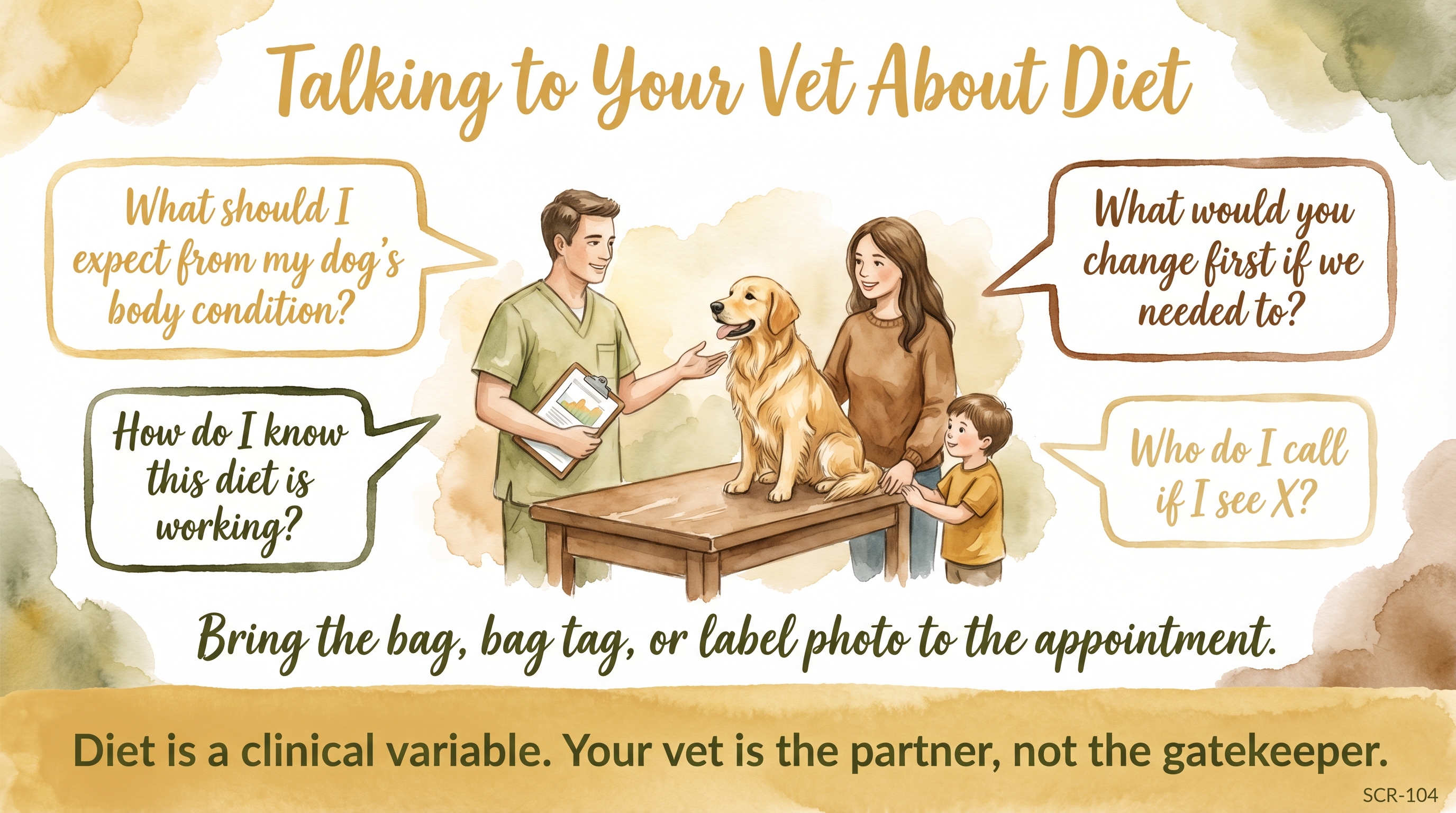
Diet is a clinical variable - your vet is the partner, not the gatekeeper.
Key Takeaways
- A productive diet appointment starts with specifics: current food, exact intake, treats, body condition trend, signs, and the real question the family wants answered.
- General practice veterinarians do not need to be full-time nutrition specialists to guide ordinary cases well and recognize when referral is appropriate.
- Board-certified nutrition help is most useful in complex disease, failed trials, and properly formulated home-cooked plans.
- The best diet conversation is not about winning an argument. It is about agreeing on one clear plan, one time frame, and one way to measure whether it is working.
The Evidence
This page is deliberately marked heuristic because it is a framework page, not a disease-mechanism page. The structure is built from documented realities already established elsewhere: adequacy claims are floors rather than total answers, disease-state nutrition can override ordinary feeding logic, and complex cases benefit from tighter professional oversight. The bridge from those facts to conversational best practice is practical reasoning rather than a randomized communication trial.
That is still useful. Families need process, not only data. The strongest process here is preparation, specificity, willingness to revise assumptions, and early referral when the case exceeds ordinary scope.
- SCR-079 supportdog-food adequacy context
Adequacy claims are meaningful floors, not full guarantees of optimality, so food decisions require case-specific interpretation. - SCR-140 supportdogs with medical conditions
Disease-state nutrition can conflict with ordinary life-stage or premium-food logic, which is why targeted veterinary guidance matters. - Veterinary nutrition referral frameworkclinical nutrition practice
Complex, multi-disease, or home-cooked cases often warrant board-certified nutrition input rather than casual extrapolation from ordinary maintenance feeding.
- Clinical workflow synthesisfamily dog care context
Diet plans work better when the current food, exact intake, treats, body condition trend, and target outcome are all explicitly documented rather than assumed. - JB care-team interpretationfamily, breeder, and veterinary collaboration
Shared trust and shared specificity usually produce better follow-through than conversations rooted in ideology or vague premium-food language.
No published study directly tests the practical implications of talking to your veterinarian about diet for domestic dog raising programs. The application to household dog raising remains an interpretive synthesis rather than a directly tested intervention finding.
SCR References
Sources
- National Research Council. (2006). Nutrient Requirements of Dogs and Cats. Washington, DC: The National Academies Press.
- AAFCO. (2024). Official Publication. Association of American Feed Control Officials.
- WSAVA Global Nutrition Committee. (2011). WSAVA nutritional assessment guidelines. Journal of Small Animal Practice, 52(7), 385-396.
- Laflamme, D. P. (1997). Development and validation of a body condition score system for dogs. Canine Practice, 22(4), 10-15.
- Parker, V. J. (2021). Nutritional management for dogs and cats with chronic kidney disease. Veterinary Clinics of North America: Small Animal Practice, 51(3), 685-710.