How to Choose a Dog Food: A Family Framework
Compound evidence detail2 SCRs / 4 parts
- DocumentedAAFCO ingredient definitions, named versus unnamed rendered-meal categories, and the pre-cook label-weight mechanic that separates transparency from simple quality ranking
- Observed-JBindustry-practice evidence that species-named meals can improve traceability for consistency, allergy management, and supply-chain review without proving nutritional superiority
- DocumentedAAFCO and FDA label-order rules plus the legal list effect by which related fractions can distribute one compositional category across multiple entries
- Heuristicthe family-facing label-reading approach that evaluates the first ingredient cluster collectively while avoiding any claim that splitting alone proves poor food quality
Most families do not need a perfect food. They need a clear way to choose a good one without getting lost in marketing pressure, ingredient panic, or the fear that every decision is a moral test. That is what this page is for. The framework here is practical rather than tribal. It uses documented selection tools such as the WSAVA questions and AAFCO substantiation, then adds the realities families actually live with: budget, schedule, storage, travel, life stage, and what the dog's body is telling you over time. Heuristic
What It Means
Choosing a dog food starts with a mindset correction. The first question is not "what is the best food on the internet right now." The first question is "what food can this family feed accurately, consistently, and safely for this dog in this life stage." That sounds less glamorous than brand rankings, but it is a much stronger start.
The most evidence-grounded public framework for company evaluation is still the WSAVA Global Nutrition Committee guidance. Documented At its core, WSAVA asks families to find out who formulates the food, what qualifications that person holds, whether the company employs a full-time qualified nutrition expert, whether the company owns and controls manufacturing or relies heavily on third parties, what quality-control measures are used, what research the company publishes, and whether the company can provide more complete nutrient information than what appears on the bag.
Those questions matter because they shift the family's attention away from front-of-bag storytelling and toward the company's actual nutrition infrastructure. Heuristic A beautiful ingredient list does not tell you who balanced the diet. A dramatic protein percentage does not tell you what quality control protects the finished product. A "human grade" or "natural" label does not tell you whether the manufacturer can answer basic scientific questions about digestibility, feeding trials, or nutrient analysis.
The second major filter is the AAFCO nutritional adequacy statement. Families should know whether the food is complete and balanced for growth, adult maintenance, all life stages, or some narrower intended use. They should also know whether the food was formulated to meet the relevant profile or whether it was substantiated through animal feeding tests conducted according to AAFCO procedures. Feeding-trial substantiation is not perfect proof of superiority, but it is still a stronger evidentiary path than a profile-only calculation when all else is equal.
The third filter is life-stage matching. Puppies should not be fed as though they are small adults, and adult dogs should not be fed as though they are still growing unless there is a reason to do so. For Golden Retrievers and other large-breed puppies, this point is especially important because growth-stage nutrient control matters, including the distinction between standard growth and large-breed growth formulations. Families looking for one universal food often make mistakes here by choosing a label that sounds convenient without asking whether it fits the developmental biology of the dog in front of them.
The Budget Reality
Budget is not a shallow consideration. A food the family cannot actually sustain is not the right food, no matter how elegant it looks in an online comparison. This is one of the most important truths in real feeding. Some families can comfortably use premium fresh food or mixed feeding. Some need a strong kibble with good company transparency. Some do best with a veterinary therapeutic diet in one season of the dog's life and a simpler maintenance food in another.
The healthy way to think about budget is not as an obstacle to love. It is as part of the feasibility of the plan. When families overreach financially, they often compensate later by cutting corners, switching abruptly, abandoning supplements, or turning the dog's feeding routine into a cycle of half-measures. A moderately priced food from a company with strong nutrition leadership is usually a better choice than an aspirational premium plan the household cannot actually maintain.
The Dog's Actual Response Still Matters
A dog food should not be chosen only on paper. The dog's body is part of the feedback system. Body condition, stool quality, coat, appetite, energy level, and overall consistency all matter. This does not mean every soft stool proves the food is wrong, or every shiny coat proves the food is superior. It means real feeding decisions should include observation as well as label reading.
This is especially important when families chase symbolic food identities. A family may choose a food because it sounds ancestral, pure, or boutique, then ignore that the dog is gaining excess weight, producing poor stool, or eating inconsistently. Another family may feel ashamed they are feeding kibble, even though the dog looks excellent on it and the routine is calm. The dog's actual response protects against both overconfidence and insecurity.
Red Flags in the Selection Process
One of the most useful parts of a family framework is knowing what should make you slow down. A company that cannot answer who formulates the food is a problem. A product without a clear complete-and-balanced statement is a problem if it is being considered as a sole diet. A marketing page filled with attack language against all competitors but thin on substantiation is a problem. A bag whose appeal depends mainly on ingredient theater, such as dramatic first-ingredient emphasis with no meaningful manufacturing transparency behind it, is a problem.
Another red flag is choosing a food because it flatters a philosophical identity rather than solving the actual feeding problem. "No grains ever" is not a selection method. "Looks like human food" is not a selection method. "My breeder's friend's trainer likes it" is not a selection method. Those may be starting impulses, but they are not enough to carry the whole decision.
What This Framework Is Trying to Prevent
This framework is not trying to produce one universally correct brand list. It is trying to prevent four common family mistakes. The first is brand panic, where owners change foods repeatedly because every new argument sounds urgent. The second is label naivete, where owners trust premium language instead of adequacy and manufacturing questions. The third is budget denial, where a food is chosen for aspiration rather than sustainability. The fourth is body-blind feeding, where the family ignores what the dog is actually showing them physically over time.
Why It Matters for Your Dog
This page matters because nutrition decisions become much easier once the family stops treating them like identity decisions. Most dogs do best when the feeding plan is calm, consistent, life-stage appropriate, and matched to a company or formulation the family can actually trust and sustain.
For Golden Retriever homes, that means a few very practical priorities. During puppyhood, life-stage matching and large-breed growth discipline matter. During adulthood, calorie control and body condition matter enormously. During medical transitions, willingness to use therapeutic diets when indicated matters more than preserving a feeding ideology. A good framework helps families move through all three periods without starting from zero every time.
The best prevention is often not a special ingredient. It is a good decision process. Families who choose food through a repeatable, evidence-aware framework are less likely to drift into chaotic switching, chronic overfeeding, or premium products that never fit real life.
This page also matters because many families are trying to solve not only for the dog, but for themselves. They want confidence. They want to stop second-guessing every bag. They want to know whether feeding an affordable, well-made kibble is enough. They want to know whether they need to chase every new food trend. A practical framework lowers anxiety because it replaces "what if I am doing this all wrong" with "I know how to evaluate this choice."
The framework also protects against another subtle problem: outsourcing judgment to charisma. Influencers, retail staff, breeders, friends, and even veterinarians may have strong opinions, but the family still benefits from having a stable evaluation process of its own. That process does not replace professional guidance when the dog is sick. It gives the family a sturdier way to interpret recommendations without being swept around by confidence alone.
Transitions deserve a place in the framework too. Even when a family chooses a better-fitting food, the transition still has to be handled calmly. Abrupt switching can create noise in the dog's stool, appetite, and behavior, making it harder to tell whether the new food truly fits. Heuristic A good framework therefore includes not just how to choose, but how to change. Slow transitions, measured portions, and one-variable-at-a-time thinking are part of sound food selection because they protect the interpretation of what happens next.
Another reason this page matters is that it frames the best food as the food the family can sustain. That sentence sounds ordinary, but it is one of the most protective truths in canine nutrition. Dogs are not fed on promise. They are fed on what the family buys, stores, portions, serves, and repeats. The food that gets executed well usually beats the food that wins abstract debates and then disappears two months later.
That is the emotional gift of a framework. It replaces food anxiety with a repeatable process. Families do not need to win the entire nutrition debate every time they shop. They need to know which questions matter, which claims are secondary, and when the dog in front of them is already doing well enough that chasing a new trend is unnecessary. In a category full of pressure, that kind of steadiness is often the healthiest outcome.
A good framework also tells families when to re-evaluate. Major life-stage transitions, meaningful weight change, recurrent stool problems, chronic itch or GI signs, new medical diagnoses, and consistent refusal of the food are all reasons to revisit the choice. Heuristic Re-evaluation does not mean panic. It means the framework is still alive. The point is not to pick a food once forever. The point is to have a way of updating the choice without falling back into chaos or trend chasing.
The framework is also helpful because it lets families compare very different foods without pretending the comparison is simple. A kibble, a canned food, a fresh cooked subscription product, and a therapeutic diet can all be evaluated with the same core questions even though the formats differ. That steadiness is what turns food choice from a series of emotional reactions into a manageable family skill.
That steadiness is what most families were actually looking for all along.
That is why a framework is more protective than a fixed opinion. Brands change, dogs change, budgets change, and medical needs change. Heuristic A family that knows how to evaluate those changes calmly will usually make better feeding decisions across the dog's whole life than a family trying to memorize one permanent answer from one moment in time.
That is a far more sustainable way to feed a dog than trying to win the argument every time the market produces a new one.
That is also why the framework is kinder to families than most food discourse. It gives them a way to be responsible without requiring perfection theater.
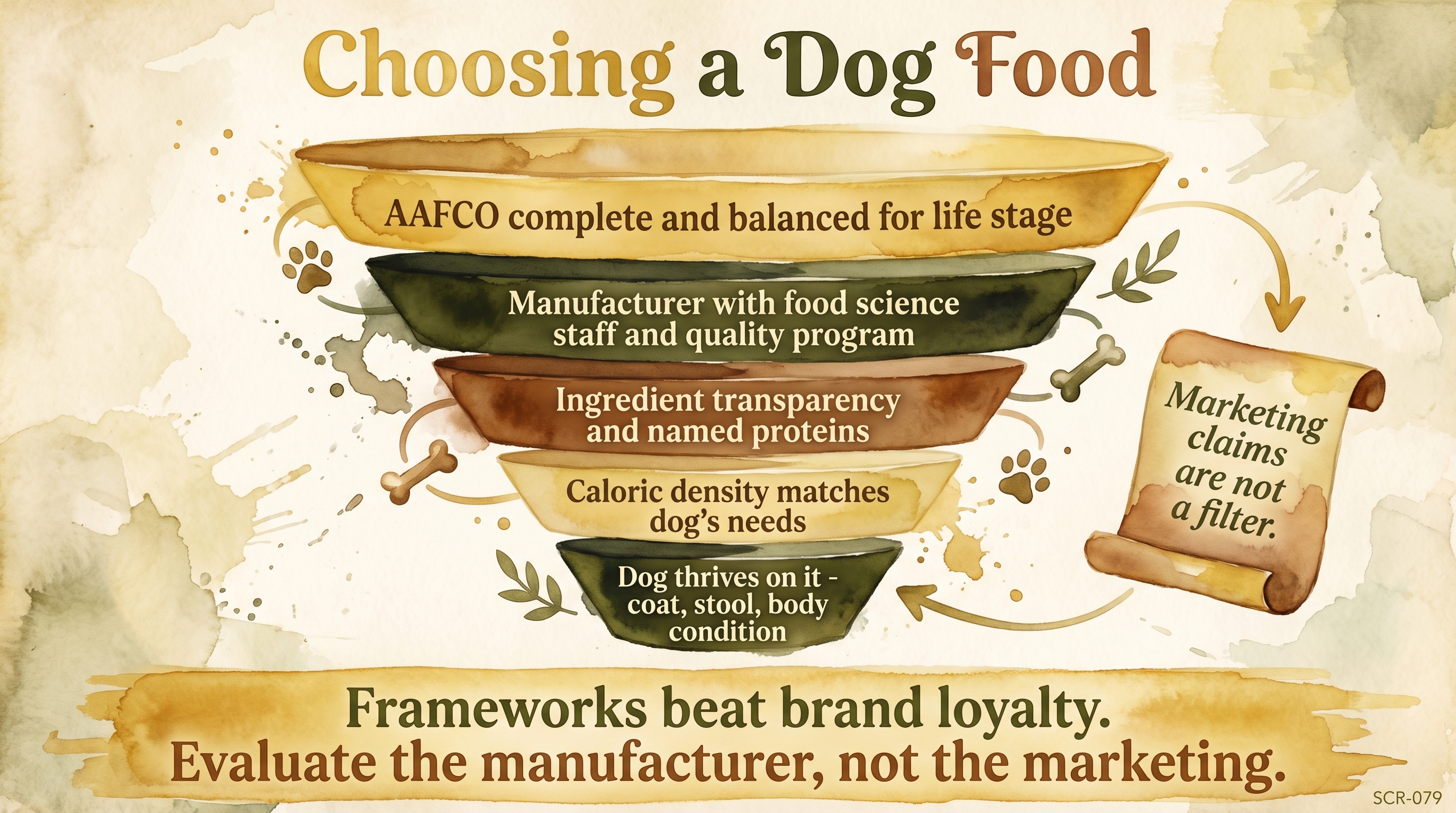
Frameworks beat brand loyalty - evaluate the manufacturer, not the marketing.
Key Takeaways
- A good dog-food decision starts with WSAVA company questions, AAFCO adequacy, and life-stage matching, not with front-of-bag storytelling.
- Budget and routine are not secondary concerns. A food the family cannot sustain is not the right food, no matter how premium it sounds.
- The dog's actual response still matters, especially body condition, stool quality, appetite, and overall consistency.
- The best food is usually not the most dramatic one. It is the one that clears evidence-based filters and works calmly in real family life.
The Evidence
The framework itself is heuristic because it combines documented decision tools with practical judgment. The documented parts are real. WSAVA's company-evaluation questions are real. AAFCO adequacy statements matter. Life-stage matching matters. Company transparency matters. The heuristic part lies in how families prioritize and combine those variables for their own dog and household.
That combination step is exactly where guidance is needed. Science can tell us what to ask. It does not always answer what a given family should choose when cost, convenience, dog preference, and company trustworthiness all have to be weighed together. That final step remains a judgment problem, not a laboratory result.
The value of a framework is that it constrains judgment inside evidence rather than outside it. Instead of asking "which food sounds best," families ask "does this company answer the WSAVA questions well," "does the label show appropriate adequacy for my dog's life stage," "can I afford and sustain this," and "does my dog actually do well on it." That is a heuristic process, but it is a disciplined one.
The framework also helps families know when not to change foods. Families often feel pressure to upgrade whenever they encounter a new argument online. But if a dog is maintaining excellent body condition, producing good stool, eating steadily, and thriving on a food from a transparent company that clears basic evidence screens, the burden of proof for changing the diet should rise. Change is not automatically progress. Sometimes the best decision process points toward staying still.
- WSAVA Global Nutrition Committeedog-food selection context
Company-level questions about formulation expertise, manufacturing control, quality assurance, and research are central to evidence-aware pet-food selection. - SCR-079 synthesisdog-food regulatory context
AAFCO complete-and-balanced status is a real adequacy floor and the nutritional adequacy statement helps families understand life stage and substantiation pathway. - Commercial regulation source synthesisdog-food labeling context
Label reading, substantiation pathway, and manufacturer transparency are more informative than front-of-bag marketing language.
- JB family-feeding synthesisdogs in household context
The best food is usually the one that clears evidence-based screening and still fits the family's budget, routine, and long-term compliance capacity. - Practical monitoring synthesisdogs
Body condition, stool quality, appetite, and coat are not perfect outcome metrics, but they are important real-world feedback signals once a food has passed baseline selection standards.
No published study directly tests the practical implications of how to choose a dog food: a family framework for domestic dog raising programs. The application to household dog raising remains an interpretive synthesis rather than a directly tested intervention finding.
SCR References
Sources
- National Research Council. (2006). Nutrient Requirements of Dogs and Cats. Washington, DC: The National Academies Press.
- Association of American Feed Control Officials (AAFCO). (2024). Official Publication. Association of American Feed Control Officials.
- U.S. Food and Drug Administration. (2014). Pet food labeling guide. FDA Center for Veterinary Medicine.
- World Small Animal Veterinary Association (WSAVA). (2021). Global nutrition committee resources. Retrieved from www.wsava.org