Chronic Kidney Disease Nutrition in Dogs
Compound evidence detail1 SCR / 2 parts
- Observed-JBthe clinical-management pattern in growing dogs with renal dysplasia, where growth requirements for minerals and protein conflict with phosphorus restriction for impaired kidneys
- Heuristicthe Golden-Retriever-specific maturity timing and practical diet-transition guidance that should remain veterinary-nutritionist-directed rather than treated as a standard formula
Nutrition is one of the few interventions that clearly changes the course of chronic kidney disease in dogs, which is why renal diets deserve to be discussed with much more precision than generic "low protein" folklore. Families often hear one slogan and stop there. In reality, kidney nutrition is not about starving the dog of protein. It is about lowering the kidney's metabolic and phosphorus burden while still protecting calorie intake, muscle mass, hydration, and quality of life. When done well, it changes outcomes. When done clumsily, it can create new problems. Documented
What It Means
Chronic kidney disease, or CKD, is progressive loss of renal function over time. As filtration capacity declines, dogs lose the ability to regulate waste products, mineral balance, hydration, blood pressure, and acid-base status with the same efficiency as healthy kidneys. The disease does not present the same way at every stage, which is why modern management relies heavily on the IRIS staging framework and on markers such as creatinine, SDMA, urine concentration, proteinuria, and blood pressure.
The staging point matters because CKD nutrition is not one-size-fits-all. A dog in very early disease may still have good appetite, minimal clinical signs, and reasonable muscle mass. A dog in later disease may have nausea, poor appetite, dehydration tendency, phosphorus retention, hypertension, and visible wasting. The nutritional plan must track that reality rather than applying one slogan to every kidney case.
Why Phosphorus Restriction Matters Most
If one nutritional intervention deserves to be called the backbone of CKD diet therapy, it is phosphorus restriction. Excess phosphorus burden contributes directly to renal secondary hyperparathyroidism and progression of renal injury. This is why well-designed renal diets lower phosphorus deliberately rather than treating it as a side issue. In practice, many nephrology conversations start with protein because owners notice it on the label. The more evidence-supported first focus is phosphorus.
This is one reason prescription renal diets are not just ordinary foods with less meat. They are carefully adjusted formulations built around kidney physiology. When families try to imitate renal diets casually with random low-protein or homemade approaches, they often miss the real target and end up weakening the dog nutritionally without giving the kidneys the same protective benefit. Observed-JB
Protein Restriction Is More Nuanced Than Owners Think
The oldest kidney myth in dog nutrition is that high protein causes kidney disease. The evidence does not support that claim in healthy dogs. Good-quality protein does not create CKD in a normal dog. That correction matters because families often carry fear from human renal folklore or from oversimplified pet-food advice.
Once CKD exists, however, protein management becomes more nuanced. The goal is not zero protein. The goal is enough high-quality protein to preserve lean mass without creating unnecessary nitrogenous waste in a dog that can no longer clear that waste efficiently. In early disease, overly aggressive protein restriction can be counterproductive because it accelerates muscle loss and weakens the dog before it meaningfully improves outcome. In later disease, especially when uremic signs appear, more noticeable protein moderation becomes more clearly justified.
This is the real distinction families need: protein does not cause CKD in healthy dogs, but protein handling does become a clinical management variable once CKD exists.
The Renal Diet Outcome Studies
The classic evidence that changed veterinary practice came from studies such as Jacob 2002 and Ross 2006, which showed meaningful outcome advantages for dogs eating renal diets compared with ordinary maintenance foods. Documented The reported benefits included delay of uremic crises and better survival. This is why renal diets are not viewed as soft optional add-ons. They are one of the most evidence-based tools in canine CKD management.
These results are especially important because they moved the conversation beyond laboratory plausibility. Veterinary medicine did not just infer that phosphorus restriction and targeted renal formulation should help. It documented that dogs on those diets did better in clinically meaningful ways.
What Else Renal Diets Are Trying to Do
Renal diets often moderate sodium, include omega-3 fatty acids, manage acid-base load, and are designed with palatability in mind. The palatability point is easy to underestimate. Kidney dogs commonly eat poorly, especially as nausea and uremia advance. A theoretically perfect diet that the dog refuses is not a clinically successful diet.
This is one of the few areas where nutritional idealism has to stay humble. If the dog will eat one renal diet and not another, the diet that gets eaten usually wins. If the dog is struggling, clinicians may use appetite support, warming strategies, multiple renal formulations, wet-food options, phosphorus binders, anti-nausea medication, or other tools to keep intake adequate. The body still needs calories even when the kidneys are failing.
Why It Matters for Your Dog
This page matters because early kidney disease is often quieter than owners expect. Increased drinking, increased urination, subtle weight loss, reduced appetite, and "slowing down a bit" can all be normalized as age. Modern screening with SDMA and updated IRIS staging helps catch disease earlier, but once CKD is identified the nutritional response matters enormously.
For your dog, the most important practical lesson is that renal nutrition is one of the clearest places where food functions as treatment. This is not a lifestyle preference page. It is disease management. Families who delay diet change because the dog still seems mostly fine can lose valuable time. Documented
In kidney disease, prevention no longer means preventing the diagnosis. It means preventing avoidable progression from the point of diagnosis forward. Nutrition is one of the strongest ways to do that.
This page also matters because it protects dogs from two opposite errors. One error is doing nothing because the dog still looks okay. The other error is hearing "kidney diet" and slashing protein indiscriminately without veterinary structure. The first misses the window where nutrition helps most. The second can worsen muscle wasting and appetite in dogs already at risk.
Families also need to understand that renal nutrition changes with stage and with the dog's lived experience. A dog in Stage 1 or early Stage 2 may need careful monitoring and timely discussion. A dog in more advanced CKD may need every palatability trick available. A thin dog with poor appetite should not be treated like a robust dog with mild laboratory changes. This is where individualized nutrition earns its keep.
Another reason this page matters is that CKD often lives inside a broader senior-dog picture. Hypertension, proteinuria, dental disease, nausea, muscle loss, dehydration tendency, and multiple medications can all shape what the food plan looks like. That complexity is exactly why renal nutrition deserves respect as a medical tool rather than a consumer preference.
The stage logic is worth making more concrete. In earlier CKD, the family may mostly be dealing with earlier detection, a conversation about when to transition, and careful monitoring of appetite and body condition while renal markers are still relatively modest. In later disease, the goals widen: control phosphorus, support hydration, manage nausea, preserve calories, reduce uremic burden, and keep the dog eating. The nutrition plan becomes more dynamic because the dog is fighting on more fronts at once.
Omega-3 fatty acids also belong in the renal conversation because they are part of why prescription renal diets are more than just low-phosphorus foods. Renal diets are often built to be broadly kidney-protective, not merely lower in one mineral. Sodium moderation may matter especially when hypertension is present. Potassium support may matter if the dog is hypokalemic. This is another reason homemade imitation plans go wrong so easily. They often copy the most famous headline, such as lower protein, while missing the more integrated design of a true renal formulation.
Palatability deserves even stronger emphasis because it often becomes the rate-limiting step in later CKD. Dogs with nausea or uremia do not read formulation logic. They either eat or they do not. Veterinarians and families may need to rotate among renal textures, use canned formats, warm food gently, split meals, or combine anti-nausea care with diet transition. This is not abandoning nutritional standards. It is honoring the basic truth that calories still matter in a chronically ill dog. A renal diet only helps if the dog will actually consume enough of it.
The protein myth also continues to matter because it distorts conversations long before any kidney disease exists. Families sometimes say they avoided a higher-protein diet for years because they did not want to "stress the kidneys." That is not what the evidence supports in healthy dogs. Documented Correcting that myth matters even on a CKD page because otherwise owners may think the diagnosis merely proves a fear they already carried. The more evidence-honest lesson is that healthy dogs do not need kidney-protective low-protein living, while dogs with established CKD do benefit from targeted renal design.
Finally, renal nutrition works best when it is paired with steady monitoring rather than treated as a single permanent decision. Body weight, muscle condition, appetite, phosphorus control, blood pressure, hydration status, and the dog's day-to-day comfort all tell you whether the plan is actually serving the dog in front of you. Documented This is why the most mature family posture is not "we found the kidney food." It is "we have an active kidney-management plan."
Routine senior bloodwork also deserves special emphasis because many kidney discussions begin before the family ever sees symptoms. A dog who feels mostly normal may already have enough laboratory change to justify a thoughtful renal conversation, and that earlier start often gives nutrition more room to help. In practical terms, the dogs most helped by kidney nutrition are often the ones whose disease was taken seriously before the crisis stage, not after it.
There is also a humane lesson here about flexibility. Families sometimes fear that accepting renal nutrition means locking the dog into one rigid food forever. In reality, the best kidney plans often blend principle with adaptation. The principles are stable: protect the kidneys, control phosphorus, preserve muscle, support appetite. The adaptation is individualized: which renal formulation the dog will eat, whether canned texture is easier, whether appetite support is needed, and how aggressively the plan must be refined as disease progresses.
This is also why owner success should not be measured only by perfect nutritional purity. In later CKD, success may mean the dog accepts enough appropriate renal food to maintain weight, keep nausea manageable, and preserve a more comfortable daily life. The best plan is the one that serves the real dog in front of the family, not the one that looks ideal on paper while the bowl remains untouched.
That humane flexibility is still evidence-based because nutrition in CKD is judged by function, comfort, and outcome, not by purity points.
Families who understand that usually make steadier and kinder renal decisions over the long haul.
That steadiness often matters more than any one dramatic dietary gesture.
Consistency is protective here.
It protects both function and appetite.
When to See a Veterinarian
Veterinary evaluation is warranted if a dog is drinking and urinating more than usual, losing weight, showing reduced appetite, vomiting intermittently, or simply seeming less robust with age. Senior screening matters here because CKD often begins as a laboratory diagnosis before it becomes a dramatic clinical one.
If CKD has already been diagnosed, veterinary follow-up becomes essential whenever appetite drops, weight falls, vomiting increases, weakness appears, or the dog starts refusing the renal diet. These are not minor quality-of-life details. They often signal the need for medication adjustment, anti-nausea support, fluid planning, blood-pressure evaluation, or diet modification.
Urgent evaluation is needed for collapse, severe vomiting, obvious dehydration, profound lethargy, refusal to eat, or neurologic change. Advanced kidney disease can destabilize quickly.
Families should also involve their veterinarian before replacing a prescribed renal diet with a random over-the-counter "senior" or "low protein" food. Those are not equivalent categories, and many are not adequately phosphorus-restricted for CKD management.
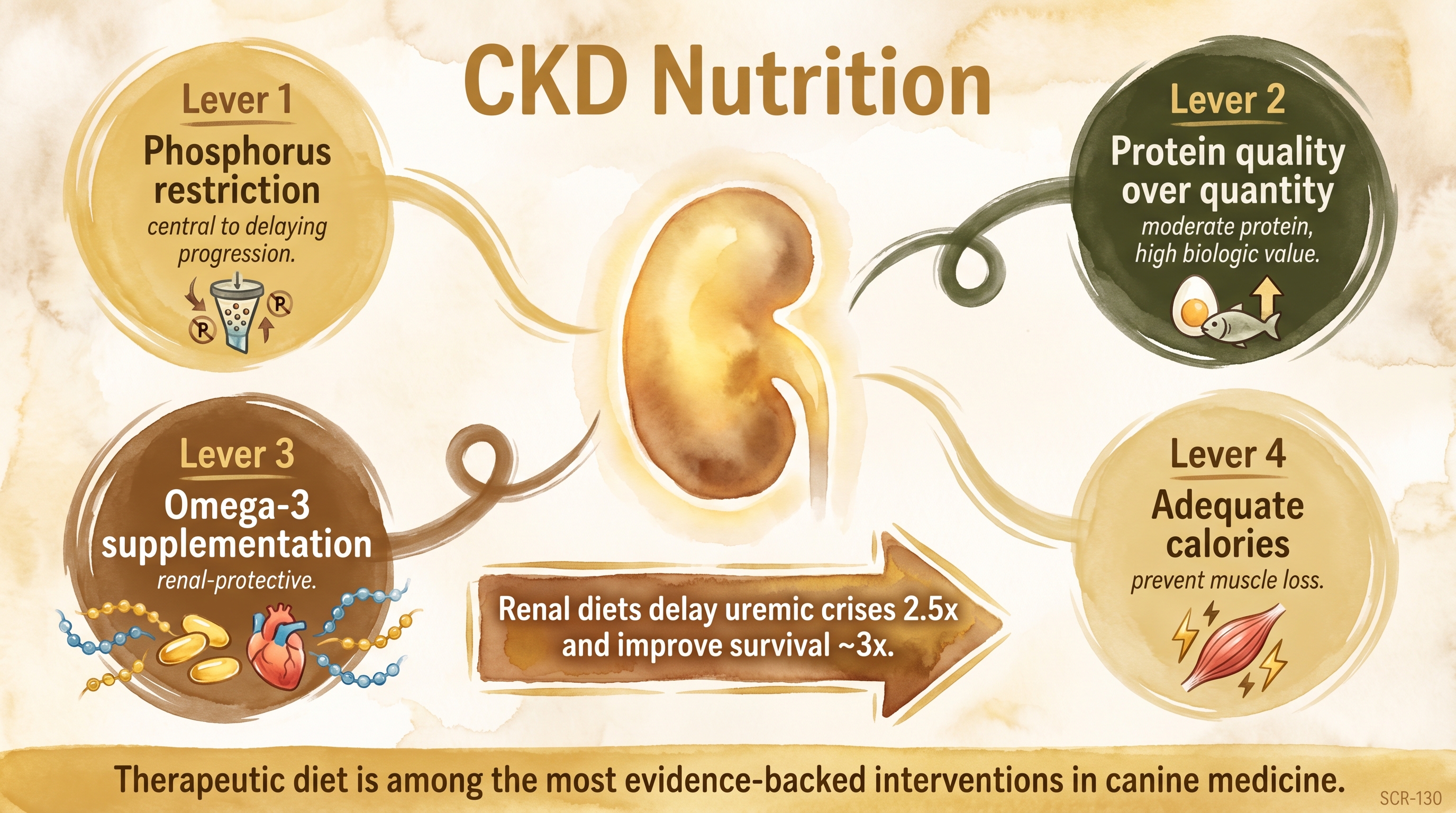
Therapeutic diet is among the most evidence-backed interventions in canine medicine.
Key Takeaways
- Renal nutrition works because it reduces phosphorus burden, moderates protein thoughtfully, and supports intake in a disease where food is part of treatment.
- High-quality protein does not cause CKD in healthy dogs, so the kidney conversation begins after diagnosis, not before.
- Prescription renal diets have documented outcome advantages, including delay of uremic crises and improved survival compared with ordinary maintenance foods.
- A kidney dog who will not eat the theoretically ideal food still needs calories, which is why palatability and veterinary follow-up matter so much.
The Evidence
This entry uses observed claim-level tags beyond the dedicated EvidenceBlocks below. These tags mark JB program observation or practice-derived claims that need dedicated EvidenceBlock coverage in a later content pass.
The evidence here is unusually solid for disease-state nutrition. SCR-122 and SCR-123 support modern staging and early detection. SCR-131 captures the renal diet outcome trial finding that dogs on a formulated renal diet had delayed uremic crises and better survival than dogs on ordinary maintenance food. SCR-140 adds the broader reminder that disease-state feeding can conflict with ordinary life-stage feeding logic.
The most important family boundary is also clear: protein phobia is not the same thing as renal nutrition. The evidence supports targeted renal formulations, not indiscriminate low-protein fear in healthy dogs.
- SCR-131 supportdogs with spontaneous CKD
Formulated renal diets delayed uremic crises and improved survival compared with ordinary maintenance foods in landmark outcome trials. - SCR-122 supportdogs
SDMA detects declining kidney function earlier than creatinine and helps identify dogs who may benefit from earlier staging and intervention. - SCR-123 supportdogs
Modern IRIS staging refines how CKD is categorized, which matters because nutritional decisions should track stage rather than ignore it.
- Renal nutrition review literaturedogs with CKD
Phosphorus restriction is the most consistently supported nutritional intervention, while protein management should protect lean mass rather than default to maximal restriction. - SCR-140 boundarydogs
Disease-state nutrition often overrides generic life-stage or premium-food logic, which is why kidney dogs should not be managed by retail intuition alone.
No published study directly tests the practical implications of chronic kidney disease nutrition in dogs for domestic dog raising programs. The application to household dog raising remains an interpretive synthesis rather than a directly tested intervention finding.
SCR References
Sources
- National Research Council. (2006). Nutrient Requirements of Dogs and Cats. Washington, DC: The National Academies Press.
- AAFCO. (2024). Official Publication. Association of American Feed Control Officials.
- Jacob, F., Polzin, D. J., Osborne, C. A., Allen, T. A., Kirk, C. A., Neaton, J. D., Lekcharoensuk, C., & Swanson, L. L. (2002). Clinical evaluation of dietary modification for treatment of spontaneous chronic renal failure in dogs. Journal of the American Veterinary Medical Association, 220(8), 1163-1170.
- Finco, D. R., Brown, S. A., Crowell, W. A., Duncan, R. J., Barsanti, J. A., & Bennett, S. E. (1992). Effects of dietary phosphorus and protein in dogs with chronic renal failure. American Journal of Veterinary Research, 53(12), 2264-2271.
- Parker, V. J. (2021). Nutritional management for dogs and cats with chronic kidney disease. Veterinary Clinics of North America: Small Animal Practice, 51(3), 685-710.