Grain-Free Diets and Dilated Cardiomyopathy in Dogs
Few nutrition topics created more confusion in the Golden Retriever world than grain-free diets and dilated cardiomyopathy, usually shortened to DCM. Families were told, sometimes with full certainty, that grain-free food causes heart failure. Other families were told the whole story was industry fearmongering and that there was nothing to worry about. The evidence does not support either extreme. There is a real association signal, Golden Retrievers mattered disproportionately in the early reports, taurine deficiency is part of the story in some dogs, and the overall mechanism is still not fully solved. Mixed Evidence
What It Means
Dilated cardiomyopathy is a disease of heart muscle function. The heart becomes enlarged and weakened, the chambers dilate, pumping ability falls, and dogs can progress to arrhythmias, congestive heart failure, collapse, or sudden death. For decades, veterinarians mostly thought of canine DCM as a breed-linked disease of classically predisposed dogs such as Dobermans, Great Danes, Boxers, and Irish Wolfhounds. That background matters because the diet story did not begin with a randomized feeding trial. It began when veterinary cardiologists started seeing DCM in dogs that did not fit the usual hereditary pattern.
The modern public timeline began in July 2018, when the FDA announced it was investigating a possible connection between certain diets and canine DCM. That alert was unusual because it publicly acknowledged an emerging pattern in dogs without the expected breed background. Golden Retrievers, mixed breeds, Labrador Retrievers, and Cocker Spaniels appeared in the reporting stream, and many dogs had been eating diets marketed as grain-free or otherwise outside the traditional large-manufacturer pattern. Ambiguous The FDA later released a larger case compilation, including 515 reports submitted between January 2014 and April 2019, which helped establish the broad shape of the concern.
The phrase grain-free quickly took over the conversation, but that shorthand was always somewhat misleading. The more precise concern was not simply the absence of grains. It was the pattern of many implicated diets being what cardiologists began calling BEG diets: boutique, exotic ingredient, or grain-free. Those diets often shared practical features such as peas, lentils, chickpeas, other pulses, or potatoes appearing prominently in the ingredient list. Some used uncommon protein sources, some came from small manufacturers with thinner research infrastructure, and some were both. Documented That is why the best evidence language has gradually moved away from saying grain-free alone and toward saying nontraditional, pulse-rich, or BEG-pattern diets.
Why Taurine Entered the Story
Taurine became central because veterinary medicine already knew that some dogs can develop a reversible cardiomyopathy related to taurine deficiency. Taurine is a sulfur-containing amino acid involved in bile acid conjugation, membrane stability, osmoregulation, retinal function, and normal cardiac muscle performance. Cats have an absolute dietary taurine requirement. Dogs are different. Most dogs can synthesize taurine from the sulfur amino acids methionine and cysteine, so taurine is not considered absolutely essential in the same way it is for cats.
That difference is important, but it does not mean taurine can be ignored in dogs. Some breeds appear more vulnerable to taurine depletion or to diets that make maintaining taurine status harder. Golden Retrievers became one of the clearest breeds in that conversation. Kaplan and colleagues documented Golden Retrievers with taurine deficiency and DCM whose cardiac status and taurine values improved after diet change plus taurine supplementation. Documented That is a real and clinically meaningful finding. It means taurine-deficient, diet-associated cardiomyopathy is not a speculative story in Goldens. It is a documented subset.
The reason the wider DCM debate remained complicated is that not every affected dog was taurine deficient. Some dogs in the FDA-era literature had low taurine. Others did not. Some improved after diet change plus supplementation. Some improved primarily after diet change and standard cardiac therapy. Some studies found stronger taurine differences between traditional and nontraditional diet groups, while others found that diet-associated cardiac changes were present even when taurine was not dramatically depleted. This is why taurine is part of the explanation but probably not the whole explanation.
The Main Working Hypotheses
Several mechanisms remain on the table. One hypothesis is that some pulse-heavy diets alter sulfur amino acid balance or make taurine synthesis less efficient. Another is that fiber profiles and legume fractions increase fecal bile acid loss, which can pull taurine out of the system because dogs conjugate bile acids mainly with taurine. Another is that ingredient formulation choices, digestibility differences, or processing variables interact in ways that are not fully captured by crude nutrient numbers printed on the bag. There is also concern that some exotic or nontraditional ingredient combinations may carry amino acid or bioavailability patterns that are adequate on paper but less safe in susceptible dogs over time.
What the evidence does not currently support is a clean one-line mechanism that explains every affected case. This is exactly why the rhetoric has to stay disciplined. If one says grain-free causes DCM, that statement overshoots the evidence. If one says the concern was fabricated because mechanism is unresolved, that also overshoots. The honest middle is that the association signal was strong enough to trigger a major federal investigation, produce multiple clinical cohorts, and change how many cardiologists counsel families, even while the full causal chain remains incomplete.
What the FDA Did and Did Not Conclude
The FDA deserves careful handling here because many families remember only the alarm phase and not the later clarification phase. The agency's 2018 and 2019 communications captured a real epidemiologic signal, especially around nontraditional diets with pulses high in the ingredient list. But the FDA later stepped back from a simplistic public narrative. By late 2022, it stated that the issue is complex and multifactorial and that adverse event reports alone cannot establish causation. It also recognized that reported diets included both grain-free and grain-inclusive products and that it did not have grounds to declare a specific category categorically unsafe in a regulatory sense.
That later shift did not erase the earlier signal. It clarified its limits. Voluntary reports are messy. Publicity changes reporting behavior. Documented Denominators are weak. Diet histories are imperfect. Brand popularity can distort raw case counts. These are all real limitations. But the post-alarm correction should not be misused as proof that the signal vanished. The more accurate reading is that the FDA stopped treating public case accumulation as the same thing as final causal proof.
What Cardiologists Actually Say Now
One of the most practical anchors in this debate is the position taken by leading veterinary cardiologists and nutrition researchers such as Freeman, Stern, and Adin. Their public and published posture has generally been cautious but directionally clear. They do not speak as though every grain-free diet inevitably causes DCM. They do advise avoiding BEG-pattern diets in dogs that do not have a compelling medical reason to eat them, especially when safer and better-studied alternatives are readily available.
That recommendation matters because it is a preventive recommendation under uncertainty, not a courtroom verdict about universal causation. In other words, veterinary cardiology does not need to prove every mechanistic step before saying that the risk-benefit trade does not currently favor casual use of BEG diets in ordinary family dogs. That is especially true in Golden Retrievers, where the breed-specific taurine-linked literature is stronger than it is for many breeds.
Why Goldens Merit Extra Caution
Golden Retrievers are not just emotionally central to this issue for JB. They are scientifically relevant to it. Goldens appeared prominently in the FDA-era reporting and in the taurine-deficient DCM literature. They are one of the breeds in which diet history, taurine measurement, and echocardiographic change intersected in a way that made the concern harder to dismiss.
That does not mean every Golden has a fixed taurine synthesis defect. The source layer is more cautious than that. The better way to say it is that Goldens are a higher-signal breed in the diet-associated DCM literature, and that enough breed-specific concern exists to justify a conservative feeding recommendation. For JB families, that recommendation is straightforward: feed a grain-inclusive, AAFCO-substantiated diet from a strong manufacturer unless a veterinarian has specifically recommended otherwise for a defined medical reason.
Why It Matters for Your Dog
This page matters because DCM is not a cosmetic problem, and because the families most likely to be drawn toward premium food stories are often the same families most vulnerable to the grain-free narrative. Grain-free foods were heavily marketed as cleaner, less inflammatory, more species-appropriate, or more premium. For many families, especially owners of beloved Golden Retrievers, the category sounded thoughtful and protective. That emotional framing matters because it helps explain why otherwise conscientious people ended up feeding diets that later became clinically controversial.
For your dog, the practical question is not whether every grain-free bag is dangerous. The practical question is whether there is enough unresolved downside, with enough breed-specific concern in Goldens, to make the category a poor default choice. Right now the answer is yes. A Golden Retriever does not need a BEG diet to thrive. A Golden Retriever may be among the breeds least worth experimenting with in this space. That is why the standard JB recommendation is conservative.
If a family is already feeding a BEG-pattern diet, panic is not the goal. Calm, structured action is the goal. Review the exact food. Ask whether pulses or potatoes are prominent in the ingredient list. Ask whether the manufacturer has strong formulation and research infrastructure. If the food fits the nontraditional risk pattern, the most defensible move is usually to transition to a grain-inclusive, well-substantiated alternative rather than waiting for symptoms. If the dog has any clinical signs suggestive of heart disease, veterinary evaluation should not wait on internet debate.
Some dogs affected in the literature improved after diet change, taurine supplementation, and standard cardiac therapy. Documented That is encouraging, but it should not create false comfort. Reversibility depends on how early the problem is caught, how advanced the disease is, what mechanism is operating, and whether arrhythmia or congestive failure is already present. The possibility of improvement is a reason for vigilance, not for delay.
The JB question is simple: if a Golden Retriever does not medically require a contested diet pattern, why ask the breed to absorb an unresolved cardiac risk signal for no compelling benefit? Prevention here is not fear. It is refusing unnecessary nutritional experimentation when safer defaults are already available.
This page also matters because it teaches a larger lesson in evidence discipline. Families are often tempted by totalizing stories. One side says the concern is settled and universal. The other says the concern was fabricated. Neither story respects how science usually works in high-noise, commercially contested spaces. Good stewardship means being able to say two things at once: the blanket causal slogan is too strong, and the clinical caution remains justified.
There is also a practical trust lesson. A food does not become safer because its marketing sounds modern, ancestral, or anti-industry. Owners sometimes act as though choosing a less conventional brand automatically means choosing a more thoughtful diet. This episode showed why that shortcut is dangerous. Research infrastructure, formulation expertise, feeding-trial culture, and post-market caution matter more than aesthetic brand identity.
For Golden families in particular, the decision is easier than the online discourse makes it seem. If a veterinarian has not diagnosed a condition that truly requires a specialized diet pattern, then a grain-inclusive, well-substantiated food from a manufacturer with serious nutrition infrastructure is the low-drama, evidence-supported answer. That does not mean every other path is forbidden. It means the default preventive recommendation is clear.
When to See a Veterinarian
Prompt veterinary evaluation matters if a dog currently eating, or previously eating, a BEG-pattern diet develops any sign consistent with cardiac disease. Concerning signs include reduced exercise tolerance, tiring earlier than usual on walks, new cough, rapid breathing at rest, increased effort to breathe, collapse, fainting, abdominal distension, weakness, or an unusual decline in enthusiasm for normal activity. In a large friendly breed like the Golden Retriever, families sometimes mistake early fatigue for simple age, weather, or mood change. That is exactly why a recent diet history should be part of the conversation.
If your Golden has been eating a grain-free or pulse-heavy diet for months or years and you are concerned, a visit is reasonable even before obvious symptoms appear. A veterinarian may recommend a physical examination, chest radiographs, NT-proBNP or cardiac biomarker screening in some contexts, taurine measurement, or referral for echocardiography if the history or symptoms justify it. Whole blood taurine is usually the preferred taurine sample when deficiency is part of the question.
Urgent evaluation is warranted for collapse, fainting, labored breathing, marked lethargy, or abdominal swelling. Those are not watch-and-wait signs. They can reflect active heart failure, serious arrhythmia, or other life-threatening disease.
Families should also involve their veterinarian before beginning taurine supplementation on their own if the dog is symptomatic. Taurine is often used safely, but unsupervised supplementation can blur diagnostic interpretation and should not replace a real cardiac workup in a symptomatic dog.
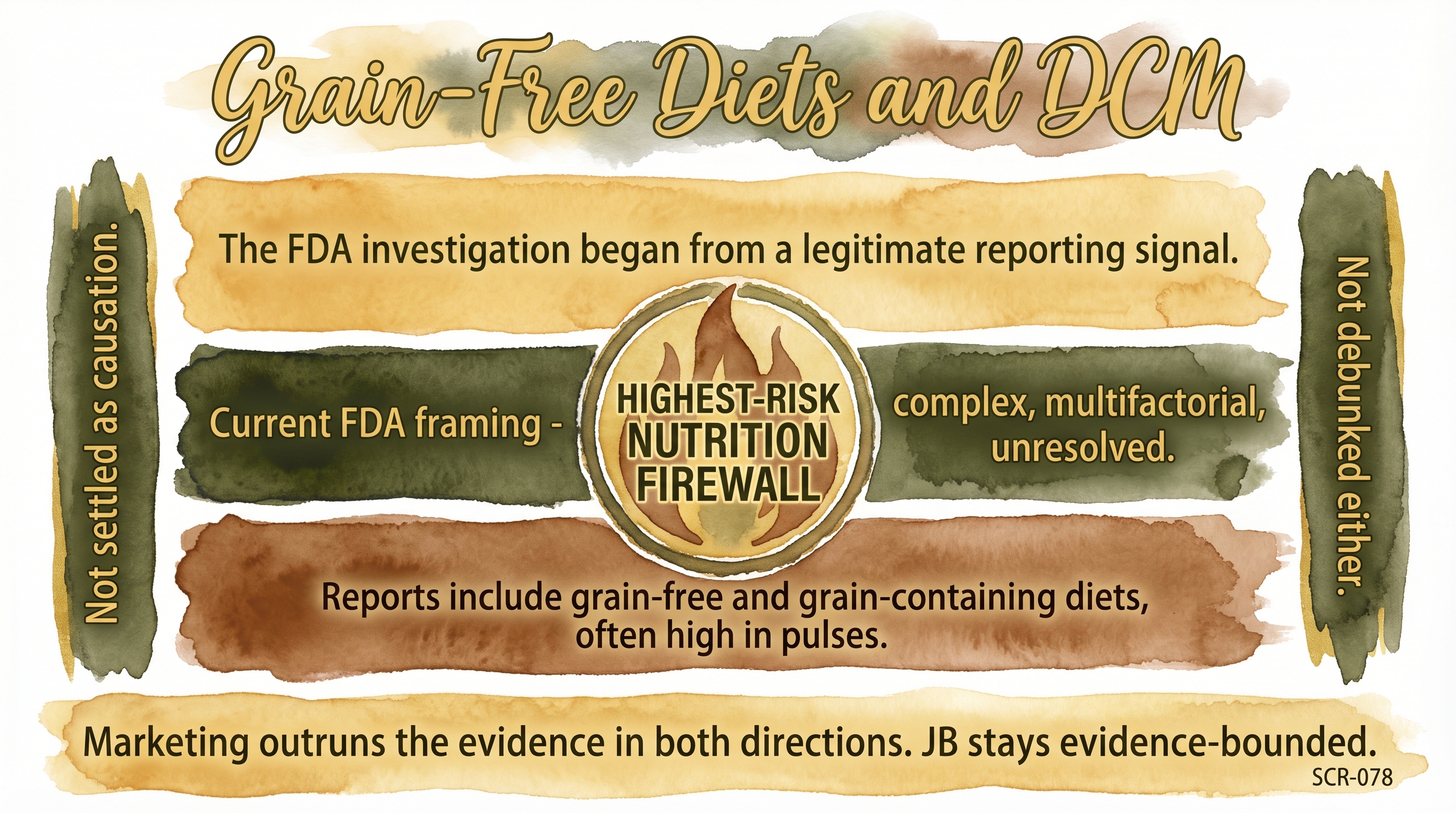
Marketing outruns the evidence in both directions - JB stays evidence-bounded.
Key Takeaways
- A real diet-associated DCM signal exists, especially around some BEG-pattern diets, but the blanket statement that grain-free diets cause DCM is stronger than the evidence supports.
- Golden Retrievers matter disproportionately in this literature because taurine-deficient, diet-associated DCM has been documented in the breed.
- Taurine deficiency explains some cases, but not all cases, which is why the broader mechanism remains unresolved.
- For Golden families without a specific medical reason to do otherwise, the most defensible default is a grain-inclusive, AAFCO-substantiated diet from a strong manufacturer.
The Evidence
This entry uses ambiguous claim-level tags beyond the dedicated EvidenceBlocks below. These tags mark claims where the literature remains unsettled or multiple interpretations coexist.
The strongest documented part of this topic is the existence of a taurine-deficient, diet-associated DCM subset in Golden Retrievers and other breeds. That is what SCR-077 captures. The most important boundary statement is SCR-078: the blanket slogan that grain-free diets cause DCM is stronger than the present evidence supports. These two statements are not contradictory. They are the evidence structure.
The broader diet-associated DCM literature supports a real association signal around many nontraditional, pulse-rich, or BEG-pattern diets. It does not yet isolate one universal nutrient defect or one single causal pathway. That unresolved mechanism is why the page stays mixed rather than pretending the question is fully closed.
- SCR-077 supportGolden Retrievers
Taurine-deficient, diet-associated DCM is documented in Golden Retrievers, and some affected dogs improve after diet change, taurine supplementation, and standard cardiac therapy. - Kaplan et al. and Golden-specific follow-up literatureGolden Retrievers
Golden Retrievers are a high-signal breed in the taurine-deficiency and diet-associated DCM literature rather than a peripheral anecdotal group. - FDA investigation chronologydogs
The FDA's 2018 to 2022 investigation documented a real reporting signal involving many nontraditional diets and many dogs eating pulse-rich formulas, even though causation was not finally established.
- SCR-078 boundarydogs
The blanket claim that grain-free diets cause DCM is an overstatement. The broader diet-associated DCM question remains multifactorial and unresolved. - Freeman, Adin, Stern, and related clinical literaturedogs
Current cardiology guidance supports avoiding BEG-pattern diets in ordinary dogs despite unresolved mechanism because the association signal is clinically meaningful and safer defaults exist. - FDA post-2022 positiondogs
The agency now frames the problem as complex and multifactorial and does not treat voluntary case reports as sufficient proof of one single causal explanation.
No published study directly tests the practical implications of grain-free diets and dilated cardiomyopathy in dogs for domestic dog raising programs. The application to household dog raising remains an interpretive synthesis rather than a directly tested intervention finding.
SCR References
Sources
-
National Research Council. (2006). Nutrient Requirements of Dogs and Cats. Washington, DC: The National Academies Press.
-
AAFCO. (2024). Official Publication. Association of American Feed Control Officials.
-
Kaplan, J. L., Stern, J. A., Fascetti, A. J., et al. (2018). Taurine deficiency and dilated cardiomyopathy in Golden Retrievers fed commercial diets. PLOS ONE, 13(12), e0209112.
-
Freeman, L. M., Stern, J. A., Fries, R., Adin, D. B., & Rush, J. E. (2018). Diet-associated dilated cardiomyopathy in dogs: what do we know? Journal of the American Veterinary Medical Association, 253(11), 1390-1398.
-
Adin, D. B., DeFrancesco, T. C., Keene, B. W., et al. (2019). Prospective investigation of the relationship between diet and dilated cardiomyopathy in dogs. Journal of Veterinary Internal Medicine, 33(5), 2171-2179.