Prescription Therapeutic Diets for Dogs
Compound evidence detail2 SCRs / 5 parts
- Observed-JBthe clinical-management pattern in growing dogs with renal dysplasia, where growth requirements for minerals and protein conflict with phosphorus restriction for impaired kidneys
- Heuristicthe Golden-Retriever-specific maturity timing and practical diet-transition guidance that should remain veterinary-nutritionist-directed rather than treated as a standard formula
- Documentedthe AAFCO veterinary-exclusionary-statement pathway, the not-a-drug legal position of therapeutic diets, veterinary oversight boundary, and board-certified nutrition specialty framework
- Observed-JBcondition-category evidence where therapeutic diets have measurable support in areas such as renal disease, pancreatitis management, hepatic, urinary, or chronic-enteropathy care
- Heuristicthe category-wide efficacy boundary requiring condition-specific SCRs rather than universal claims across all therapeutic diet products
Prescription therapeutic diets are where canine nutrition becomes openly clinical. They are not prestige foods, boutique upgrades, or moral statements about how much a family loves its dog. They are tools designed to help manage disease. In many cases they are among the strongest evidence-supported interventions available in a treatment plan, which is why dismissing them as "just expensive kibble" is often a serious misunderstanding. Documented
What It Means
Veterinary therapeutic diets are foods formulated to help manage specific medical conditions such as chronic kidney disease, urinary stone disease, food allergy, chronic gastrointestinal disease, obesity, diabetes, hepatic disease, cardiac disease, and selected joint or mobility problems. They are usually sold through veterinarians or under veterinary oversight, which is why families often call them prescription diets.
It is important to be precise about the regulatory point. Therapeutic diets are not a separate magical FDA category outside the rest of pet-food law. They still operate within the broader commercial pet-food framework. What makes them different in practice is the intended use and the degree of veterinary involvement. The diet is being used not simply to feed a healthy dog, but to change the nutritional environment of a disease process.
That is why the details matter so much. A renal diet is not just "gentler food." It usually manipulates phosphorus, protein burden, sodium, omega-3 profile, and energy density in a way that supports kidneys under strain. Observed-JB A hydrolyzed-protein diet is not just "limited ingredient." It is built around proteins broken down to sizes less likely to trigger immune recognition during an elimination or management trial. A urinary diet is not just "good for the bladder." It is built to alter urine pH, urine concentration, mineral delivery, and crystal-forming risk.
Major Therapeutic-Diet Categories
Renal diets are among the clearest examples of nutrition functioning as treatment support. In dogs with chronic kidney disease, therapeutic diets often reduce phosphorus, control sodium, adjust protein characteristics, and increase energy density so that the dog can maintain intake while reducing some metabolic burden on compromised kidneys. Observed-JB Renal nutrition does not cure CKD, but it can materially change quality and length of life in appropriately selected patients.
Urinary diets are designed for stone dissolution, recurrence prevention, or lower urinary tract management depending on the formula. Different stone types require different strategies. A diet appropriate for struvite dissolution is not necessarily the same as one appropriate for calcium oxalate prevention. These diets manipulate mineral content, acid-base effects, moisture encouragement, and urine concentration to reduce the chemical conditions that support stone formation.
Hydrolyzed and novel-protein diets are used heavily in food-allergy workups. Their real role is diagnostic as well as therapeutic. During a formal elimination trial, the diet has to be boringly precise. If the dog is eating multiple proteins, flavored medications, table scraps, and chew treats, the family is not really running an elimination trial. Therapeutic allergy diets matter because they create the dietary control needed to interpret the dog's response honestly.
Gastrointestinal diets are another major category. They may alter fat content, fiber profile, digestibility, or ingredient simplicity to support dogs with chronic enteropathy, recurrent GI upset, pancreatitis risk, or recovery from acute digestive disruption. Not every GI diet is identical, because "GI support" can mean different things depending on whether the goal is bland digestibility, fiber support, low fat, or microbiome tolerance.
Weight-management diets work by combining calorie dilution, satiety support, nutrient density, and portionability in ways that allow fat loss without simple starvation. Because obesity is one of the most important and most common diet-linked disease burdens in dogs, these diets are more medically serious than families often realize. They are not cosmetic foods. They are treatment tools for a chronic health problem.
Cardiac, hepatic, and diabetic diets round out much of the core category. These diets are usually narrower in their indications and should be matched carefully to the condition, but the principle is the same. Nutrition is being used intentionally to support physiology under strain.
Why These Diets Are Usually Vet-Gated
Families often ask why therapeutic diets are not simply sold next to every other bag on a shelf if they are just food. The practical reason is not that they are controlled substances. It is that their use depends on diagnosis and context. A renal diet is not automatically the right answer for every dog with a slightly abnormal kidney value. A urinary formula may be counterproductive if used for the wrong stone type. A hydrolyzed diet loses its value if the family misunderstands how strict the elimination trial has to be.
The veterinary gate therefore protects two things at once. It protects against misapplication, and it helps families understand what clinical question the diet is supposed to answer. In many cases, the diet is part of the diagnostic logic, not just the treatment logic.
This practical gate also helps families avoid one of the most common therapeutic-diet mistakes, which is treating foods designed for one disease state as broadly healthier foods for all dogs. Observed-JB A renal diet is not a premium maintenance food for every senior dog. A hydrolyzed diet is not a fashionable simplification diet for all itchy dogs without a real workup. A urinary formula is not simply a nicer moisture-rich food. The diet needs a reason, and the gate helps preserve that reason.
Why Therapeutic Diets Deserve Respect
Therapeutic diets are often made by large established companies, which makes some families suspicious before the clinical conversation even starts. They may assume a specialty fresh or raw plan must be nutritionally superior because it sounds more premium. But the relevant question is not which food sounds more artisanal. It is which food has the best condition-specific evidence.
In many disease states, the answer is still the veterinary therapeutic diet. These products are often formulated by teams with deep clinical-nutrition expertise, are used in research settings, and are built with a specific pathophysiologic target in mind. Observed-JB That is not a guarantee that every individual dog will like the food or respond perfectly. It is a reminder that therapeutic diets are often more evidence-led than the alternatives families are tempted to substitute.
Why It Matters for Your Dog
Therapeutic diets matter because they turn food from a background habit into a treatment variable. This changes the family's role. They are no longer simply buying food that sounds good. They are participating in medical management every day.
That daily participation can be powerful. A dog with kidney disease may not need only pills. Documented A dog with recurrent struvite crystals may not need only monitoring. A dog with suspected food allergy may not need only antihistamines. In many of these cases, the diet is one of the main levers that actually changes the physiologic environment. When families understand this, compliance usually improves because the food no longer feels optional.
Therapeutic diets also matter because they often require discipline that the family did not need before. A hydrolyzed-protein trial fails if the dog also gets chicken-flavored treats from a neighbor. A weight-loss plan fails if the dog is being fed a therapeutic diet and five extra scoops of table food. A urinary diet becomes less effective if water intake is poor and the family keeps rotating in unrelated snacks. These foods ask the family to behave consistently because inconsistency changes the treatment.
When a diet is part of treatment, consistency becomes a form of caregiving. The food is no longer a place for improvisation or guilt-driven extras. It becomes part of the dog's medical support structure.
For Golden Retriever families, therapeutic diets often become relevant in exactly the kinds of life-stage transitions that feel emotionally heavy. A dog ages into kidney disease. A chronic ear and skin problem raises the question of food allergy. An overweight adult needs a real weight-loss plan after years of casual feeding. These moments are stressful, and families sometimes resist therapeutic diets because the food symbolizes illness. A steady, honest page like this can reduce that resistance by showing that therapeutic feeding is not a failure. It is one of the most practical ways to help the dog.
Therapeutic diets also matter because they create a useful counterweight to the idea that the best food is always the least processed or most natural-looking food. In a healthy dog, that debate is already complicated. In a sick dog, it can become actively unhelpful. The best diet in a clinical context is the one that supports the disease goal. Sometimes that means a familiar-looking home-cooked plan is appropriate. Often it means a veterinary therapeutic formula is the better evidence-supported move.
The page therefore asks families to make a maturity shift. When the dog is ill, food is no longer mainly a lifestyle preference. It becomes part of treatment architecture. Once families see therapeutic diets this way, the emotional resistance often softens. The food does not need to look artisanal to be deeply helpful. It needs to serve the medical problem honestly and consistently.
The better families understand the specific goal of the diet, the easier adherence becomes. Renal diets are not simply bland foods for older dogs. Urinary diets are not generic bladder-support foods. Hydrolyzed diets are not just clean ingredient lists. Each one is trying to alter a different physiologic problem. That specificity is exactly why these foods should be discussed in concrete medical terms instead of being treated as a mysterious separate shelf.
Seen this way, therapeutic diets become easier to accept. They are not separate from care. They are one of the places care becomes concrete.
That is why nutritional treatment deserves the same seriousness as any other part of the case plan.
When to See a Veterinarian
Talk with a veterinarian promptly if your dog has signs that commonly trigger discussion of a therapeutic diet, including unexplained weight loss, chronic vomiting or diarrhea, recurrent urinary issues, itchy skin with suspected food triggers, worsening kidney values, persistent obesity, or new diagnosis of a chronic disease that may benefit from nutritional management.
Veterinary discussion is also warranted if your dog refuses a prescribed diet, develops GI signs after starting it, or if you are considering replacing a therapeutic diet with a non-prescription alternative. The key question is not simply whether the dog likes the food. It is whether the clinical goal is still being protected.
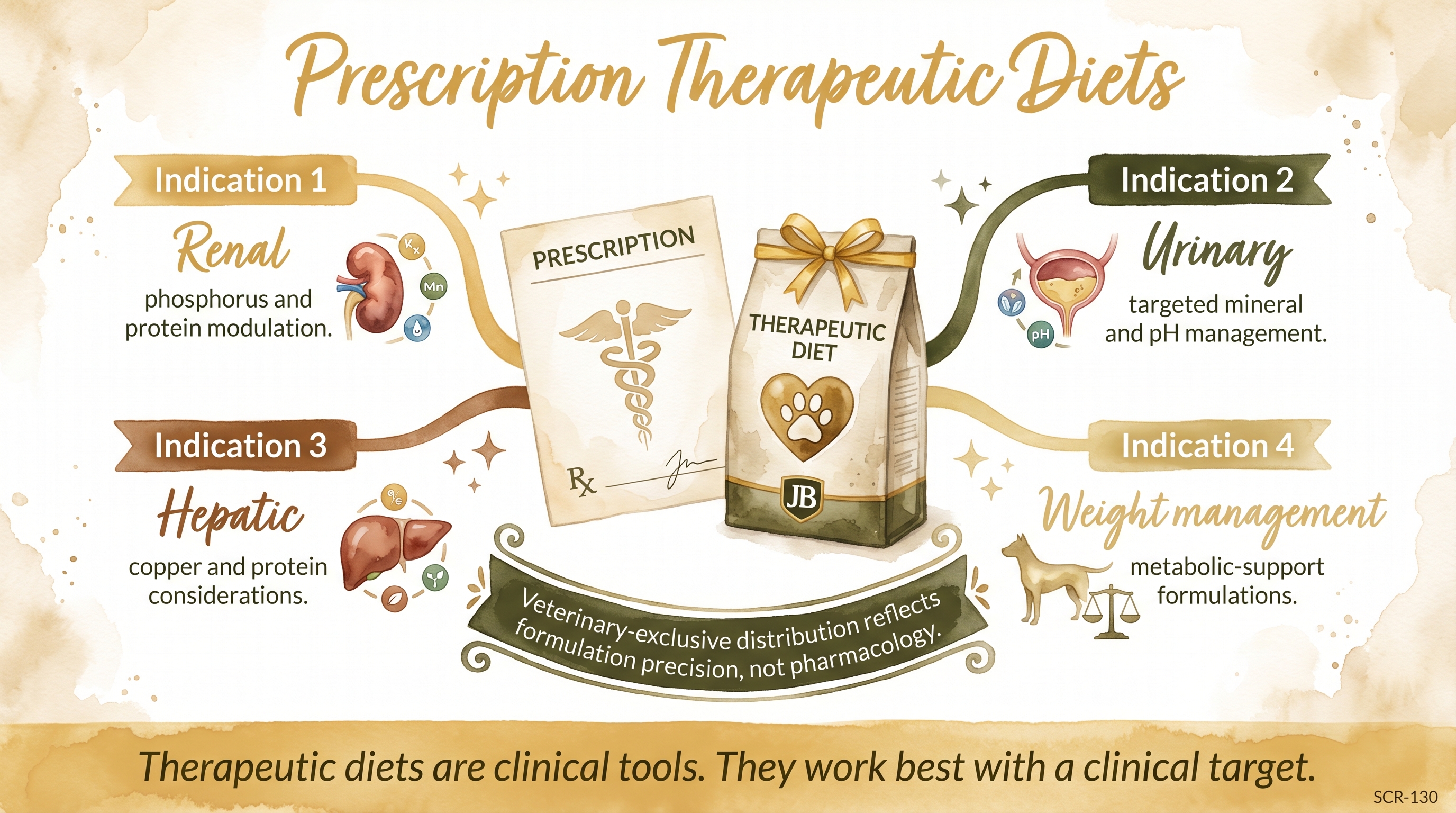
Therapeutic diets are clinical tools - they work best with a clinical target.
Key Takeaways
- Prescription therapeutic diets are not prestige foods. They are disease-management tools designed to change the nutritional environment of specific conditions.
- Renal, urinary, hydrolyzed, GI, weight-loss, cardiac, hepatic, and diabetic diets all work through different nutrient strategies and should not be treated as interchangeable.
- These diets are often the most evidence-supported nutrition intervention in a treatment plan, but only when matched to the right diagnosis and fed consistently.
- If a dog needs a therapeutic diet, the central question is not whether the food sounds premium. It is whether the food supports the actual medical goal.
The Evidence
This entry uses observed claim-level tags beyond the dedicated EvidenceBlocks below. These tags mark JB program observation or practice-derived claims that need dedicated EvidenceBlock coverage in a later content pass.
The evidence supporting therapeutic diets is stronger and more condition-specific than many families assume. These diets are not validated because they are sold through clinics. They are validated, when they are validated, because specific nutrient manipulations have meaningful physiologic effects in specific diseases. The strength of evidence still varies by category, but in general the therapeutic-diet space is one of the most clinically serious parts of commercial nutrition.
The biggest mistake families make is to flatten all prescription diets into one vague idea. Some are evidence-rich and central to disease management. Some are more supportive than transformative. Some are diagnostic tools as much as chronic-management tools. That variation is normal. What matters is using the right diet for the right reason and not substituting a lifestyle preference for a medical strategy.
Therapeutic diets also sit on an important evidence boundary. They are not magic. A renal diet does not reverse severe kidney damage. A weight-loss food does not undo overfeeding if intake remains uncontrolled. A hydrolyzed diet does not diagnose food allergy if the elimination trial is sloppy. The best way to respect these diets is to see them neither as miracles nor as overhyped branding. They are targeted tools that work best inside a coherent veterinary plan.
Cost reality belongs in that same adult conversation. Therapeutic diets are often more expensive than ordinary maintenance foods, and some families understandably resist them for that reason. But the comparison should not be made only against shelf price. It should also be made against the cost of a disease process that is harder to control when nutritional management is neglected. In many cases, the diet is not an optional add-on to treatment. It is one of the more cost-effective parts of treatment.
This is also where trust matters. Families asked to feed a therapeutic diet need to know why that particular formula was chosen, what goal it is serving, what outcomes to watch for, and when it should be reassessed. The better that conversation is, the more likely the family is to treat the food as medical support rather than as a mysterious premium product they are grudgingly buying.
- Diet-disease source synthesisdogs
Therapeutic diets alter nutrient delivery in condition-specific ways that can materially support management of renal, urinary, GI, allergy, obesity, and related disorders. - SCR-079 synthesisdog-food regulatory context
Therapeutic diets still operate within the pet-food framework, but their practical value lies in targeted nutritional design rather than generic adequacy alone. - SCR-140 cross-referencegrowing dogs with renal disease
Disease-state nutrition can create real conflicts with life-stage nutrition, which is why veterinary guidance matters rather than one-size-fits-all feeding.
- Clinical nutrition practice synthesisdogs
The effectiveness of a therapeutic diet depends on matching the formula to the diagnosis and using it consistently enough for the clinical question it is meant to answer. - Elimination-diet and urinary-diet frameworkdogs
Misapplication of the wrong therapeutic diet or inconsistent feeding can invalidate both treatment and diagnostic interpretation.
No published study directly tests the practical implications of prescription therapeutic diets for dogs for domestic dog raising programs. The application to household dog raising remains an interpretive synthesis rather than a directly tested intervention finding.
SCR References
Sources
- National Research Council. (2006). Nutrient Requirements of Dogs and Cats. Washington, DC: The National Academies Press.
- AAFCO. (2024). Official Publication. Association of American Feed Control Officials.
- U.S. Food and Drug Administration. FDA Center for Veterinary Medicine. Regulatory framework for veterinary therapeutic diets.
- Jacob, F., Polzin, D. J., Osborne, C. A., Allen, T. A., Kirk, C. A., Neaton, J. D., Lekcharoensuk, C., & Swanson, L. L. (2002). Clinical evaluation of dietary modification for treatment of spontaneous chronic renal failure in dogs. Journal of the American Veterinary Medical Association, 220(8), 1163-1170.
- Parker, V. J. (2021). Nutritional management for dogs and cats with chronic kidney disease. Veterinary Clinics of North America: Small Animal Practice, 51(3), 685-710.