Canine Obesity: The Most Common Nutritional Disorder
Compound evidence detail1 SCR / 3 parts
- Documentedthe Kealy diet-restriction longitudinal evidence for longevity gain, the WSAVA nine-point body-condition scoring framework, the documented gap between owner-reported and veterinary-assessed body condition, and the canine comorbidities associated with elevated body fat
- Documentedthe specific approximately 1.8-year median longevity gain in lean-fed versus ad-libitum-fed Labrador Retrievers from the Kealy cohort - this exact figure derives from Labrador Retrievers and downstream citations must always carry the Labrador-Retriever qualifier rather than being presented as a universal canine or Golden Retriever lifespan constant
- Documentedthe documented prevalence of overweight and obesity among Goldens in veterinary-practice survey populations, supporting body condition management as a meaningful prevention lever for the breed
Canine obesity is the most common nutritional disorder in dogs, which is another way of saying that the most common nutrition problem is not exotic deficiency. It is ordinary excess, repeated daily, in loving homes that rarely mean harm. That is why obesity deserves such serious treatment. The problem is not only that dogs look heavier. The problem is that excess adiposity changes lifespan, mobility, inflammation, respiratory comfort, and disease burden. In a Golden Retriever program built around prevention, weight stewardship is one of the clearest places where affection either sharpens into leadership or collapses into drift. Documented
What It Means
Obesity is not merely having a broad frame or a thick coat. In clinical terms, it means excess body fat sufficient to impair health. In practice, most veterinary teams think about the issue through body condition scoring rather than through scale weight alone, because one dog can weigh more than another and still be perfectly appropriate for its frame. The key distinction is whether the dog is carrying excess fat over the ribs, lumbar area, and abdomen and whether that fat burden is affecting movement, metabolism, and long-term risk.
The prevalence data are sobering. Association for Pet Obesity Prevention surveys have repeatedly estimated that roughly 55 to 60 percent of United States dogs are overweight or obese. Exact numbers vary year to year and survey methodology is not perfect, but the big picture is stable. Excess weight is not an unusual clinical niche. It is the default drift of the modern family-dog environment. Golden Retrievers are highly relevant to that drift because they are one of the breeds families and veterinarians routinely describe as weight-prone.
Why are Goldens overrepresented? Part of it is breed temperament. Goldens are food-motivated, socially integrated, often heavily treated, and frequently live in family homes where multiple people feed them. Part of it is perception. A broad-headed, feathered, golden-coated dog can hide body fat more easily than many families realize. Part of it is life pattern. Goldens often move from active puppyhood into a more sedentary adult routine while portions and treat habits stay emotionally tied to the younger, more active dog.
Obesity Is an Energy Problem, Not a Moral Problem
At the simplest level, obesity reflects an imbalance between energy intake and energy expenditure. If a dog consumes more calories over time than the body uses, the excess must be stored somewhere, and fat tissue becomes that storage system. Documented That principle sounds obvious, but many families still look for more dramatic explanations because the daily numbers seem too ordinary to explain a major health problem. In reality, very small chronic excesses are enough.
A few extra treats each day, imprecise measuring, table scraps, second breakfasts from another household member, or the habit of using food to organize every interaction can produce meaningful weight gain over months. This is why obesity feels mysterious to families while looking mathematically inevitable from the veterinary side. The rate of drift is often slow enough that the dog still seems normal to the people who see the dog every day.
The energy-balance model also helps explain why obesity management is individualized. Neuter status, age, pain, muscle mass, endocrine disease, environment, breed tendencies, and activity all modify the calorie needs of a specific dog. Documented One Golden may stay lean on a portion that makes another Golden heavy. That is why measured feeding always has to be checked against the dog's body condition rather than against a generic cup guideline alone.
Why Excess Weight Matters So Much
The strongest long-term evidence comes from the Kealy Labrador life-span work, which showed that lean-fed dogs lived longer and developed chronic disease later than their more generously fed pairmates. Documented The often-cited median difference was about 1.8 years, which is remarkable in dog terms. That single number is one of the most important nutrition figures a family can know because it reframes weight control from appearance management into lifespan management.
Obesity also increases the burden on joints. More mass means more force across already vulnerable hips, elbows, stifles, and spine. This matters especially in Golden Retrievers, where orthopedic disease already deserves respect. Heavy dogs do not merely look rounder. They carry more mechanical load with every rise, step, jump, and turn.
The metabolic consequences matter too. Obesity is associated with insulin resistance, chronic low-grade inflammation, poorer respiratory comfort, poorer heat tolerance, reduced quality of life, and increased risk or worsened management of conditions such as pancreatitis and diabetes mellitus. It can complicate anesthesia. It makes exercise harder, which then worsens the very inactivity that helped create the problem. Obesity therefore becomes a self-reinforcing loop if nobody interrupts it.
Why Owners Miss It
One of the most important realities in obesity medicine is that many families underestimate their dog's condition. Families normalize what they see every day. They also compare their dog to other overweight dogs, which shifts the internal baseline. In breeds like Goldens, coat and build make under-recognition even easier.
Another reason families miss the problem is that affection often hides inside feeding. Treats feel relational. Snacks feel kind. Sharing food feels bonding. A dog that loves food creates strong reinforcement for the people around it. Over time, food becomes part of the family language. The result is that calorie creep rarely feels like neglect. It feels like care.
That is exactly why obesity management has to be framed warmly and honestly. The solution is not to shame families for loving their dog. The solution is to help them see that appropriate boundaries around food are one of the clearest forms of love.
Why It Matters for Your Dog
This page matters because obesity is one of the most modifiable health risks most families will ever manage. There are diseases families cannot fully prevent. There are lifespan variables nobody controls. Weight is different. It is not perfectly simple, but it is unusually actionable. Measured portions, honest body condition scoring, fewer calorie-dense extras, more movement, and family consistency work far better than many families expect once the plan is truly followed.
For a Golden Retriever, the stakes are especially practical. Goldens are large, social, food-oriented dogs with real orthopedic and inflammatory vulnerability if the body condition drifts upward. Keeping a Golden lean is not a cosmetic ideal imported from show culture. It is one of the strongest evidence-supported ways to protect comfort, mobility, and longevity.
The JB framing is especially helpful here because it replaces deprivation language with stewardship language. A lean dog is not a deprived dog. A lean dog is a dog whose adults are providing boundaries that the dog cannot provide for itself. Dogs do not self-regulate food wisely just because they are loved. They eat what is available and what works socially. The human has to carry the metabolic responsibility.
Measured feeding is not meanness. It is parental clarity. The dog cannot be asked to manage a modern family's calorie environment alone, so the adults have to provide the structure that protects the body over a lifetime.
This page also matters because obesity management often fails at the household level rather than at the mathematics level. One person weighs the food. Another person free-pours. One person counts treats. Another person shares toast, cheese, or chicken at the table. One person walks the dog daily. Another person assumes the yard counts as exercise. When families say the dog gains weight mysteriously, the mystery is often that nobody truly owns the whole intake picture.
The interventions that work are not glamorous. Use a gram scale rather than eyeballing cups. Convert treats into calorie budget rather than treating them as nutritionally invisible. Keep extras under about 10 percent of daily calories. Use a therapeutic weight-loss diet when the dog's hunger, health status, or needed calorie restriction makes ordinary maintenance food impractical. Increase structured exercise within the dog's orthopedic comfort. Most importantly, make the entire household follow one plan.
There is also a quality-of-life issue many families notice only after the weight comes off. Leaner dogs often move more freely, rise more easily, tolerate heat better, and seem brighter because the body is no longer carrying the same chronic physical burden. Weight loss is therefore not only about reducing future risk. It often improves present life in visible ways.
For Goldens, weight control also protects against the false story that calm equals inactivity. Heuristic A well-raised Golden should be emotionally steady, but not metabolically neglected. Calmness in JB is a nervous-system baseline, not a sedentary lifestyle. Structured daily movement belongs inside the same calm, consistent household that measures food honestly.
Families also need a more concrete picture of what "lean" actually means. On the common 9-point body condition scale, most healthy dogs should live around a 4 or 5 out of 9. You should be able to feel the ribs easily under a light fat covering, see or palpate a waist behind the ribs, and notice an abdominal tuck from the side. Many overweight dogs lose that waist gradually enough that the household stops seeing the change. Documented This is one reason objective scoring matters so much. The eye adapts. The hands are often more honest.
Therapeutic weight-loss diets also deserve clearer explanation than they usually get. They are not punishment foods. They are designed to let the dog eat a useful volume of food while still lowering daily calorie intake, often by changing fiber, moisture, and nutrient density so that the plan is more sustainable than simply cutting ordinary maintenance food down to a tiny portion. For some dogs, especially food-motivated Goldens, this is the difference between a plan the family can actually keep and a plan that unravels because everyone feels guilty about hunger signals.
Exercise matters, but it should be placed correctly in the hierarchy. Weight gain is usually driven faster by excess intake than by lack of heroic exercise. Families often imagine they can outwalk a sloppy feeding plan. In practice, exercise helps best when the calorie side is already honest. It preserves muscle, improves mobility, supports metabolic health, and makes a lean body easier to maintain. It does not rescue a household that is still feeding by sentiment.
The most common failure modes are predictable. Free feeding lets intake drift invisibly. Measuring cups get rounded upward over time. "Healthy treats" are still calories. Multiple adults feed without one shared budget. Grandparents, children, or guests give extras because the dog is charming. Dogs in training classes or sports accumulate food rewards that nobody subtracts from the main meal. Once families see how ordinary these errors are, they also see why success is less about exotic nutrition theory and more about calm consistency.
This is also why weight stewardship works best when the household shifts from reactive emotion to a monitored plan. Weigh the dog regularly. Re-score body condition. Adjust intake slowly rather than waiting for obvious obesity. If the dog is losing too quickly, appears weak, or seems persistently ravenous, the plan can be refined. But the default rule remains simple: structure beats drift.
When to See a Veterinarian
A veterinary visit is appropriate whenever a family suspects a dog is overweight and especially if the dog is already struggling with mobility, heat intolerance, panting, or reluctance to exercise. Veterinarians help distinguish simple overconditioning from a more complicated picture that may include pain, hypothyroidism, Cushing's disease, orthopedic disease, or other contributors to weight gain or exercise avoidance.
Veterinary involvement matters even more before beginning an aggressive weight-loss plan in a middle-aged or older dog. A safe plan usually includes a starting body condition score, muscle condition assessment, target weight estimate, calorie target, diet decision, treat budget, and monitoring interval. That is much more reliable than guessing portions and hoping for slow improvement.
If a dog is obese enough that walking is difficult, if the dog pants heavily with mild exertion, if weight gain has been rapid rather than gradual, or if there are signs such as vomiting, diarrhea, drinking more, urinating more, or obvious pain, a medical workup should come before a simple calorie-cut conversation. Obesity can coexist with other disease, and sometimes those diseases change the safest nutritional plan.
Families should also seek veterinary input if they are reducing calories and the dog is still not losing weight after a reasonable interval. That may mean the intake estimate is wrong, the exercise picture is being overestimated, or a concurrent medical factor needs attention.
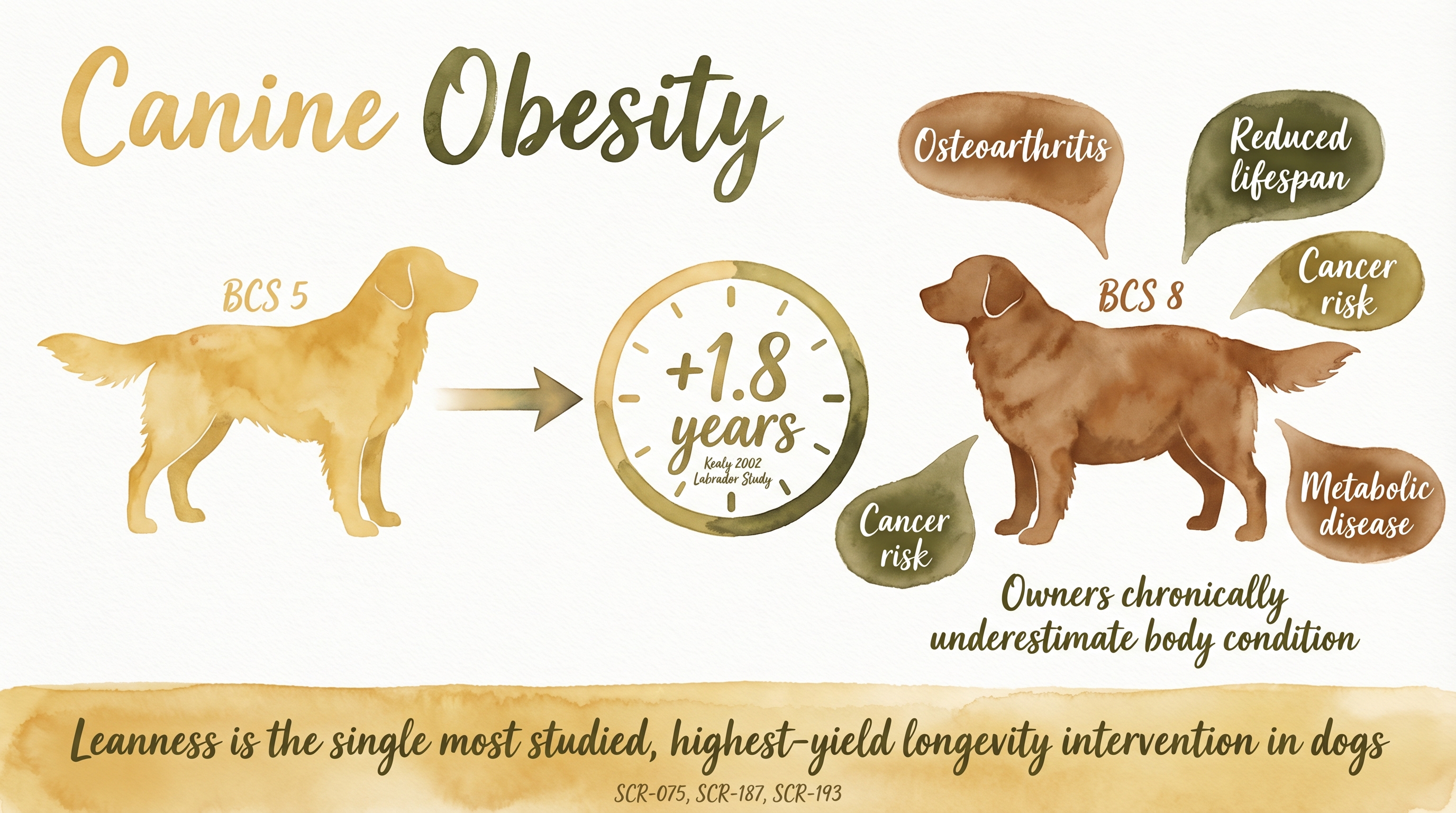
Leanness is the single most studied, highest-yield longevity intervention in dogs.
Key Takeaways
- Canine obesity is the most common nutritional disorder in dogs, with roughly 55 to 60 percent of United States dogs estimated to be overweight or obese.
- The strongest long-term evidence shows that keeping dogs lean extends lifespan and delays chronic disease rather than merely changing appearance.
- Golden Retrievers are especially vulnerable to quiet weight drift because they are food-motivated, family-integrated, and prone to family under-recognition of body condition.
- Successful weight management depends less on perfect theory than on measured feeding, limited extras, structured exercise, and full-household consistency.
The Evidence
This entry uses heuristic claim-level tags beyond the dedicated EvidenceBlocks below. These tags mark JB interpretive application rather than direct study findings.
The evidence here is unusually strong for a family-facing nutrition topic. SCR-075 captures the major long-horizon conclusion: maintaining dogs in lean body condition extends lifespan and delays chronic disease. SCR-187 adds the obesity-specific framework, including the Kealy Labrador findings and the role of body condition scoring. Together they support a firm rhetorical posture. This is not a minor lifestyle preference. Weight control is one of the highest-yield interventions in canine health.
Prevalence estimates carry the usual survey limitations, but they are directionally consistent enough to support the practical statement that obesity is now common in pet dogs. The rest of the literature on orthopedic load, metabolic dysfunction, and quality of life reinforces the same conclusion from multiple angles.
- SCR-075 supportdogs
Maintaining dogs in lean body condition extends median lifespan and delays chronic disease, making weight stewardship one of the strongest preventive interventions available. - SCR-187 supportdogs
Canine obesity is a common disease state, body condition scoring is the practical clinical tool, and the Kealy Labrador study demonstrated an approximately 1.8 year median lifespan advantage for lean-fed dogs. - APOP prevalence trend and supporting epidemiologyUnited States pet dogs
Roughly 55 to 60 percent of dogs are estimated to be overweight or obese, confirming that excess adiposity is widespread rather than unusual.
- Weight-management clinical literaturedogs
Measured portions, calorie budgeting, weight-loss diets when indicated, and family-wide compliance are the main drivers of successful canine weight reduction. - Golden Retriever clinical contextGolden Retrievers and large family dogs
Weight control carries extra importance when orthopedic risk and food motivation are both high, which is why Goldens deserve especially honest body-condition monitoring.
No published study directly tests the practical implications of canine obesity: the most common nutritional disorder for domestic dog raising programs. The application to household dog raising remains an interpretive synthesis rather than a directly tested intervention finding.
SCR References
Sources
- National Research Council. (2006). Nutrient Requirements of Dogs and Cats. Washington, DC: The National Academies Press.
- AAFCO. (2024). Official Publication. Association of American Feed Control Officials.
- Kealy, R. D., Lawler, D. F., Ballam, J. M., Mantz, S. L., Biery, D. N., Greeley, E. H., Lust, G., Segre, M., Smith, G. K., & Stowe, H. D. (2002). Effects of diet restriction on life span and age-related changes in dogs. Journal of the American Veterinary Medical Association, 220(9), 1315-1320.
- German, A. J., Holden, S. L., Moxham, G. L., Holmes, K. L., Maycock, R. M., & Morris, P. J. (2007). Dietary energy restriction and successful weight loss in obese client-owned dogs. Journal of Veterinary Internal Medicine, 21(6), 1174-1180.
- Laflamme, D. P. (1997). Development and validation of a body condition score system for dogs. Canine Practice, 22(4), 10-15.