Home-Prepared Raw Dog Diets: BARF and Prey Model
Compound evidence detail1 SCR / 2 parts
- Documentedcanine nutrient-profile and toxicity evidence showing defined vitamin and trace-mineral requirements, narrow safety margins for selected micronutrients, and clinically important deficiency-or-excess consequences
- Observed-JBthe recipe-survey pattern that unformulated home-prepared diets commonly miss mineral or vitamin targets and require veterinary-nutrition formulation review
Home-prepared raw diets are where raw-feeding philosophy becomes most personal. The caregiver is no longer choosing a finished commercial product. The caregiver becomes the formulator, assembler, and food-safety manager. That shift feels empowering to many people, but it also concentrates the category's two biggest problems into the kitchen: nutrient imbalance and pathogen exposure. If commercial raw requires careful evidence discipline, home-prepared raw requires even more. Mixed Evidence
What It Means
Home-prepared raw diets are usually built around one of two broad frameworks. The first is BARF, often expanded as Biologically Appropriate Raw Food or Bones and Raw Food, associated with Ian Billinghurst and related advocates. BARF plans usually include raw meaty bones, muscle meat, organ meat, and selected plant ingredients or supplements. The second is prey-model raw, which tries to mimic the rough tissue distribution of a whole prey animal more closely and often excludes plant matter entirely.
These systems are presented as more natural than commercial feeding because they appear to restore a carnivore-style feeding pattern. Families often talk about ancestral eating, species-appropriate menus, or the idea that wolves did not evolve on kibble. Those claims are emotionally attractive because they frame the dog as being returned to its biological roots rather than adapted to a household feeding economy.
The difficulty is that the kitchen implementation rarely resembles the confidence of the rhetoric. A home-built raw plan is only as good as the caregiver's nutrient math, sourcing discipline, hygiene practice, and long-term consistency. It is one thing to buy chicken necks, liver, muscle meat, and supplements. It is another thing to build a complete diet repeatedly, over months and years, with appropriate calcium, phosphorus, trace minerals, vitamins, essential fatty acids, and calorie control.
The Adequacy Problem
The adequacy problem is the biggest scientific issue in home-prepared raw feeding. Studies examining home-prepared diets, including both raw and cooked versions, repeatedly find high rates of nutrient deficiency or imbalance. Documented The best-known summary from Stockman and related work is sobering: the great majority of evaluated recipes had at least one nutrient below recommended minimums, and most had multiple deficiencies.
The commonly missing nutrients are not obscure trivia. They include calcium, vitamin D, zinc, copper, choline, and vitamin E. Documented These are the kinds of gaps that affect bone development, hematologic function, antioxidant protection, and general health. This is especially important in puppies and large-breed growth, where nutritional imprecision can do real developmental harm.
One of the reasons families miss this problem is that the diet can still look rich. A bowl full of raw meat, organ tissue, and bone can look biologically complete to a human observer because it looks primal and dense. But visual richness is not nutrient balance. A food can look ancestral and still be deficient in exactly the nutrients the dog needs most consistently.
The Bone Problem
Bone inclusion is one of the places where home-prepared raw feeding moves from philosophy to risk very quickly. Advocates often value raw meaty bones as a natural calcium source, chewing substrate, or biologically appropriate element of the diet. Observed-JB But bone does not solve all mineral questions automatically. Too little bone can contribute to calcium deficiency. Too much bone can distort calcium and phosphorus balance, create constipation, and, in growing dogs, contribute to more serious developmental problems.
This is why "just feed 80-10-10" or similar ratios should not be treated as professional nutrition. Ratios can be heuristically appealing while still failing the actual nutrient math. Dogs do not require a vibe of balance. They require actual balance.
The Pathogen Problem
The pathogen burden of home-prepared raw is at least as important as the adequacy burden, and in some households it is the more urgent issue. Raw animal products can carry Salmonella, Listeria, Campylobacter, pathogenic E. coli, parasites, and antimicrobial-resistant organisms. In a home-prepared raw system, the caregiver handles the sourcing, transport, thawing, prep surfaces, storage containers, bowls, leftovers, and waste disposal personally.
That means the exposure pathway is broader than simply "does the dog get sick." The home environment becomes part of the biological story. Dogs can shed organisms in stool, lick people after eating, contaminate bowls and floors, and carry pathogens through ordinary family interaction. The more chaotic the household, the more this matters.
The risk is especially relevant for homes with toddlers or young children, elderly adults, immunocompromised family members, pregnant women, frequent visitors, or therapy-dog or healthcare-contact settings.
In those households, home-prepared raw is not merely a dietary preference. It is a household public-health decision.
That burden is one reason many evidence-aware clinicians view home-prepared raw as the most management-intensive feeding choice in the entire consumer landscape. The caregiver is simultaneously taking responsibility for ingredient sourcing, nutrient assembly, storage, thawing, sanitation, and response to adverse outcomes. If any one of those layers becomes casual, the whole system becomes more fragile. The category is not unforgiving because caregivers are bad people. It is unforgiving because the workflow has very little slack.
Why the "Wolf" Argument Does Not Finish the Conversation
The wolf argument can help explain why families are attracted to raw feeding, but it does not settle whether a home-prepared raw plan is safe or complete for a domestic dog in a household environment. Modern dogs are domesticated, live longer under human care, eat from supply chains rather than hunted ecosystems, and are expected to coexist safely with children, kitchens, furniture, and medical vulnerability within the home.
Even if one accepts that dogs remain carnivore-shaped and can digest raw animal tissue, that does not prove a modern caregiver's kitchen-built ration is nutritionally sound. Documented It proves only that the dog can eat raw tissues. It does not answer the specific questions that determine whether the plan is a wise long-term feeding strategy.
The Narrow Legitimate Use Case
This is the part of the conversation that needs nuance. There are narrow clinical situations in which a veterinary nutritionist may prescribe a home-prepared diet, including sometimes a raw protocol, for a specific patient. That does not validate the general family narrative that home-prepared raw is broadly a superior default. It means professional formulation can sometimes justify a category choice for a medically specific reason.
The more important practical lesson is this: if a family is committed to home preparation, the safest compromise is not "trust your instincts." It is to use a veterinary nutritionist-formulated recipe, follow it precisely, and include the required mineral-vitamin support. Whether the final plan is cooked or raw, the presence of professional formulation changes the adequacy conversation dramatically.
This compromise matters because many families hear criticism of home-prepared raw as criticism of all home preparation. That does not have to be the conclusion. In many cases the more responsible response is not to become defensive, but to shift toward a professionally formulated home-cooked plan that keeps the ingredient control the family values while reducing the pathogen burden and adequacy uncertainty. That is often a much more realistic "best of both worlds" answer than doubling down on kitchen-built raw ideology.
Why It Matters for Your Dog
Home-prepared raw matters because it is the diet type most likely to be defended with conviction and executed with confidence before the math is actually secure. The caregiver is usually highly motivated, which is admirable. The problem is that motivation is not the same thing as accuracy.
For dogs, the cost of that mismatch can be high. A diet can be fed with love and still be deficient. A dog can appear glossy and energetic for months while a micronutrient gap is quietly accumulating. Puppies are at even greater risk because developmental errors can become structural errors. The dog does not care how sincere the feeding philosophy was if the calcium, trace minerals, or vitamin balance was wrong.
For families, the burden is emotional as well as biological. Many families who commit to home-prepared raw feel that backing away from it would mean admitting they were wrong or less devoted than they hoped to be. This emotional investment can make it harder to respond calmly when the evidence points toward risk. Documented That is why the page needs to be warm but firm. The conversation is not about judging commitment. It is about protecting the dog and the household.
Feeding from the kitchen does not become responsible simply because it feels personal. Leadership means accepting the burden of accuracy when you take formulation into your own hands, not assuming that closeness to the food makes the plan correct.
Home-prepared raw also matters because it is where household safety and dog nutrition become inseparable. A diet that is marginally acceptable for the dog but risky for a toddler, a chemotherapy patient, or an elderly grandparent is not an isolated pet decision. It is a family-environment decision. Prevention has to include everyone the feeding routine touches.
For Golden Retriever families specifically, there is another reason to be careful. Goldens often live in social, high-contact homes and are large enough that mistakes scale. A seven-pound toy breed and a seventy-pound retriever do not move the same amount of raw material through the house. Volume matters. Repeated exposure matters. Waste handling matters. The logistical burden grows with the dog.
The most constructive message for families who want home-prepared feeding is not "never cook or prepare food for your dog." It is "do not confuse intimacy with nutritional validity." If the family wants home preparation, the responsible path is formulation, supplementation, and hygiene discipline. That is a much safer standard than romantic confidence.
That is also why home-prepared raw deserves more humility than confidence by default. The dog may be enthusiastic, the caregiver may be attentive, and the ingredients may look beautiful on the counter, yet the plan can still be wrong in ways no one can see at a glance. The category's core risk is not bad intention. It is invisible error. Once families understand that, the appeal of professional formulation stops sounding fussy and starts sounding responsible.
That is the reason many evidence-aware households ultimately decide that if they want strong ingredient control, a professionally formulated home-cooked diet is the more responsible answer. It preserves the caregiver's involvement and customization preferences while removing much of the pathogen burden that makes home-prepared raw such a difficult long-term category to defend outside narrow special cases.
That humility is not a criticism of devotion. It is what devotion looks like when it is willing to be corrected by evidence.
That is the standard the category deserves if it is going to be defended responsibly.
That is why the strongest defense of the category is never confidence alone. It is confidence that has already passed through formulation, hygiene, and real-world scrutiny.
When to See a Veterinarian
Veterinary evaluation is appropriate for any raw-fed dog that develops vomiting or diarrhea that is persistent, bloody, or recurrent, unexplained weight loss, repeated gastrointestinal upset after meals, poor growth or skeletal concerns in a puppy, recurrent skin or ear disease in the context of a homemade elimination-style plan, or signs of systemic illness such as lethargy, fever, or marked appetite change.
Veterinary discussion is also warranted if any human in the household develops a concerning gastrointestinal illness while the dog is eating a home-prepared raw diet, especially when there has been recent raw-food handling, shared surfaces, or high-risk household contact.
The goal of the veterinary visit is not simply to blame the diet. It is to ask whether infection, nutritional imbalance, or another medical problem is present and whether the current feeding plan needs to be changed immediately.
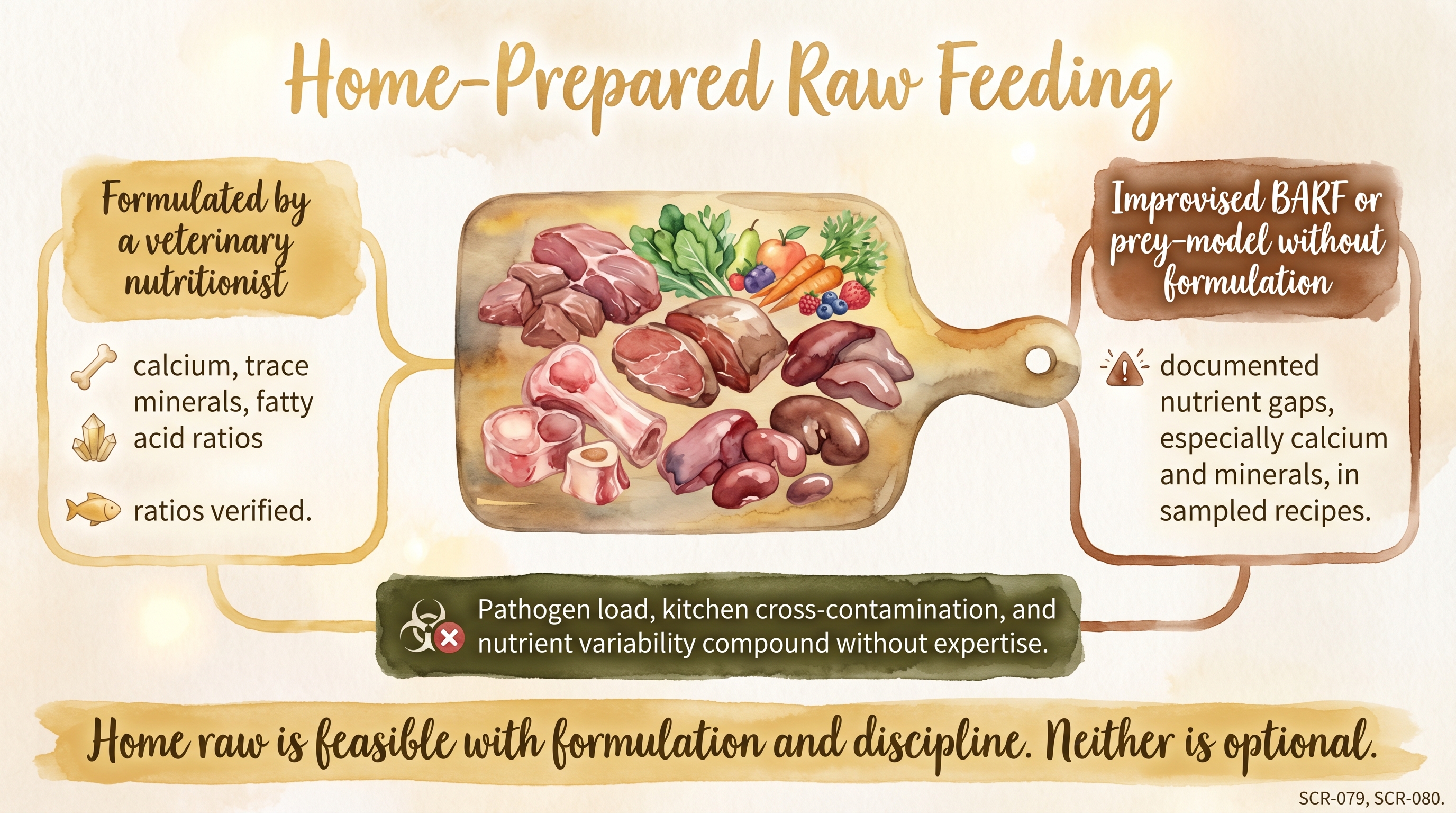
Home raw is feasible with formulation and discipline - neither is optional.
Key Takeaways
- Home-prepared raw feeding concentrates both nutrient-formulation risk and pathogen-handling risk in the owner's kitchen.
- The biggest evidence-supported problems are not philosophical, they are practical: deficiencies, imbalances, contamination, and household exposure.
- BARF and prey-model frameworks may sound biologically coherent, but they do not guarantee adequacy without professional formulation and supplementation.
- Families committed to home preparation should work with a veterinary nutritionist rather than treating raw ratios or online recipes as nutrition science.
The Evidence
This entry uses observed claim-level tags beyond the dedicated EvidenceBlocks below. These tags mark JB program observation or practice-derived claims that need dedicated EvidenceBlock coverage in a later content pass.
The evidence for home-prepared raw is mixed overall but sharply documented in its major failure domains. It is documented that improvised home-prepared diets are often nutritionally incomplete. It is documented that raw animal products carry pathogen burden. It is documented that those risks extend into the household environment. These three points are sturdy enough that they should anchor the category review.
The more positive raw-feeding claims are much softer. Owners often report smaller stools, good coat quality, or subjective vitality improvements. Some of these effects may reflect high palatability, digestibility of specific formulas, or the absence of poorly tolerated ingredients. Those observations are not meaningless. They are simply weaker than the documented deficiency and contamination evidence when deciding whether home-prepared raw is a wise default plan.
This is why the best compromise recommendation is so consistent across evidence-aware clinicians: if families want home preparation, use professional formulation and complete supplementation. That recommendation is not anti-raw ideology. It is what follows from the adequacy data.
A second quiet conclusion follows from the household-risk data. The right feeding choice is not only about the dog's theoretical digestive capacity. It is also about the humans sharing the dog's environment. A diet that fits poorly with the health status, age, or vulnerability of the household is often the wrong diet even before the dog's own nutrient balance is fully considered. That broader frame is one of the most useful ways to bring real-world perspective to a category that is often argued as if the dog lived alone.
- Stockman et al. (2013)dogs
Most evaluated home-prepared recipes contained one or more nutrient deficiencies, with multiple deficiencies common. - Pedrinelli et al. (2019)dogs
Laboratory analysis of home-prepared diets found widespread nutrient inadequacy and additional contaminant concerns. - SCR-080 synthesisdog-food and household exposure context
Raw diets carry documented microbiological contamination risk and handling burden that matter for both the dog and the home.
- Owner-observation and digestibility literaturedogs
Some dogs may appear to do well subjectively on raw plans, but this does not override the category's documented adequacy and pathogen risks. - Clinical formulation synthesisdogs
The safest home-prepared path is a professionally formulated and supplemented recipe, regardless of whether the final plan is cooked or raw.
No published study directly tests the practical implications of home-prepared raw dog diets: barf and prey model for domestic dog raising programs. The application to household dog raising remains an interpretive synthesis rather than a directly tested intervention finding.
SCR References
Sources
- National Research Council. (2006). Nutrient Requirements of Dogs and Cats. Washington, DC: The National Academies Press.
- AAFCO. (2024). Official Publication. Association of American Feed Control Officials.
- Joffe, D. J., & Schlesinger, D. P. (2002). Preliminary assessment of the risk of Salmonella infection in dogs fed raw chicken diets. Journal of the American Veterinary Medical Association, 221(2), 250-254.
- Pedrinelli, V., et al. (2019). Concentrations of macronutrients, minerals and heavy metals in home-prepared diets for adult dogs and cats. Scientific Reports, 9, 9436.
- Schlesinger, D. P., & Joffe, D. J. (2011). Raw food diets in companion animals: a critical review. Canadian Veterinary Journal, 52(5), 532-540.
- Stockman, J., Fascetti, A. J., Kass, P. H., & Larsen, J. A. (2013). Evaluation of recipes of home-prepared maintenance diets for dogs. Journal of the American Veterinary Medical Association, 242(11), 1500-1505.