Pet Food Recalls and Safety Monitoring
Compound evidence detail1 SCR / 2 parts
- Documentedthe FDA and FSMA recall framework, voluntary-first recall pathway, mandatory-authority reserve, and documented failure categories such as microbial, mycotoxin, nutrient, formulation, and mechanical contamination
- Heuristicfamily response guidance limited to recall awareness and veterinary-context decision making, without product-specific clinical thresholds or industry-wide condemnation
Most families think about pet food as a stable household product rather than as part of a food-safety system. That usually makes sense because serious problems are uncommon compared with the total volume of pet food sold. But recalls do happen, and when they do, speed and clarity matter. A recalled food is not a reason for vague worry. It is a reason for specific action. Families who know how the recall system works are much better positioned to respond without panic and without delay. Documented
What It Means
In the United States, pet-food safety oversight lives primarily with the FDA Center for Veterinary Medicine, often in coordination with state feed-control authorities and broader food-safety systems. Observed-JB Pet food is expected to be safe, manufactured under sanitary conditions, truthfully labeled, and free from harmful contamination. When those expectations fail, recalls can occur.
Recalls may be voluntary or, in more serious legal circumstances, mandatory. In practice, many recalls are initiated voluntarily by the manufacturer once a contamination or safety problem has been identified. Observed-JB That does not make the event minor. It simply reflects how the system often functions. The key family-facing point is that a recall means the product should stop being fed, not that the family should wait to see whether the situation becomes more official.
Major Recall Categories
Pathogen contamination is one major category. This includes organisms such as Salmonella and Listeria, which may sicken dogs directly or create household exposure risk even when the dog remains asymptomatic. Documented Raw products deserve special attention here because they carry a more persistent pathogen risk profile even outside discrete recall events.
Mycotoxin contamination is another major category, especially aflatoxin concerns in ingredients such as corn when storage or sourcing failures allow mold toxins to enter the chain. These events matter because aflatoxins can cause serious illness or death in dogs and because contaminated lots can affect large production runs before the problem is recognized. Documented
Chemical contamination is another recall class. The most notorious example in recent memory remains the 2007 melamine crisis, when adulterated ingredients led to widespread illness and death. More recent examples include vitamin D toxicity recalls. These events are useful reminders that a food does not need to be visibly spoiled to be dangerous. Nutrient excesses and adulterants can be biologically severe even when the product looks normal.
Physical contaminants, such as metal fragments or pieces of plastic, form another category. These may be less common in public discourse than pathogen or toxin issues, but they are still important because they can create immediate injury risks.
Families also benefit from knowing where to look for reliable recall information. Official FDA recall pages and manufacturer notices are the primary anchors. Some families also follow third-party alert systems, which can be useful for awareness, but those should ideally point back to verifiable notices and lot-specific information rather than functioning as rumor engines. In recall situations, specificity matters more than outrage.
What the Recall System Is Actually Doing
The recall system is a monitoring and response structure, not a promise that every problem will be caught instantly. Problems may be identified through manufacturer testing, consumer complaints, veterinary reports, state inspections, or FDA investigation. Some issues are recognized quickly. Others emerge only after dogs begin getting sick or after patterns in complaints become visible.
This is why good recall behavior is not passive. Families should not assume that because they have not heard about a recall, there cannot be a problem. Nor should they assume that every social-media rumor is trustworthy. The safest route is to know where official recall information is posted and to respond to confirmed notices seriously.
Historical Events That Changed Owner Awareness
The 2007 melamine recall remains important because it changed how families think about supply chains and contamination. It showed that ingredient adulteration far upstream can have devastating downstream effects. Later vitamin D recalls reinforced a different lesson, namely that nutrient excess from formulation or premix error can also create widespread harm. More recent aflatoxin events reminded families that storage, agricultural inputs, and contamination monitoring remain part of food safety, not just manufacturing hygiene.
These historical cases matter because they show that "recall" is not one type of problem. Documented A food can be unsafe because it is contaminated with bacteria, with toxins, with adulterants, or with incorrect nutrient levels. Families benefit from understanding that breadth because the symptoms and urgency may differ by category.
Why It Matters for Your Dog
This page matters because when a recall happens, the family needs to move from confusion to action quickly. The first step is not to argue online about whether the brand is usually good. The first step is to stop feeding the lot in question, preserve the packaging and lot information, and assess whether the dog may already have been exposed.
The next steps are just as practical. Owners should isolate the product so it is not fed accidentally, photograph or retain the lot number, and write down any symptoms or timing that may matter if a veterinarian becomes involved. If the food was stored in another container, the family should do its best to reconstruct purchase timing and brand details. The clearer the household record, the more useful the response can be.
For Golden Retriever households, this matters in the same way it matters for every dog household, but with one extra practical point. Goldens are often social dogs in family environments where food is shared between multiple people, storage bins are used, and extra treats or toppers are mixed in. That increases the importance of keeping original bags, lot numbers, and purchase information. Once dry food is poured into an unlabeled container, responding accurately to a recall becomes much harder.
Safe feeding is not only about what food is chosen. It is also about whether the family stores it in a way that preserves traceability. A lost lot number can turn a clear recall response into guesswork.
This page also matters because it helps families separate ordinary category risk from discrete recall events. Raw food, for example, may carry pathogen burden even when no recall has been issued for the specific product in the freezer. A recall is one kind of safety failure. Ongoing category-level risk is another. The family needs language for both.
This distinction is one of the most protective ideas in the entire nutrition-safety conversation. A recall is an acute, lot-specific warning. A category burden is a standing risk characteristic. Families who understand the difference are much less likely to treat the absence of a recall as proof of safety in categories where the baseline evidence already shows a higher burden.
Another practical reason this page matters is that recall response often feels emotionally confusing. Owners may feel embarrassed they bought the food, guilty they fed it, or unsure whether they are overreacting. A calm framework helps. The correct posture is not shame. It is specificity. Identify the product, confirm the notice, stop feeding it, monitor the dog, and involve the veterinarian when indicated.
When to See a Veterinarian
Contact a veterinarian promptly if your dog has eaten a recalled food and is showing symptoms such as vomiting, diarrhea, lethargy, collapse, refusal to eat, tremors, excessive thirst, jaundice, unusual bruising, or other signs that fit the contaminant risk described in the recall notice.
Veterinary guidance is also appropriate even before symptoms appear when the recall involves a serious contaminant, prolonged exposure, or a medically vulnerable dog. Families do not need to guess alone about what level of exposure warrants evaluation.
One of the most useful habits families can build is keeping enough information with the food to respond quickly if needed. That may mean saving the bag until it is empty, taking a photo of the lot code before pouring the food into a storage bin, or keeping purchase records where they can be found easily. None of these habits feels dramatic when everything is fine. They become extremely valuable when a recall notice appears and the family needs to know whether the dog's specific product was involved.
Recall literacy also lowers panic because it gives the family a script. Confirm the notice from a reliable source. Match the lot information. Stop feeding the product. Preserve packaging or at least lot details. Watch for the symptoms relevant to that contaminant class. Call the veterinarian when the dog has signs or the exposure is high risk. Families who know that sequence usually feel far more capable than families who experience the recall only as a wave of internet alarm.
Recall awareness also works best when it is built before there is a crisis. Families who already know where to check official notices, who keep lot information accessible, and who understand the difference between category risk and lot-specific recall risk can respond much faster and with far less confusion than families who are learning the system in the middle of a frightening social-media storm.
That preparedness is part of everyday feeding stewardship. It sounds administrative, but it is deeply practical. Food safety is not only about choosing a brand once. It is also about keeping just enough information and routine discipline around the food that, if something goes wrong, the family can act from facts instead of from memory and fear.
That is also why recall communication should be treated as part of ordinary feeding competence, not as something only anxious families track. Most days nothing happens. On the day something does happen, the family that can match a lot code, stop feeding promptly, and describe the dog's exposure clearly to a veterinarian is in a far stronger position than the family trying to reconstruct everything from memory.
Preparedness is quiet until the day it matters, and then it matters a great deal.
Seen that way, recall readiness is not paranoia. It is simply one more part of competent food stewardship. Most of the time it does nothing visible. In the small number of cases where the system is actually needed, it can save time, reduce confusion, and help the family protect the dog much more effectively than improvised reaction ever could.
That is exactly why the safest households tend to look calm rather than alarmed when a real notice appears.
When that habit is in place, the family can respond quickly, specifically, and with much less fear.
That kind of calm readiness is one of the most practical forms of food safety a family can build.
And in the rare moments where a recall does become relevant, that quiet preparation can matter a great deal.
That is why storage habits, lot-code awareness, and recall literacy belong in the same conversation as brand choice. They are all parts of the same safety system once the food reaches the home.
That is what turns recall response from an anxious scramble into a manageable household procedure.
That kind of clarity is often what protects both the dog and the family best when timing matters.
Preparedness rarely feels exciting, but it is often exactly what effective response looks like.
That is the point.
Preparation matters.
Stay specific.
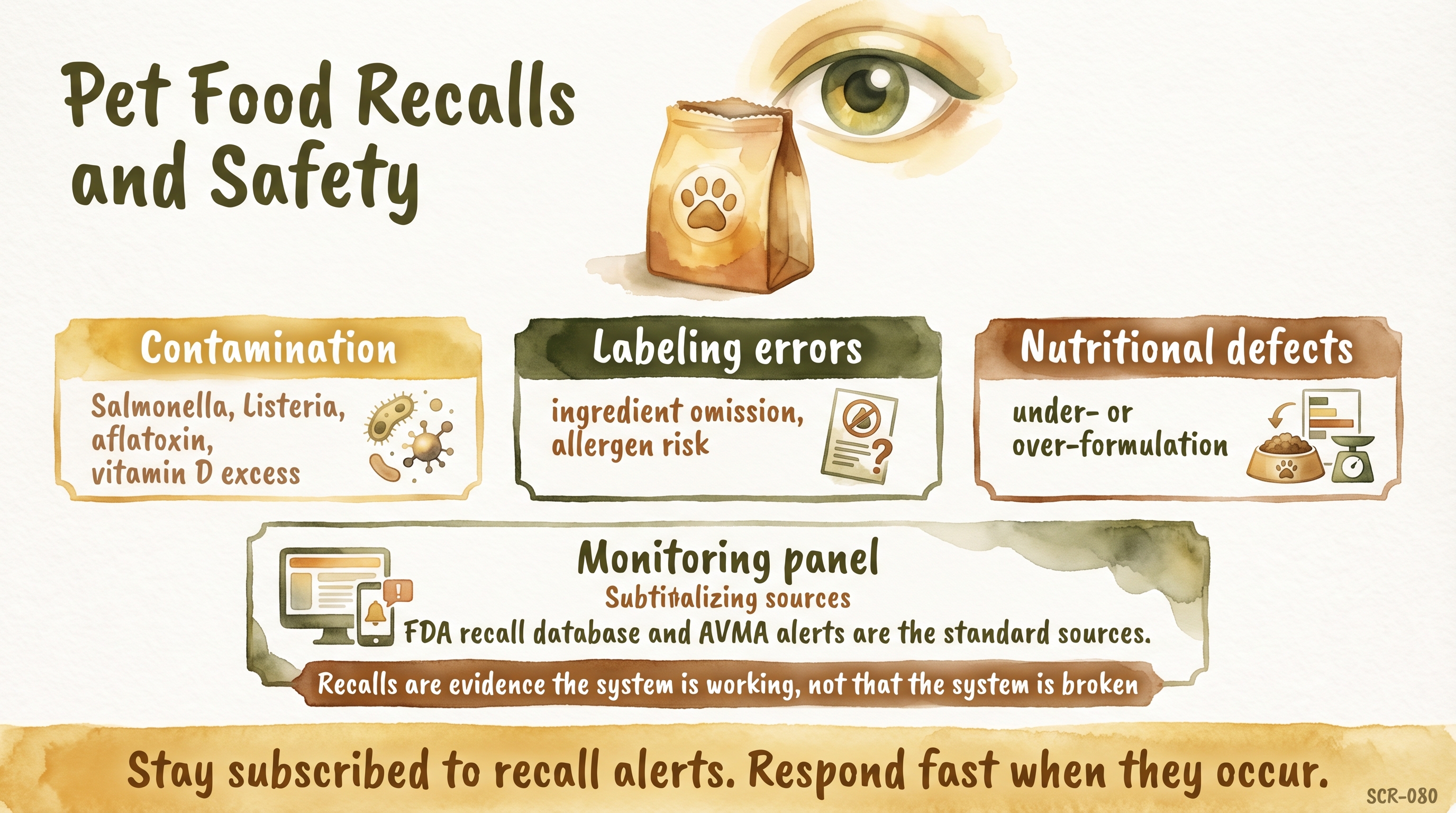
Stay subscribed to recall alerts - respond fast when they occur.
Key Takeaways
- Pet-food recalls are uncommon relative to total market volume, but they are serious events that require specific action rather than passive worry.
- Recalls can involve pathogens, toxins, chemical contamination, nutrient excesses, or physical contaminants, so the risk is not one-size-fits-all.
- Families should keep packaging and lot information whenever possible because traceability is central to safe recall response.
- A confirmed recall means stop feeding the product immediately and involve a veterinarian if the dog has symptoms or the exposure is high risk.
The Evidence
This entry uses observed claim-level tags beyond the dedicated EvidenceBlocks below. These tags mark JB program observation or practice-derived claims that need dedicated EvidenceBlock coverage in a later content pass.
The evidence around recall systems is strong in the sense that the regulatory structure, the major recall categories, and the historical case types are all well documented. What varies is timing. The safety system does not identify every problem instantly, which is why family vigilance and lot-number traceability still matter.
That timing point is why safe storage and documentation deserve a place in everyday feeding, not only during emergencies. Keeping the original bag or at least the lot information is a small habit with unusually high payoff. When something goes wrong, traceability often matters as much as memory. Families who treat traceability as part of routine feeding are much easier to help when a recall occurs.
The recall history also supports a useful humility point. Neither premium branding nor ordinary branding immunizes a food from failure. Problems can arise from sourcing, formulation, contamination, storage, transport, or manufacturing. A recall does not necessarily mean the company is permanently disqualified from trust, but it does mean families should expect transparency, specificity, and serious corrective action.
The raw-food category requires one further evidence boundary. Raw products carry documented pathogen risk even outside formal recall events. That means families should not use the absence of a recall as proof of safety in categories where the baseline microbiological burden is already higher.
- FDA CVM frameworkpet-food regulatory context
FDA CVM oversees core safety expectations for pet food and participates in recall, warning, and enforcement pathways when products are unsafe. - Commercial regulation source synthesisdog-food safety context
Major recall categories include pathogen contamination, mycotoxins such as aflatoxin, chemical contamination including vitamin excess or adulterants, and physical contaminants. - Historical recall synthesisdog-food safety context
Events such as the 2007 melamine crisis, vitamin D recalls, and aflatoxin recalls demonstrate that recall risk spans multiple failure modes rather than one single pattern.
- Recall-response practicedog-food consumer context
The correct immediate response to a confirmed recall is to stop feeding the product, preserve lot and packaging details, and contact the veterinarian when symptoms or high-risk exposure are present. - SCR-080 synthesisdog-food and household exposure context
Raw-product safety concerns can exist apart from formal recalls because baseline pathogen burden in the category is already documented.
No published study directly tests the practical implications of pet food recalls and safety monitoring for domestic dog raising programs. The application to household dog raising remains an interpretive synthesis rather than a directly tested intervention finding.
SCR References
Sources
- National Research Council. (2006). Nutrient Requirements of Dogs and Cats. Washington, DC: The National Academies Press.
- AAFCO. (2024). Official Publication. Association of American Feed Control Officials.
- U.S. Food and Drug Administration. FDA Center for Veterinary Medicine. Recalls, market withdrawals, and safety alerts.
- Rumbeiha, W. K., & Morrison, J. A. (2011). A review of class I and class II pet food recalls involving chemical contaminants from 1996 to 2008. Journal of Medical Toxicology, 7(1), 60-66.
- Bischoff, K., & Rumbeiha, W. K. (2018). Pet food recalls and pet food contaminants in small animals. Veterinary Clinics of North America: Small Animal Practice, 48(6), 917-931.